
.avif)
Teens paid to burn businesses, steal from seniors, or shoot at rivals. In Greater Montreal, criminal networks are increasingly assigning “jobs” to young people, sometimes even minors. In 2024, this phenomenon was highlighted by the death of Mohamed-Yanis Seghouani, a 14-year-old killed in Beauce during an attack targeting a site linked to the Hells Angels.
One December evening, in a Montreal neighborhood. The biting cold had emptied the streets, while snow began to pile up on the sidewalks. Inside a community organization’s premises, the atmosphere was very different. The light was dim, soft music played in the background, and young people sat around a table. They played cards, joked around, and laughed loudly. From time to time, they perked up their ears when Édouard*, a frontline worker and co-founder of an organization* that hosts these youth, reminded them of a rule or opened a more serious discussion.
It is here that four young people agreed to speak about the phenomenon of criminal contracts. One by one, sitting on a couch, they shared what had been offered to them, what they saw, what they did—or refused to do. Behind the door, laughter continued. Two worlds coexisted under the same roof.
Adam, 20: “I accepted… unfortunately”
Adam was the first to speak. His tone was calm, direct. He neither sought to justify nor downplay the facts. “I was recruited for a ‘barbecue’ downtown.” The word surprises. Adam explains without hesitation: “A barbecue is when you set a car on fire.” He pauses, then continues: “And I accepted… unfortunately.”
He reports the figures flatly: “I got $1,500. My recruiter, $1,600,” he says, admitting the gap is absurd. “He’s the one who recruited. That’s how it works in the scene.” Regret comes when he thinks about the consequences of his actions. “When I realized the car I burned could have been mine or my family’s… I regretted it immensely.” His voice trembles slightly.
Behind the door, Édouard watches over the group. “It’s become so accessible that young people now know the rates,” he warns aside.
In the scene, words spread quickly. Car theft, barbecue, fraud—each action has a price, adjusted to the risk. Édouard explains that youth sometimes show him exchanges on the Telegram app, in closed groups where offers circulate. “They ask me: ‘Do you think I should do it?’”
Édouard witnesses the consequences every day: accidents during police chases, severe burns like Ali’s, and sometimes death, like the tragic end of young Mohamed-Yanis Seghouani.
Léo, 18: The shock of the avoided tragedy
Léo arrived in Canada two years ago. At school, on the street, or on his screen, he says he was never approached for a contract. But his closest friend nearly fell into it, he confides.
For $500, his friend was supposed to participate in a home burglary. “It was supposed to be his first time,” Léo specifies. But on the day of the operation, he felt uneasy. So he backed out and stood up his recruiters. The next day, he learns the operation went badly. Léo lowers his voice as he speaks. His friend realizes what happened and understands what he narrowly escaped. The shock is immediate. The young man can’t sleep and needs to talk, calling Léo.
For Léo, something also fractures at that moment. The realization is brutal. “He was scared. He’s still in shock,” Léo adds about his friend. Since that day, his friend “has completely changed.” His life has reorganized around simple anchors: home, school, family. “He changed his mindset. Good for him,” Léo believes.
Manu, 18: Turning down $5,000
Manu was born in Quebec. He spent several years of his childhood in his parents’ country of origin before returning to his birthplace. He too was approached. “I was offered to burn a house,” he says calmly. The offer was clear, the amount too: $5,000. He didn’t hesitate. “I knew it would end badly.”
The recruiter was not a stranger. “It’s a friend of mine who already does this. He used to tell me what happened with the guys doing it, how it works, and all that.” One day, labor was lacking; “the friend” turned to Manu and offered him a contract. Manu thought of his parents and declined the offer without hesitation. “They worked for me to be here. I couldn’t do that.”
The young Montrealer compares his situation to others. “They do this with 14-year-olds for $500, and they are impressed,” he says. Manu says he saw the trap. “I’d rather work 12 hours a day,” he says, “and earn clean money than do harm and take a risky path.”
Yanis, 19: “We know before the police”
A CEGEP student, Yanis speaks with the perspective of someone who never carried out a contract but knows the network from the inside. “30% of my acquaintances are involved. 70% want to get in,” he says, estimating he has about 200 friends and contacts. His eyes light up as he describes an informal, yet structured, ecosystem. “I know people who participate in serious crimes,” he says. About four months ago, members of a family in Saint-Léonard were awakened in the middle of the night because their car was on fire, in front of their house. The fire was not an accident, according to Yanis. “It was retaliation,” he says. The target was not the vehicle, but the family’s youngest daughter.
The “barbecue” was carried out by two neighborhood teens recruited for the occasion, but sponsored, he adds, by an older man known for illegal activities. Yanis knows both sides of the story. The victim and the sponsor had been in a relationship. “When you have money, you have power,” he sums up. After the breakup, the man allegedly paid minors to burn the car of his ex’s parents, simply to get revenge.
The method, the teen explains bluntly: adolescents go to a gas station, quietly fill a gas can, then return at night. “They put gas around the car, inside, everywhere. Then they set it on fire,” Yanis recounts. According to him, the girl recognized her ex on neighborhood surveillance cameras, but fear was stronger. “She was so scared of him she said she didn’t know him,” the teen adds.
Yanis claims to stand apart from this world, even though he knows it from the inside. He observes the phenomenon with sadness and distance, never as a moralizer. When a crime occurs in Montreal, he says, young people are often the first to know. Informal, nocturnal circulation of information quickly shares details, including the identities of perpetrators, long before police investigations make progress.
“When there’s a crime in Montreal, it can take three, four, or five days of investigation to find out who did it. We already know,” he says.
“They invest in vulnerability”
When asked how often he sees young people approached for criminal contracts, Édouard replies without hesitation: “All the time.” Since the pandemic, he observes, the phenomenon has accelerated and transformed. “We are seeing a lot of offers in closed online groups. But there are also recruiters in schools, parks, and through word of mouth…”
For him, calling it a simple “offer” is reductive. “It’s not just making a proposal to a young person. It’s an investment.” Before any concrete request, he explains, the target is observed, evaluated, and prepared. “We measure their vulnerability. Does the youth need money? Do they have a safety net? A parent around, an older sibling?” Once the profile is established, recruiters wait for the right moment: “A parental separation, bullying, school dropout. They choose the right time and the right person. They invest in vulnerability.”
Once in the circuit, the young recruit follows a trajectory, explains Ismaël Benyettou, a psychosocial worker at the Saint-Michel Community Center. “The word ‘recruitment’ gives the impression of something sudden, almost spectacular. In reality, it’s progressive, relational. It takes place along paths marked by unmet needs and a context of social exclusion.”
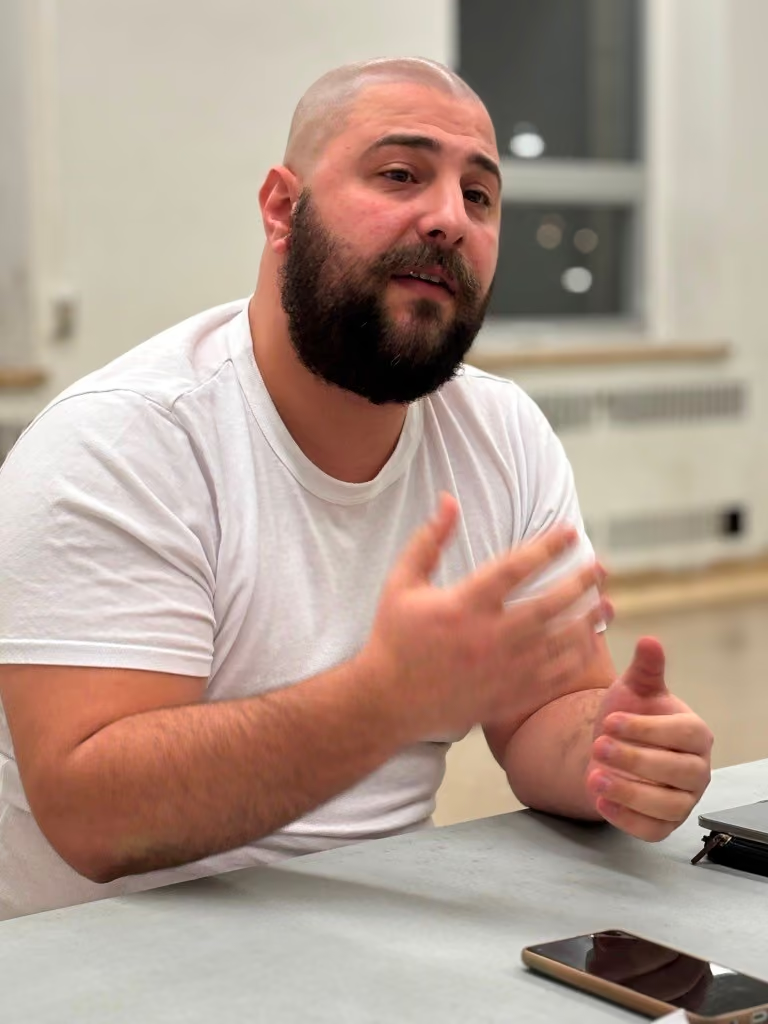
Trained in psychoeducation and clinical criminology, he observes behind the actions “repeated traumas, as well as difficulties in emotional regulation, planning, and anticipating consequences.” All of these factors, combined, “create a fertile ground for sliding into risky behavior.”
The money as an accelerator
In this process, money acts as a powerful accelerator. “The young people present it as something very simple, without risk,” Édouard says. “They think that, at worst, they’ll end up in a youth center.” The amounts themselves speak volumes. “Imagine: $1,000 for half an hour. For a 14- or 15-year-old, that’s huge,” he emphasizes.
Beverly Jacques, a youth worker and founder of DOD Basketball in Saint-Léonard, observes the same effect. “Money has become a vital need. We’ve associated it with freedom, with power. When a young person can earn in a few days what their parents earn in a year, it completely overturns their reference points.”
Antoine Riguerre, a mobilization agent at Équipe RDP, also sees the influence of social media. “Young people are caught in the ideology of ‘I’m in America, I want the big house, the big car, my place in the sun.’ When school or work doesn’t seem like fast tracks to these goals, they take as models those who flaunt success online.”
In the short term, Ismaël Benyettou acknowledges, the system works. “The young person has money, status, recognition, sometimes a substitute family.”
He also describes safe spaces that are an integral part of this universe. “They call them the bando or the trap.” These are, he explains, places where the group gathers. Often they are illegally rented apartments, sometimes Airbnbs. For these young people from underprivileged backgrounds, these spaces offer both protection, recognition, and a sense of belonging—a form of security that their path has not always provided.
The contract in the digital age
Social networks have become the new alleyways where criminal “jobs” for adolescents are organized. Beverly Jacques speaks of a territory that adults still pay too little attention to. “We always talk about the physical neighborhood. But there’s also a digital neighborhood. If you’re not online, you miss a part of youth life.”
According to him, adolescents “live three lives”: personal, school, and digital. “During COVID, they created a world for themselves. That’s where many problems escalated,” he explains, citing Snapchat, Telegram, Discord, and Instagram.
While on-the-ground recruitment remains central, the digital has profoundly changed the dynamic. “Before, gangs tagged walls. Today, they tag social media,” summarizes Francesco Campisi, a criminology and digital sociology researcher at Simon Fraser University.
This phenomenon, which he calls “cyberbanging,” relies on constant online presence. “Platforms act like storefronts. They give social capital: respect, power, protection. Most gang-related content isn’t explicitly criminal. You see sports, music, cars. But about 85% of gang content is propaganda: money, weapons, symbols, lifestyle. Like influencer marketing. They sell a lifestyle, not a product.”
But this digital territory is not just a space for observation or analysis. Édouard sees it driving decisions, movements, and actions. “They show me exchanges, screenshots, Telegram groups known for sharing contract offers,” he explains.
“We know how it works”
Édouard distinguishes anonymous offers circulating online from targeted recruitment, often more discreet, happening in schools or close social circles. When these situations involve enrolled minors, the worker often encounters what he calls institutional denial: “Schools say, ‘It doesn’t happen here, it happens outside.’”
Yet, he points out, the young people name both the locations and the people involved. “They tell me: ‘There’s someone at school who approached me and asked: “Do you want to make money?”’”
This gap between the field and institutions worries him deeply. “We know how it works. But how is it that schools and authorities say they don’t?”
Back in the room, the youth resume their card game, the music rises, and laughter returns. Édouard tidies a few chairs, keeping an eye on the group without intervening. Adam is still there. He listens to the others, a faint smile on his face. Four years ago, his mother had noticed a change in his habits. She sought the help of the organization, and gradually, Adam found his way back. “Today, I’m finishing high school. I’m no longer on the wrong path,” he says proudly in the intimacy of the office.
Under the same roof, efforts are made to fill what the system leaves behind: time, constant presence, and a bond that doesn’t break at the first misstep. Sometimes, this bond prevents everything from collapsing. Sometimes, it simply prevents being alone.
*For safety reasons, the identity of the organization and the worker and young witnesses cannot be revealed.