

Each year, Black History Month revives discussions about slavery and racism experienced by Black communities. But beyond commemorations, a question persists in families: how to find the words to talk to children about them without crushing them under the weight of history? In the Saint-Michel district, a literary evening devoted to this subject brought together Afro-descendant women, parents and adolescents. Between intimate stories, children's literature and artistic performance, the encounter highlighted the silences, tools and acts of kindness through which a community tries to give roots to its children in the context of immigration.
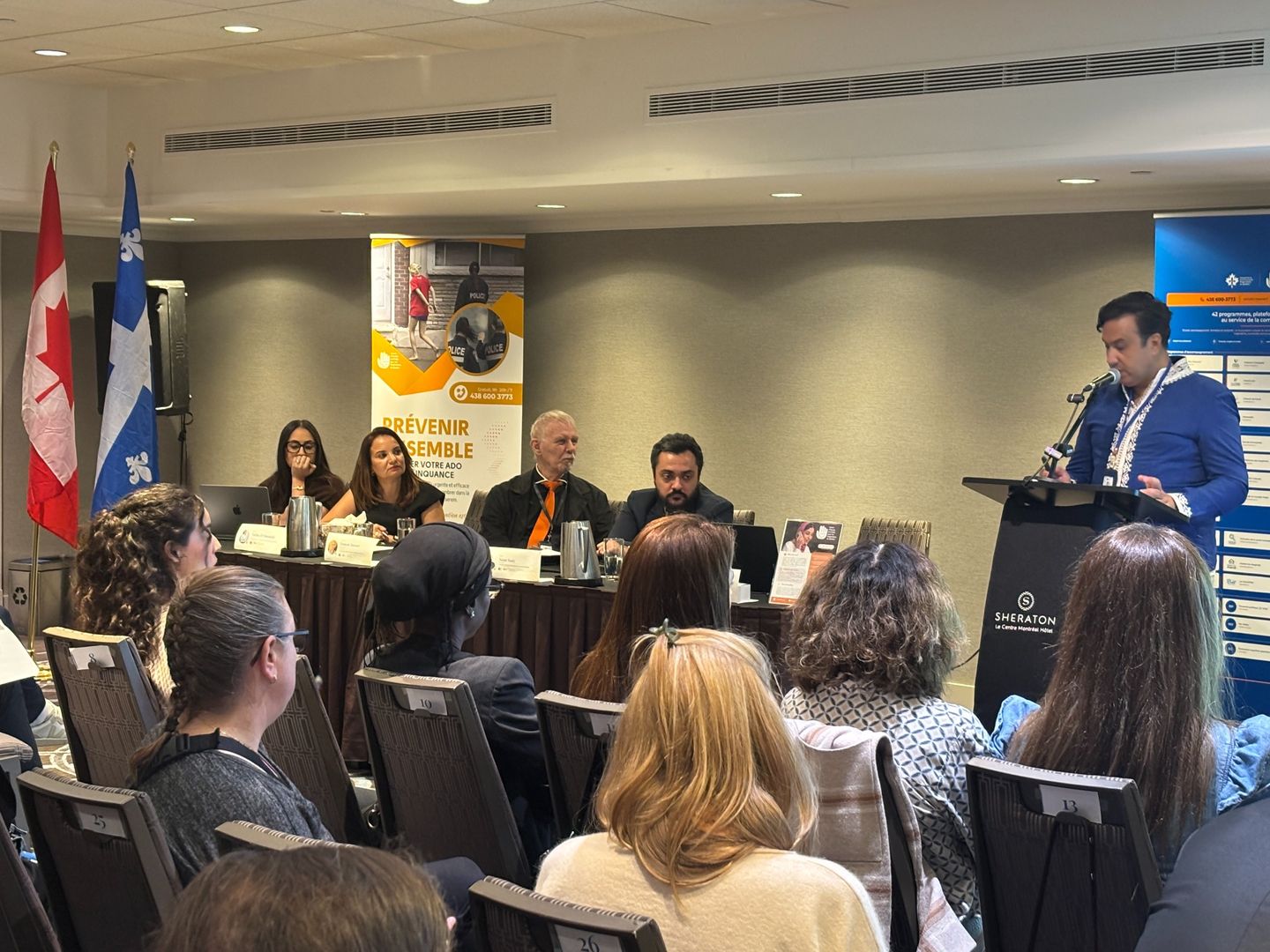
In the Hall of the Arts Center of The House of Haiti, on a Thursday evening in February, teenagers mingle with parents, artists and locals. On stage, four Afro-descendants take their seats around a table. The title of the activity — Slavery told to my child — could announce a master conference. Rather, it will be a dialogue with multiple voices, filled with silences, intimate anecdotes and artistic gestures. At the heart of the exchanges: transmission, this fragile thread that connects the generations of the black diaspora.
” Hey Mistikrik! ” (Is the yard sleeping?) Even before the first questions, the presenter, Maguy Metellus, captures attention with an appeal drawn from Haitian oral traditions. ” Yé Mistikrak ! ” the hall replies in chorus. No, the yard does not sleep! With his low and calm voice, M.Me Metellus establishes a climate of listening and recalls the framework: the Biennial of Afro-Descendant Women Artists, a space designed for creation, encounter and dialogue between practices. In the room, several young black people came in groups. The activity is explicitly addressed to them.
On stage, five red chairs arranged in a semicircle contrast with the purple background of the screen, where the title of the round table is displayed. The speakers are seated at the same height, microphones in hand or notebooks placed on their knees, in a position of exchange rather than conference. The warm light accentuates the feeling of intimacy, despite the size of the room.
Plural paths, the same question
Around the table, the trajectories differ. Marie‑Denise Douyon is an author and illustrator; she is known for her visual and editorial work. Gabriella Garbeau is an author, publisher and bookseller. Houmou, a poet and literary critic, runs writing workshops for racialized youth in Quebec City. Andjelica Caméus, who arrived from Haiti as a teenager, participates in a support program for young women. Ages, accents, and migration experiences vary, but one question comes up: how do you talk to your children about racism and slavery, and when?
The answers are built in layers. Gabriella Garbeau reports that motherhood has changed her outlook. “Becoming a mom was like putting on a new pair of glasses,” she confides. She evokes “umbrella themes,” such as strength, resistance, creativity — all doorways to harsher realities. “I want to tell my children that their story does not start with a kidnapping,” she summarizes, referring to the transatlantic slave trade and the abduction of entire populations, forcibly moved to North America to serve as slaves. She prefers, she says, to tell young people that Africa, the mother continent, was the land of kingdoms, cultures and knowledge that predated trafficking. Books then become tools, “a toolbox for my children”, allowing me to start conversations.
Houmou, who grew up in France, describes a blind spot in literature for teenagers. “There is a lot for children, a lot for adults, but very little for teens,” she observes. On social networks, she therefore presents books by Afro-descendants authors to remedy this lack. She also recounts the visit of Gorée Island, in Senegal, a seminal moment in her understanding of slavery; a story, she says, little passed on within her own family, which was “more focused on the positive than on the pain of memory”.
Silence, between protection and heritage
Andjelica Caméus, on the other hand, speaks of a different silence. Born in Haiti, where she was raised until she was 13, she says she grew up in an environment where skin color did not structure social relationships like here. “Before coming here, I knew absolutely nothing about racism,” she says. It was only when she arrived in Quebec that she became aware of it. She reports an incident that occurred in a library in Saint-Léonard, where an elderly woman accuses her of “invading America.” She does not immediately tell her parents about it, as a reflex of reverse protection, so as not to worry them, not to rekindle injuries. Silence, in this case, is not oblivion: it is a defense mechanism.
This idea also comes up with Marie-Denise Douyon, who deepened this reflection in an interview with La Converse after the round table. According to her, transmission does not necessarily oppose silence; it can sometimes bypass or delay it. The author distinguishes three realities observed in families from exile or migration. First, the silence of the parents themselves, often linked to journeys marked by war, dictatorship or genocide, and to a desire to protect children from memories that are too heavy. Then, the question of age: not all stories can be delivered at the same time, some requiring greater emotional maturity. Finally, the opposite phenomenon, which causes children to ignore discriminatory experiences in order not to hurt their parents. In all cases, she says, it is not a refusal to transmit, but an adjustment. “It is more of a protection mechanism. ”, she summarizes.
For Marie-Denise Douyon, this balance remains essential, because ” Know where you come from to know where you are going ” According to her, constitutes an identity base that helps young people to face discrimination and to locate themselves in societies where they are often perceived as a minority.
Tell stories differently: animals and metaphors
Children's literature seems to be a privileged field for these discussions. Marie-Denise Douyon presents her album The crossing of Manmzèl Gougousse, where slavery is told through the character of a mongoose torn from its forest. The choice of the animal, she explains, aims to avoid stigma and to shift the focus. The metaphor makes it possible to approach transatlantic trafficking without attributing human faces to caricatures inherited from colonial history. The story evokes fear, but also dignity and hope.
For her part, Gabriella Garbeau discusses her book Grann and I, the summer of my 11 years, the story of a pre-adolescent confronted with prejudices about Haiti at school and invited by her father to discover the country by herself. Travel acts as a counter-narrative to the dominant media images. Both works share the same concern: to offer young people narrative support points to locate themselves.
Dance as a vector of transmission
Before and after the discussion, dance echoes reflection. Choreographer Shérane Figaro and her daughter, the interpreter Aurélie Ann Figaro, present a performance combining classical, contemporary and Haitian traditions. From the outset, dance appears to be a vector of memory and transmission. Slow and simple gestures give shape to an intergenerational dialogue, illustrating the transmission of knowledge, mentoring and cultural continuity.
The audience, silent and attentive, seems suspended from each gesture, each fold of the dancers' bodies. There is a silent communion: the eyes follow the movements as one follows a story, and the breaths seem to match the hybrid rhythms of the scene. At the end, a whisper of admiration gives way to loud applause, testifying to the profound resonance between the artists and those who watch them.
Houses to recognize each other
Several participants emphasized the importance of community spaces. For Andjelica Caméus, ” The Maison d'Haïti is really a pillar ”, and walking through her door was synonymous with “going home” for her. She says that she was able to talk about delicate situations that she did not dare to address as a family, in particular the risks associated with using the Internet. “Cheers” abound in the room, especially for the speaker who knew how to listen to young Andjelica. For his part, Houmou, who lives in Quebec City, notes the absence of comparable infrastructures in his city and the structuring effect that these spaces can have on young people looking for points of reference.
In the room, a mother takes the microphone. Her son, now an adult, only understood the racist nature of some experiences years after having had them. Time, she suggests, sometimes brings out the words that were missing at the time. This delayed temporality runs through the evening: telling a story is less about “saying everything” than “opening a path.”
A moment of community
Throughout the interventions, transmission seems more like a tool for living in the present than as a memory duty. In a context where young black people often grow up between several cultural references, access to a plural history (African, Caribbean, diasporic) contributes to consolidating their identity. The workers do not avoid pain, but refuse to allow it to be the only way in. They favor gradual approaches: children's literature, metaphors accessible to children, discussions adapted to age, artistic performances and intergenerational exchanges. The aim is not to sugarcoat the story, but to make it understandable without making it overwhelming.
More than a literary event, the encounter leaves the impression of a moment of community, a space where we talked about history, but above all about belonging. In this simple and generous warmth, transmission no longer seems like a lesson: it becomes an ordinary, almost familial gesture that lasts long after the last words.