


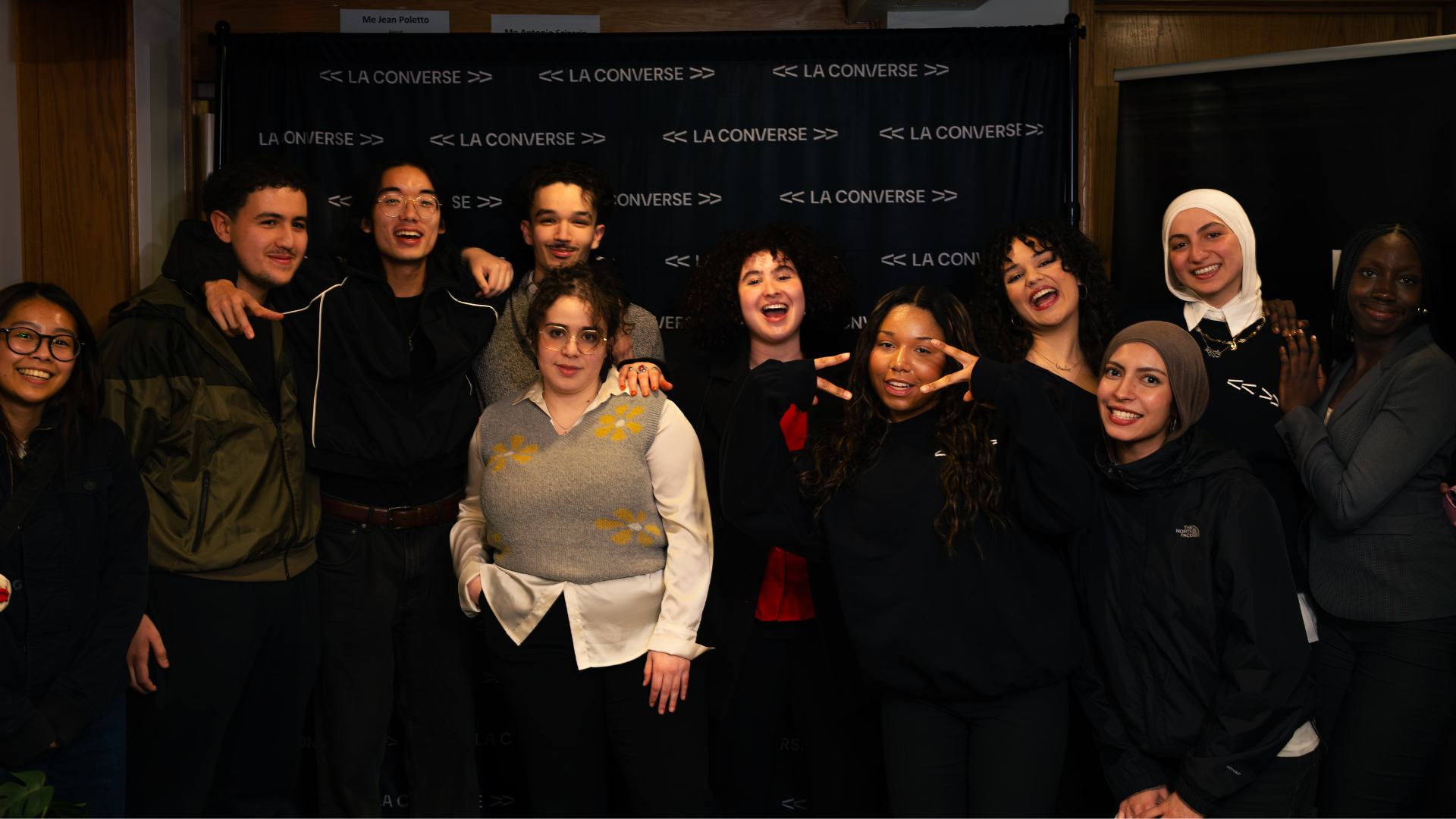
It's March 31st, and it's launch night at La Converse. The atmosphere is festive, a stark contrast to the serious subject of the podcast being launched. With four episodes, “Elle veut, elle veut” assesses the state of masculinism. Through testimonials, conversations, and analyses, we delve into the realities young people face to open a dialogue about relationships and, perhaps, even find solutions to evolve the dynamics between men and women.
Investigating the reality of young people
The project's hosts and initiators are Melissa, Abigail, Razane, and Malika – all four racialized Montrealers in their early twenties. Until recently, they worked on the project anonymously, which speaks volumes about the backlash such a topic can provoke.
"'It started in CEGEP with group debates: girls, boys,' says Razane. Following Momo's intervention, a meeting took place between the students and Lela Savic, editor-in-chief of La Converse. The effect was immediate. 'We ended up sharing what was on our minds, what we saw at school, and how many girls didn't feel comfortable enough in the hallways, in specific areas of the school. We had a lot to say, but no one to listen,' Razane continues."
"'They told me about what they're experiencing,' says Lela. The impact of these conversations was such that the editor-in-chief deemed it necessary to mobilize the resources needed to carry out an initiative with these young people, from a journalistic perspective."
For the four aspiring journalists, this was their first contact with the profession. "'I really enjoyed our conversations in CEGEP, and I wanted to learn more about masculinism because it's a very broad topic,' explains Abigail. 'I had the chance to express myself publicly, because not all girls can do so freely,' she continues, noting that she trembles with nervousness, being introverted by nature. 'Thanks to this podcast, I was able to amplify the voices of girls who couldn't. It's a success.'"
"'I'm very happy to have been able to demystify certain things,' adds Melissa about the podcast. 'It's important to represent what we experience, the realities we face. I also wanted to share my own experiences in the podcast,' Malika continues."
Serious repercussions
The apprentice journalists covered sensitive topics: harassment, intimidation, and attacks experienced by girls and women. They had to find and gather testimonials from girls, sometimes very young, who were willing to speak on air. "'They did thorough research to understand what's happening. These are conversations we mostly have among adults, but when we see that it's something that starts in elementary school, it was quite shocking to hear,' explains Lela Savic."
This is what the budding journalists observed in the field. "'From a very young age, [girls] already feel pressure. If they want to play with a little boy, he might tell them: "Don't play with me." There's a separation in the classroom: girls on one side, boys on the other. There's so much work to be done,' analyzes Melissa."
Given such a sensitive issue, the hosts first had to work anonymously, while keeping in mind that those who testify also expose themselves. "'There's a certain fear: Montreal is small, and it's easy to identify people,' laments Malika. 'As a woman, you experience a lot, but you don't necessarily want people to know what you're going through,' states Razane."

She was particularly struck by 'confession accounts': a real scourge on social media, where anonymous posts discredit female students. "'In one school, it went to extremes! Girls were harassed for days, weeks, until the account was shutdown ,' reports Razane."
It's hard not to be affected, she says, seeing a student harassed 'morning, noon, and night' on social media. "'Seeing the direct impact of social media on this girl... I didn't know her at all, yet I wanted to comfort her, but I couldn't, because it was part of the job,' she says."
Razane also notes that the seriousness of such situations is minimized by those who experience them and by their peers. "'I went for a walk, and I was called a slut.' It's become so normal in their reality. And the worst part, Razane continues, is that girls all fear ending up in the same situation if they help a girl who is subjected to such remarks."
Speaking of the consequences of such behaviors, Malika adds that following the aforementioned bullying incident, the student stated she no longer wanted to go to school – which could only jeopardize her academic path. The young journalist recounts the pressure she experienced when she was a student at CEGEP de Maisonneuve.
"'If you wore leggings, you were considered a slut. After my gym class, I would change into jeans or sweatpants,' she recalls. She goes on to describe other situations. 'There was a bench where guys always hung out. You'd just walk by, and they'd point at you, make comments.' Social media ensures that harassment continues outside school walls. 'You're at home, minding your business, and someone calls you a slut. You haven't done anything. Just because you have a public account. Or, someone takes your picture on the street, and sends the photo to a groupchat. You'll change how you act to avoid being targeted. It's not normal,' testifies Malika."

For her part, Melissa had to act as a mediator following some testimonials. "'It was stronger than me; it really got to me. I hadn't realized the extent, the seriousness of this situation. Wow, all this is happening in a place we go to every day? I was a bit shocked,' she recounts."
The young host believes that cyberbullying is particularly underestimated. She quotes young girls saying: "'Being called every name in the book? It's just that. Anyway, what do you want me to do? Even if I talk about it, it won't change anything.' 'You just suck it up and say, "It's no big deal," but in reality, it's extremely serious,' she believes."
Melissa points out that measures have fortunately been taken, and one of the podcast episodes addresses this. However, she fears it might not be enough. "'In our communities, I feel we really don't talk about it enough. It's still taboo,' she says. 'I'd like to be able to offer more than just a podcast.'"
Shifting perspectives
This was far from the only challenge the journalists faced during the podcast's production. As Lela points out, 'you can't talk about this topic without talking to men.' One episode of “She wants, she wants” is thus dedicated to their testimonials.
"'There's an episode where we spoke with the boys, and it was a very sensitive and emotional moment. Some of the responses were disheartening,' confides Razane."
"'From a journalistic perspective, you have to be neutral. When you're faced with comments that you generally wouldn't let slide, you have to remain neutral, be professional, remove biases,' adds her colleague Malika. 'When we were facing the guys and saw that it clashed with our ways of thinking, it was difficult.'"
Despite what you feel deep down, you have to dig deeper. "'It's important to remove biases; it allows us to understand where these thoughts come from in these guys, and even in girls sometimes too,' she says, reflecting on these exchanges."
Indeed, ways of thinking can evolve, and the journalists witnessed this. "'I was in episode 3. I talked about toxicity in men and women. Looking back, I believe women experience much more than we think, and it's thanks to this kind of project that a man can change, myself included,' declares a listener, thanking the hosts for their work."
The series concludes with expert analyses. Melissa now hopes to go beyond the podcast. "'The project opens doors for further research. I'd like to understand a bit more about where all this comes from, and look for solutions.'"
.avif)
.avif)
