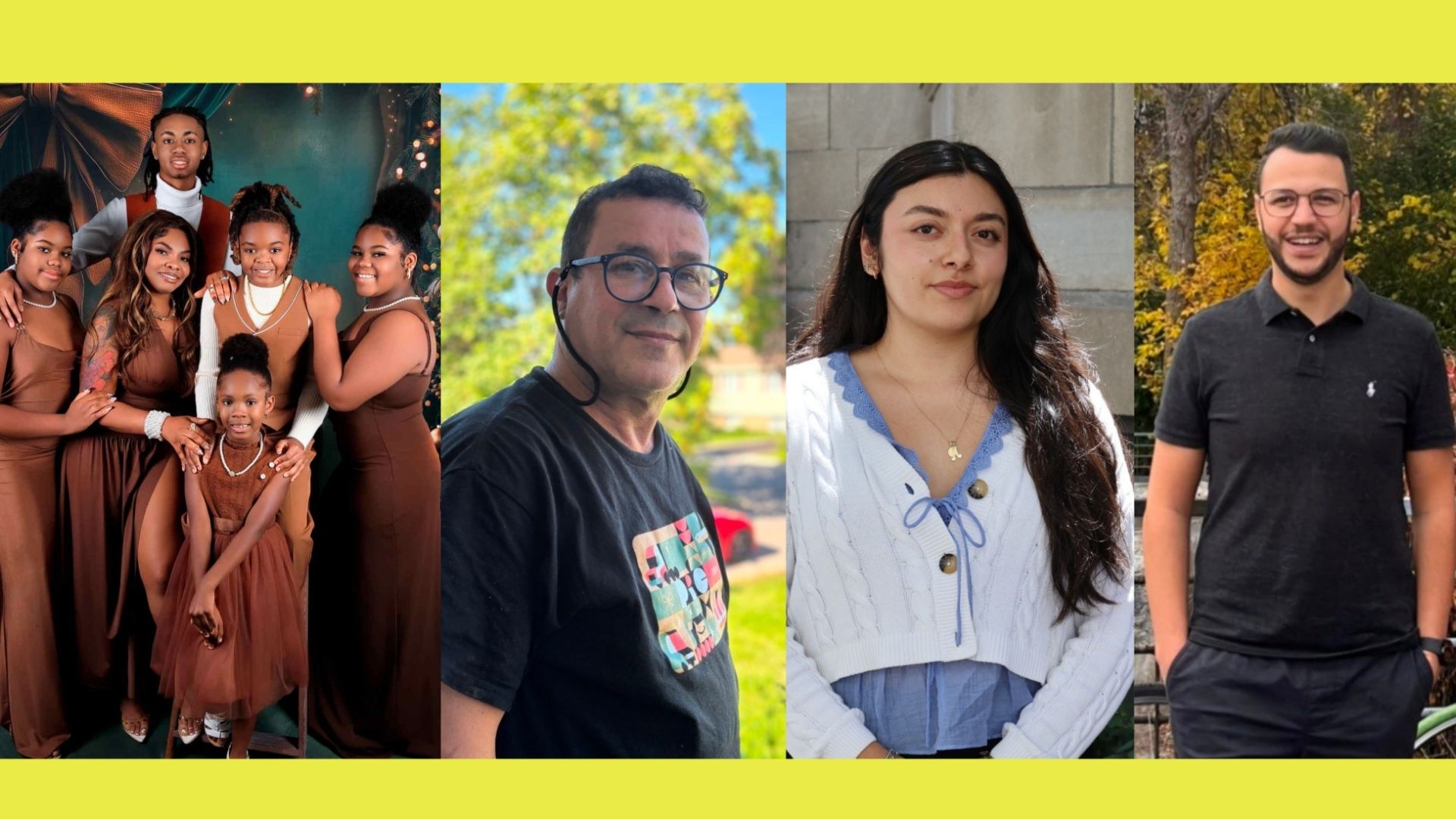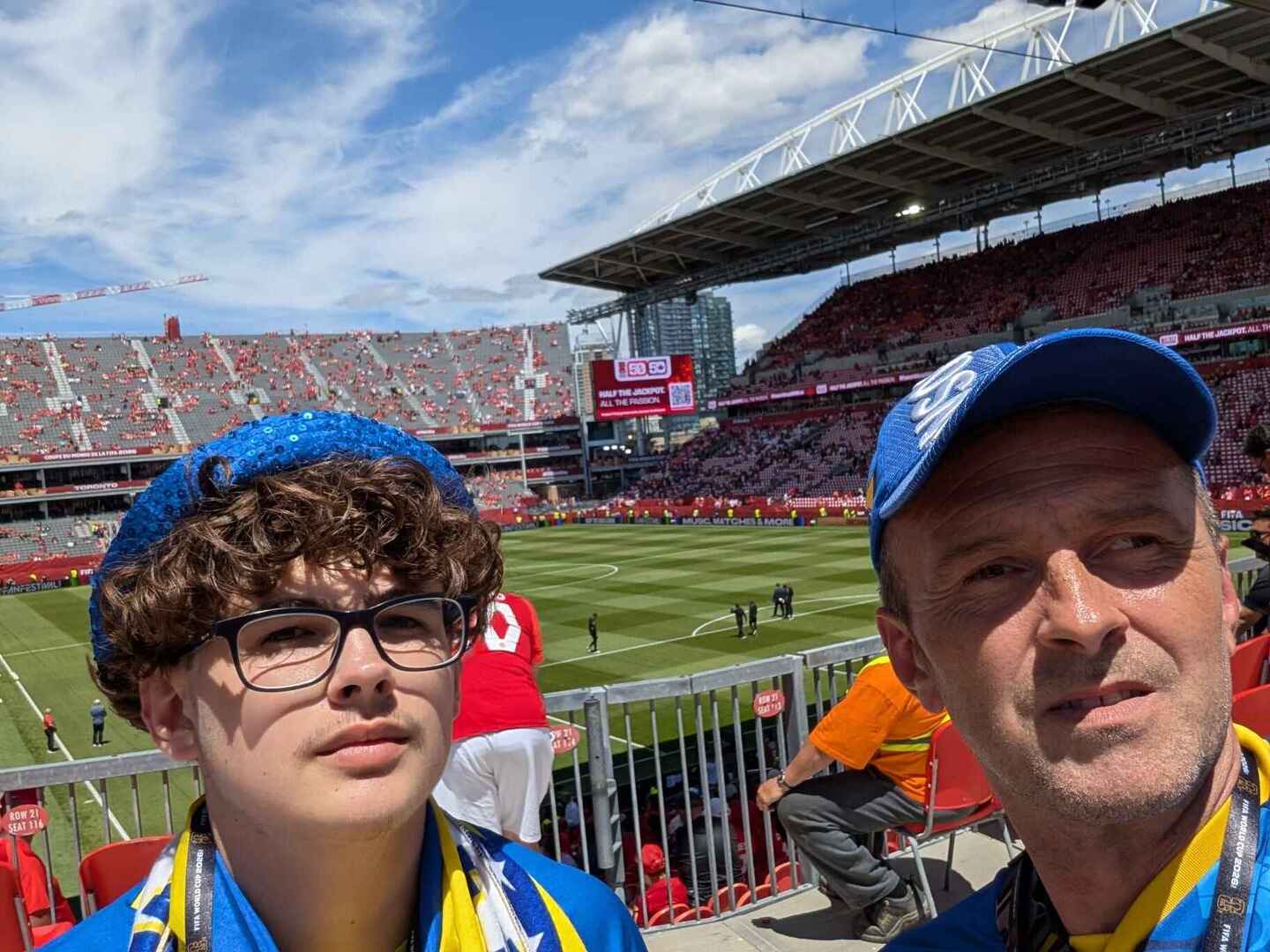
For Bosnian refugees in Canada, Bosnia’s appearance at the World Cup is more than a sporting event. It is a communion with a land many fled as children, a chance to celebrate a generation raised in peace, and, for some, an opportunity to replace memories of war with memories they can share with their own kids. Across Quebec and Canada, families who survived the Bosnian war are discovering that football has become an unlikely vehicle for healing, belonging and reconciliation.
Ibro Hadzic, his wife and two sons, and relatives, all in Bosnian jerseys, are sitting around the back porch of their Laval home. Two Bosnia flags hang on the clothes wire over the yard.
At one point, Ibro, 45, gets nose to nose with his youngest son, Mahir, four, and asks him in Bosnian: "Tell me who is the best player in the world, Messi, Ronaldo, or Dzeko?" Edin Dzeko, who captains for Bosnia this World Cup, had been among the best strikers of the Messi and Ronaldo generation.
The kid hesitates a moment and then says, "Ronaldo." With a smile, Ibro retorts, "Noooo, it's Dzeko. Say Dzeko." To an outsider, it is an ordinary exchange between a father and son about football. To Ibro, it is something much bigger.
I met Ibro, a general contractor, two days before the June 12, 2026 World Cup match between his native country and his adopted one, at Toronto Stadium, to talk about its significance. He was seething. At $3500 a piece, the initial ticket prices made it not worth it to consider going to Toronto. But now that brokers were giving them out for $800, he saw an opening.
Even for the most fervent Bosnian fans, going to Toronto for the match was not only about football. Many of the boys who wear the Bosnian jersey today are the sons of refugees, migrant workers and survivors scattered across the West. Unlike Ibro Hadzic they did not spend their childhood or adolescence hiding from shells or fleeing their home, learning how to survive a war.
They learned how to play football.
Rooting for them at the stadium is about taking pride at what a generation grown up in peace can do. It is, in the words of the Bosnian-born, Trois-Rivières-based writer Adis Simidzija, about overcoming hate.
.jpeg)
A childhood lost
Ibro remembers vividly the day when the shelling in his village of Grapska in central Bosnia. First, there had been two blasts in the morning, around nine. Mother went robotically to feed the cows in the yard, as if nothing had happened. Then there were more shells, and she tried to force her children to eat the pljeska pancake she had made. Then the gunshots and the shelling intensified, one blast so close it could have been the neighbor’s house next door.
Then mother took her daughter Nevzeta, then 13, Ibro, 11, to seek shelter on the tunnel under the rail track near their house, which was the last in the village.
The upending of Ibro Hadzic’s world happened on May 10, 1992.
The war was barely one month old then. Bosnia had seceded from Yugoslavia, a federation, in early March, and another member country, Serbia, was protesting it under the threat of weapons. Half of Bosnia's four-million population was Moslem like Ibro, a third Christian Orthodox, which identified as Serb, the remainder Catholic, which identified as ethnically Croat. The neighboring country of Croatia had left Yugoslavia one year earlier, with an armed conflict that had abated only shortly before. Now, Serbia's president Slobodan Milosevic was encouraging the Bosnian Serb nationalists to secede and called the army to fight Bosnian Muslim resistance. In a flare of nationalist craze, the area was run over by paramilitaries marauding the population.
Even after all this time, he remembers every detail. When they left the tunnel as the shelling stopped and went back to the village, they learned that the Serbs had issued an ultimatum that the men of fighting age disarm, the old and the infirm gather in a house, while the civilian population would leave the village. He and his sister and his mother were bussed to a village eight kilometres further. After a week, they moved to his mother’s native village, where someone undertook to drive them, through the shelling, to Croatia, where her brothers lived.
When they took the raft near an industrial river port to cross into Croatia, he could see the shelling of the oil refinery and the car bridge behind. They took the bus to Croatia’s capital, Zagreb, and then the train to his uncle’s town.
There, after two months, with other Bosnian refugees they were bussed to Switzerland, which had offered them shelter. They ended up in Küssnacht am Rigi, a town on Lake Luzern in the country’s center, with a population of 10,000, a quarter of whom were migrants from former Yugoslavia.
A lot that was going on for a refugee kid in picture-card, placid Luzern was running after the ball with other kids.
Ibro Hadzic joined the junior mini-football team of the local Bosnian club and the town's regular junior team, which reflected its ethnic composition. Most of the time, he played the goalie. His bestie, a kid called Edis, born to Bosnian parents who had migrated there in the sixties, was the playmaker and striker. They'd work very well together: when they played, he'd kick the ball to Edis who was deep in the opponent’s half, and if Edis was lucky, he'd get the ball, dribble his way to the goal, or kick it inside on some good angle. The single goal scored, the whole team's duty was to seal their own goal for the rest of the match.
"That strategy worked, mostly," recalls Ibro. "We would reach the quarterfinals, we'd get trophies. We'd fight for 200 Swiss Francs in prize money, and then we'd go and feast on cevapi," the Bosnian meatballs.
He says his friend Edis was the soul of that team. He would have definitely become a professional footballer, Ibro says. But for his friend, playing football had always meant playing with friends.
Ibro pauses. "You know how Edis played?" he says. "He played like that kid (18-year-old Bosnian international winger Karim) Alajbegovic. Edis was incredible with the ball."
Rebuilding
After the Bosnian war ended in 1995, Switzerland began to exert soft pressure on the Bosnian refugees to return home now that the country was at peace. But the Hadzices lost their house, the village was ravaged, the population perished. His first cousin’s body is yet to be found. In fact, the first trial on genocide charges related to the war had been conducted in Germany against a Bosnian Serb resident of that country, who was found guilty for the summary execution of 30 people in Grapska that month of May, 1992. For the Hadzices, the present was just to hard to deal with.
They left behind seven years in Switzerland, and found their way to Montreal. After high school (college), he took up house painting, evolving it into a business he was happy with for a while. Then, he shifted into house renovation, which is what keeps him busy to this day. He married a fellow Bosnian whose mother was from the area of Srebrenica, the site of the massacre of 8000 Bosnian Muslims in mid-1995. They had their two sons, and moved to the suburban neighborhoods of Laval.
To this day Ibro does not eat the pljeska, the pancake his mother tried to force on him the day his village was shelled in 1992. He says he barely speaks with his sister Nevzeta about those times. But life goes on, both in Bosnia and here. All the houses in Grapska have been rebuilt, Ibro says, and you would not have thought there had ever ever been a war there. Nevzeta’s son lives now in Bosnia, playing football for the team of the town of Bihac. Here, Ibro cherishes organizing events that bring the Bosnian community of Montreal, which numbers in the upper hundreds, together.
As the crowd marched to the stadium, Ibro learned that the broker who had sold him the $800 tickets had invalidated them and sold them at better prices. “At that moment, I lost hope, and could not even look Tarik in the eye.” As they walked along with the crowd to the stadium, he tried frantically to go to ticket brokerage sites to get new ones, to no avail. Then, he says, all of a sudden, the broker found other tickets and they would have been uploaded shortly.
“The tickets popped up in the app and we and the people around us started celebrating as if Bosnia had already scored the first goal.”
He scanned the ticket barcodes and the gate opened.
They were in.
The feast that brought everyone together
Ibro knows all the players, the coaches, their anecdotes and factoids. He seethes and enthuses about the team and imagines game strategies. He says that the team’s very young age is both a boon, because they are very creative, and a bane, because of the inexperience. But the strength of all those players is that they are a tightly-glued group. While the Bosnian war had killed 60,000 to split the country into its three main ethnic groups, the Bosnian coach Sergej Barbarez is a mix of all three and has always played for Bosnia. Ibro recounts how Barbarez went all over Europe and North America to convince young Bosnian players to join the team, and his strong point had indeed been the team’s spirit and ethnic diversity. "They are doing what my generation was not able to do,” Ibro says. “They did more than anybody to bring Bosnia together."
It was important for him to be in that stadium for the match, Ibro said, because “we went through all this and we still exist, we stand high and are with the best in the world. And even more because my son is stepping into my footsteps and having the same passion and love I have for Bosnia, even more.”
For Adis Simidzija, the Bosnian-born Trois-Rivières writer, the match had a deeper personal meaning. On June 12, 1992, when he was three years old, his father and uncle were abducted by the Serbian paramilitaries in their home town of Mostar, later to be found in a mass grave. His grandmother perished later in the conflict. Mostar became a battleground for Bosnian Muslims, Croats and Serbs. Thirty-four years later, among the Bosnian fans strolling the streets of Toronto he met Darko, a Croat, who had travelled from Vancouver to watch the komsije, the neighbors, play. He found Serbs among the throngs of Bosnia supporters.
June 12 would “not be associated with the murder of our father any more,” he wrote on a Facebook post.
He recalls how, at Trois-Rivières a few months earlier, he had been approached by a Serbian woman, who told him crying that she was deeply sorry for the pain her people inflicted on his. He responded that she did not have to feel guilty for things she did not do. Guilt should belong to the perpetrators. In the thirty-fourth year after the abduction and murder of his father, he found this moment, of joining Bosnian and Croat and Serb and other Bosnia team supporters to cheer for the team and for justice.
At one point, the fans shouted, “Free, Free Palestine.”
“It was so important that we did that,” Adis says. “We were victims of genocide and when we said we did not want genocide to happen, we wanted to say we did not want the genocide to happen anywhere.
“That’s how we can beat fascism.”
As I watched the game at a Montreal bar that Friday, I could not help but think of Ibro when I watched Bosnia score in the 21st minute and then seal itself in front of the goal for much of the first half. Dzeko, the 40-year-old best player in the world, remained on the bench. That kid Alajbegovic, who played like Ibro’s bestie Edis, entered the second half. The match ended in a one-one draw. But the Bosnian players deserved their cevapi after the game. “It was important that we did not lose the first match,” Ibro texted.
I asked him how does he split his allegiances between Bosnia and Canada now that he has lived here for almost thirty years.
"In the same (World Cup) group," he texted back, "we have Bosnia, Canada and Switzerland. Who should I cheer for? Lol."

.jpg)
.jpeg)