
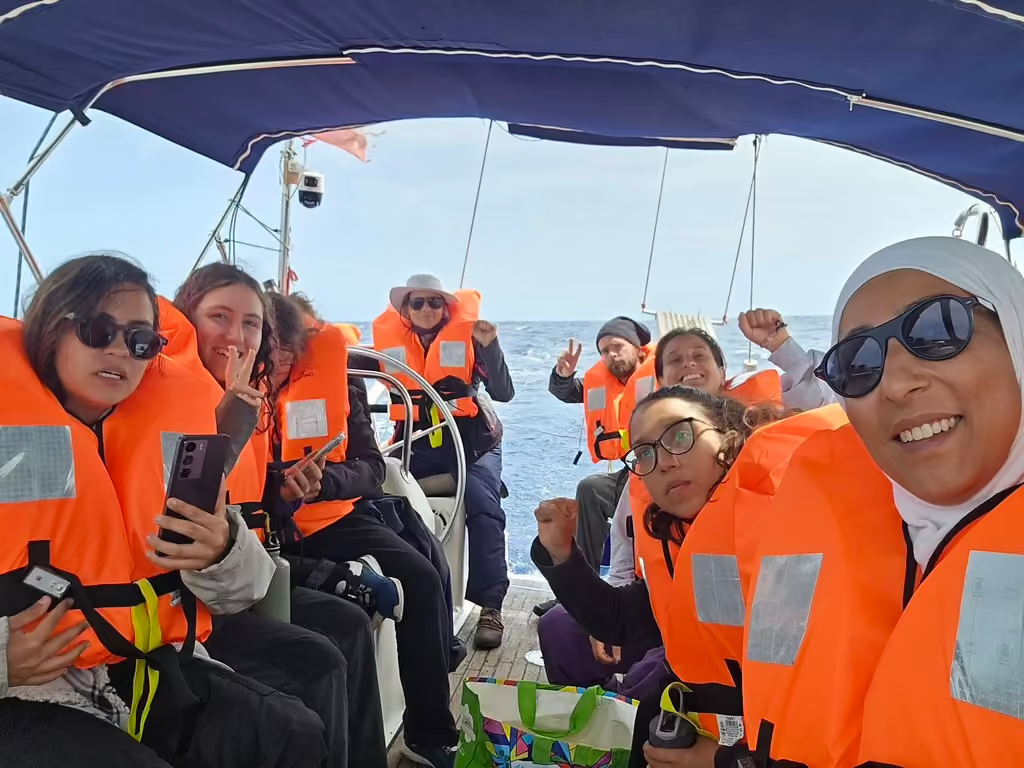
The boats never reached Gaza. Yet, for many who participated in the Global Sumud Flotilla or followed it from Gaza and Montreal, the core of its mission may not have been about what happened on the water. Through the testimonies of a Canadian activist who returned from the mission, a Montreal Palestinian, and a journalist speaking from a bombing zone, another question emerges: can a flotilla still make a difference when it doesn't deliver its aid?
Through the testimonies of a Canadian activist who returned from the mission, a Montreal Palestinian, and a journalist in Gaza, our report explores a question: can a flotilla still make a difference when it doesn't reach its destination?
The video went viral. It shows Global Sumud Flotilla activists kneeling, face down on the ground, hands tied behind their backs during their detention, surrounded by Israeli Defense Forces (IDF) soldiers. Hours earlier, their boats had been intercepted in international waters, and the activists were arrested and transferred to Israeli warships, en route to Ashdod port. The images, released by Israeli National Security Minister Itamar Ben-Gvir, quickly sparked a wave of international outrage and criticism against Tel Aviv. Several countries, including Spain, France, Italy, Great Britain, and the Netherlands, condemned "a violation of human dignity." "Inhumane treatment" and "heinous abuses for which those responsible must be held accountable," condemned Anita Anand, Canada's Minister of Foreign Affairs, 12 of whose nationals were part of the flotilla.
“All torture techniques were applied to all participants,” testifies Safa Chebbi. “There were fractures, there were really very serious injuries; there are still people in the hospital. And there were also sexual assaults against men and women,” she confides to La Converse. The testimonies will be documented in a detailed report that will soon be made public, she promises, and this report will be used to bring the Israeli state before a court.
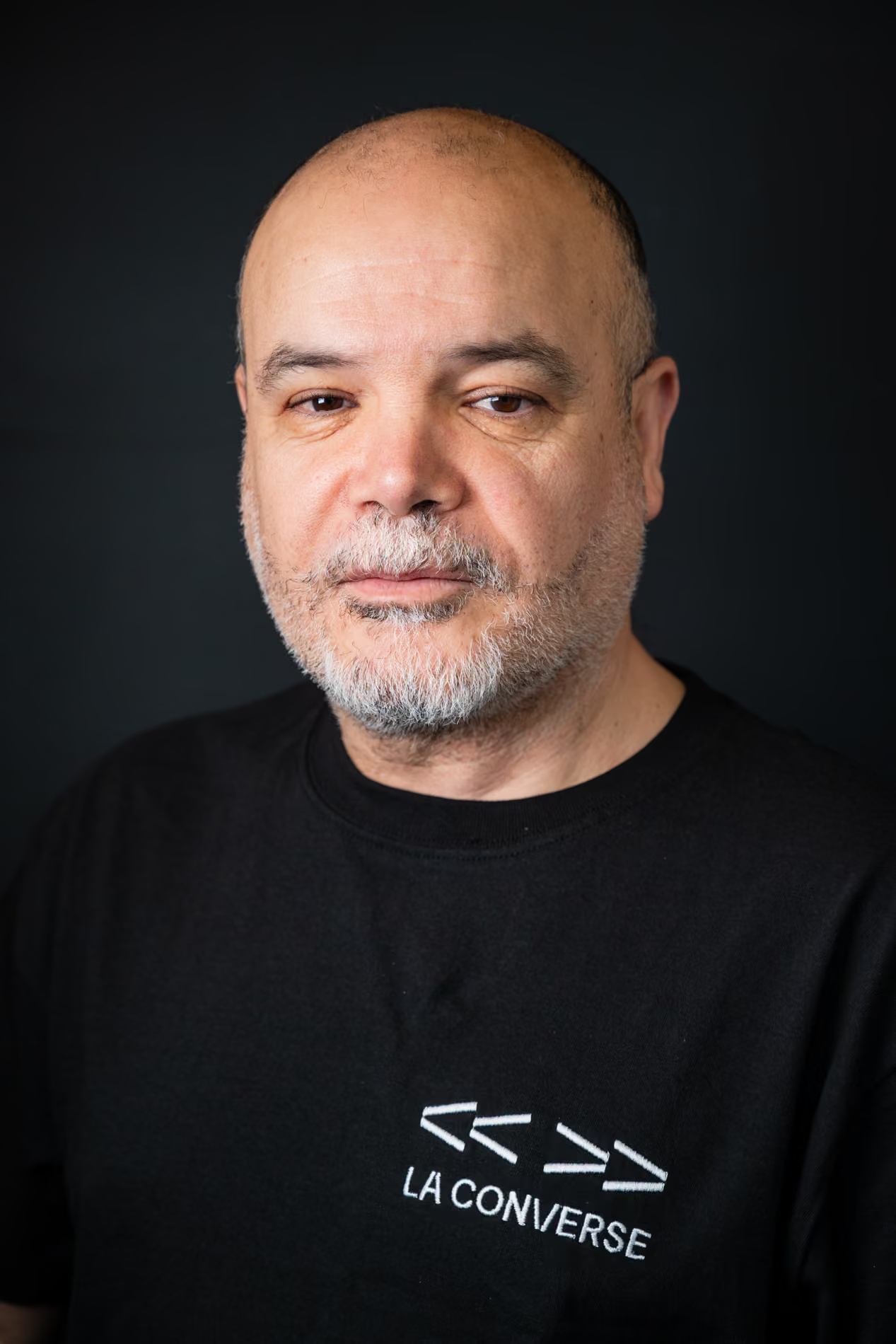
We met her at her home in Montreal. Two days after returning to the country, Safa Chebbi still shows signs of great fatigue, a few bruises she ignores, and a calm, distant smile – that of someone returning from a battle without having fully left the field behind. Among the powerful images she retains from her detention are the marks left on cell walls by Palestinian detainees: “It carried a lot of pain and love at the same time. You also saw traces of violence, traces of blood on the walls. The cell truly speaks to the violence experienced by Palestinians and prisoners in these spaces.”
“Putting Gaza Back in the Spotlight”
The Global Sumud fleet initially comprised 58 boats and thousands of participants from 56 countries. Starting May 18, the Israeli navy began boarding them off the coast of Cyprus. Ultimately, 50 boats were intercepted, and 426 activists were arrested and detained in Israeli prisons.
Its initiators describe the flotilla as the "largest coordinated civilian maritime operation ever conducted in Palestine." It set out with a clear objective: to deliver humanitarian aid to Gaza and attempt to break the blockade imposed on the Palestinian territory – which is driving the population into famine – and widely condemned, notably by the Canadian government.
Israel justifies these interceptions on security grounds and defends the legality of the maritime blockade imposed on Gaza.
"Israel has every right to prevent provocative flotillas of Hamas terrorist supporters from entering our territorial waters and reaching Gaza," Israeli Prime Minister Benjamin Netanyahu stated in a social media post.
It should be noted that the Israeli army intercepted the flotilla's boats more than 400 km from Gaza. In a joint statement issued on May 18, the foreign ministers of Spain, Turkey, Bangladesh, Brazil, Colombia, Jordan, Libya, Malaysia, the Maldives, Pakistan, and South Africa described the seizure of these boats in international waters as a "flagrant violation of international humanitarian law."
Israeli authorities also reject accusations that Gaza is being deprived of humanitarian aid. "The Gaza Strip is flooded with aid," stated Israeli Foreign Minister Gideon Sa'ar, claiming that over 1.58 million tons of humanitarian aid had entered the enclave since October 2025.
These claims are, however, disputed by several international humanitarian organizations and UN bodies, which continue to raise alarms about the food and health situation in the Palestinian enclave.
For their part, the flotilla activists maintain that the mission goes beyond food aid. For those we asked (see our video), the answer is not just measured in tons of food or boxes of medicine, but also in the visibility created for the issue of Palestine. "Obviously, it's a maritime, civilian, and humanitarian mission. Its goal is to bring humanitarian aid to Gaza, break the siege, and open a humanitarian corridor for aid," explains Safa Chebbi. "But breaking the siege isn't just a humanitarian or geographical mission. It's also political, diplomatic, and media-related."
She continues: "Our role is also to break the silence around a siege that has existed against Gaza for almost 20 years. Our objective is to once again put Palestine at the center of international news."
In Gaza, a War That Continues
While the activists were returning home, Issa Saadallah spoke with us from Jabaliya, in northern Gaza. A journalist for 26 years, he has not left the enclave since the war began in October 2023.
What is the situation like in Gaza right now? To this first question, he replies, almost nonchalantly: "About ten minutes ago, an Israeli bombing targeted a group of civilians about a hundred meters from here. I don't have the details yet because I connected to speak with you."
He then continues: "The situation is currently at its most critical point in 32 months of continuous crisis. A tragic situation. Most people are living in tents. The water is undrinkable, the food is unfit for consumption, the healthcare system is completely destroyed, the education system is in ruins."
He also recounts the first months of the siege: "For about six months, we were forced to eat animal feed, sometimes spoiled. We ate grass. We drank stagnant water and held our noses to swallow it."
In this context, he himself acknowledges the material limitations of aid from a flotilla. "Even if it reaches Gaza, it only brings a few items." He immediately adds a nuance, however: "These movements express global helplessness. The helplessness of governments, European countries, Arab countries, countries all over the world."
Selective Outrage
For her part, Safa Chebbi speaks of "selective outrage." The question emerged after images of detention: why did international reactions seem stronger when Western citizens were among those detained?
"While the hundreds of Sumud flotilla activists who were illegally detained by Israel are on their way back to their countries, Palestinian prisoners continue to endure unspeakable abuses," Amnesty International reminds us.. Abuses documented by Francesca Albanese, Special Rapporteur of the United Nations on the human rights situation in the occupied Palestinian territories since 1967.
Indeed, more than 9,600 Palestinians are believed to be detained in Israeli prisons, most without trial. Ms. Chebbi puts this figure in the context of the war on Gaza: "The genocide has been ongoing for three years, and outrage is still selective." For her, the flotilla existed because governments failed. That's when people organize and take responsibility. "The role of people in the Global North is to use their privileges, to use their bodies to confront a war machine and make the reality of Palestinians visible."
This interpretation aligns with a broader reflection on international solidarity movements: if institutions seem unable to change a situation, some citizens seek to act on their own.
When Citizens Step In
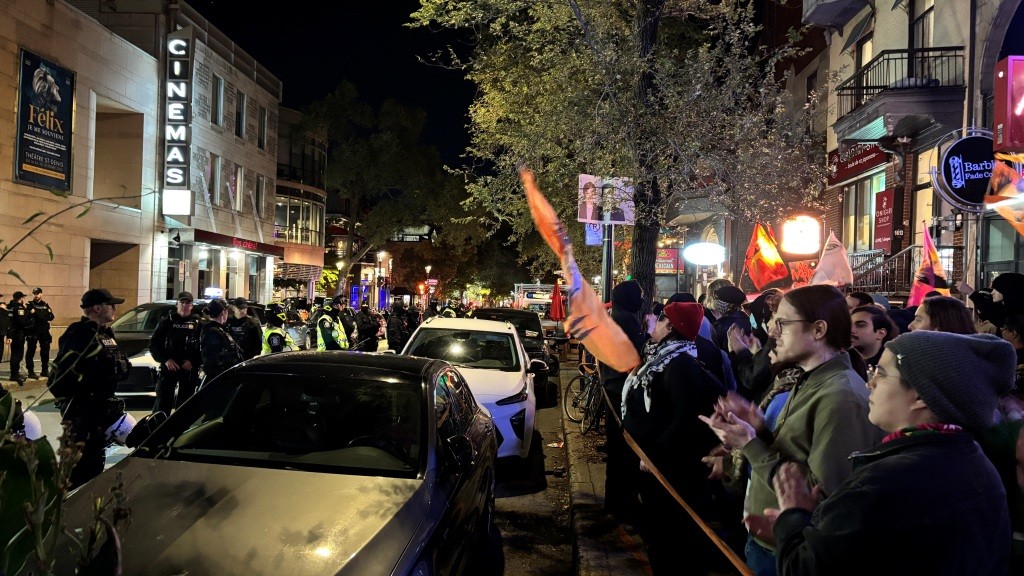
During a discussion evening, La Converse explored the frustration of Palestinians living in Montreal regarding the neglect of their pain and the violence plaguing their country. Among them, Reem Majid follows recent events from a different perspective: that of a Palestinian living far from Gaza, but who sees the war affecting the daily lives of thousands of people here too.
A member of the Palestinian Youth Movement (PYM), she has participated in demonstrations and solidarity campaigns organized in the city since the beginning of the war.
For her, the flotillas emerged in a particular context: that of a popular mobilization that expanded without, in her opinion, getting the expected response from Western governments. "We can see that the West rose up in response to this genocide, protested and brought people into the streets, but people saw that it wasn't enough." Then she adds: "People wanted to take matters into their own hands and offer help themselves, because Western governments weren't doing it."
Reem Majid believes that the role of the flotillas goes beyond their immediate humanitarian function, also carrying another idea: that of an international mobilization that continues despite repeated interceptions and the support that some states continue to provide to Israel. "The flotilla is a sign that people worldwide, especially people of conscience worldwide, continue to fight against the Israeli regime," she states, "despite the fact that their governments support it." She also sees it as a way for some citizens to take a public stand: "People continue to say that they refuse to be complicit [...] and that they support Palestinians."
From Montreal, her perspective echoes a question that runs through all the testimonies collected: when institutions seem unable to act, to what extent can citizens step in?
What's left to do
Issa Saadallah says he wasn't surprised by the recent events. Since the blockade imposed on Gaza in 2007, several flotillas have been intercepted by Israel, sometimes violently. He specifically mentions the Mavi Marmara, in 2010, when nine Turkish activists were killed during an Israeli assault.
But what strikes him more is the weakness of international reactions. "I was surprised by the modest global reaction, particularly the European reaction."
For him, diplomatic condemnations remain largely symbolic. "All they do is summon an ambassador to protest or reprimand them." He believes that this lack of concrete consequences risks encouraging Israel to go further. "It's an indicator that allows Israel to attack again and encourages attacks against anyone trying to help the Palestinian people."
He then broadens his reflection to the flotillas themselves. In his view, their immediate impact is necessarily limited given the international power dynamics. "The result is relative. Even if it's modest, I think that in the long term or medium term there will be a positive outcome."
He speaks of the cumulative effect of social media, images, and citizen mobilizations that continue to fuel a gradual shift in Western public opinion. "Even a large part of the American people are very unhappy with Israeli crimes. There are also European populations who are not satisfied with what is happening, and they find these means of solidarity."
But this solidarity is still marked by a deep contradiction, because, as he summarizes, "the flotillas express global powerlessness: the powerlessness of governments, European countries, Arab countries, countries all over the world."
Even if a flotilla reaches Gaza, he says, its cargo remains negligible compared to the scale of the needs. Its true function, therefore, lies elsewhere: in its ability to keep Gaza visible and, despite everything, to create a space for international solidarity. "The least they can do is organize such maritime missions to express their solidarity and ease their conscience," he says, referring to citizens who refuse to remain passive in the face of "children killed, burned alive," prisoners "tortured to death," and a "completely besieged" population.
From Jabaliya, in the northern Palestinian enclave, Issa Saadallah also sends a message to the Canadian Prime Minister. "What you wouldn't accept happening to your children and grandchildren under the Canadian flag, don't accept happening to Palestinian children," he says. He then adds: "I hope he will take a stand that will ease his conscience and that of humanity."
The Global Sumud Flotilla did not reach the Palestinian enclave, like several missions before it. But for those who participated in it or observed it from Gaza and Montreal, its main cargo may not have been solely on the boats.
In the days following the interception, images of the arrests, and then of the activists being welcomed upon their return to their home countries, put Gaza back in the spotlight, after the enclave had been largely overshadowed by the conflict between the United States and Iran.
And while diplomatic debates continue, the death toll also continues to rise.
Flotillas to Gaza: Key Milestones
Since 2008, several international civilian flotillas have attempted to reach Gaza to challenge the blockade imposed by Israel since 2007 and deliver humanitarian aid.
The movement's first missions Free Gaza managed to reach the Palestinian enclave in 2008. But the most significant episode occurred in 2010 with the Mavi Marmara, a Turkish ship stormed by the Israeli army in international waters. Nine activists were killed, causing a major diplomatic crisis between Israel and Turkey.
Since then, several other maritime missions, such as the Freedom Flotilla, the Women’s Boat to Gaza in 2016, and the Handala expedition in September 2025, have been intercepted, their participants arrested and then expelled. The Global Sumud flotilla is the 38th expedition in the tradition of naval solidarity with Gaza.
Over the years, the flotillas have become as much humanitarian operations as political and media actions aimed at keeping Gaza in the international spotlight and denouncing the Israeli blockade.