
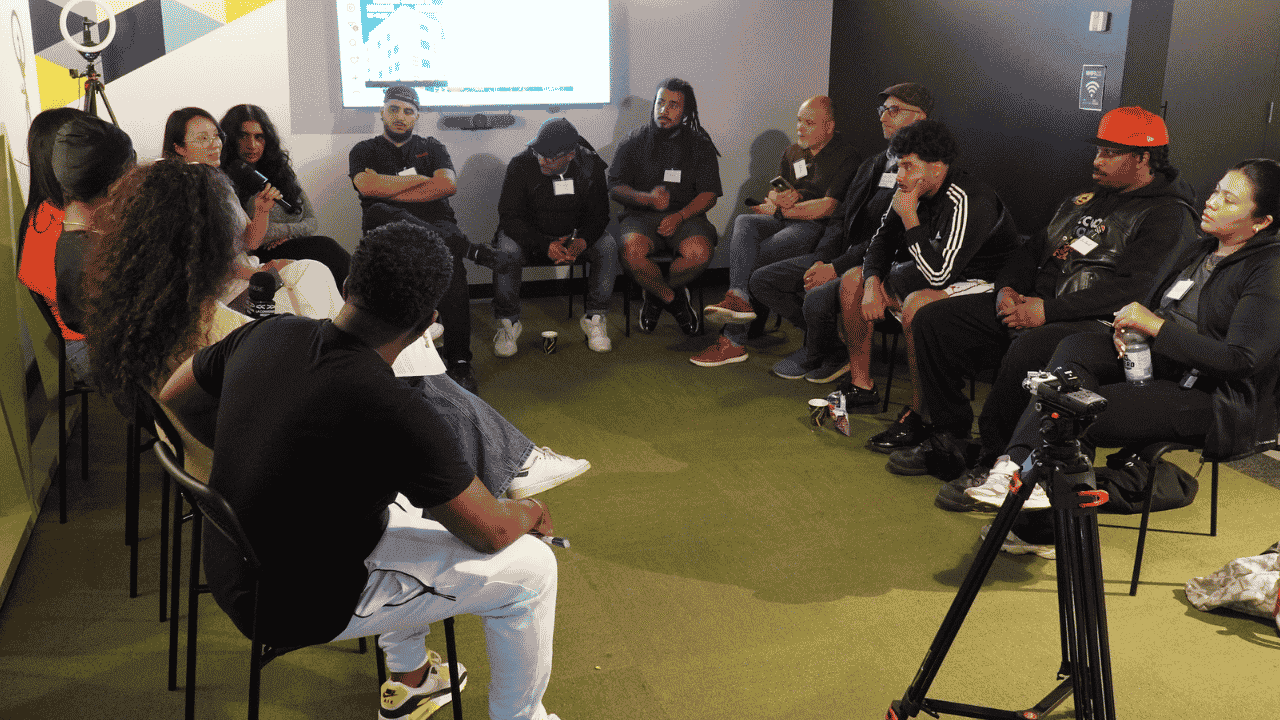
A moratorium on street checks, a public inquiry, defunding the police, strengthening oversight mechanisms: solutions to police racism are numerous – and some have been around for a long time. Gathered in Anjou for a dialogue evening organized by La Converse, young people, activists, researchers, and community workers primarily questioned the obstacles preventing their implementation, particularly institutional resistance and sometimes divergent views on change.
"Even before I was born, they were already talking about solutions. I'm sure that when my grandchildren are born, they'll still be talking about solutions!" When Julian Grau-Brown speaks, the evening organized by La Converse at the Coalition Pozé headquarters is well underway. A social worker and PhD candidate at McGill University, he expresses a weariness that transcends his own generation: that of communities who, for decades, have seen the same observations about racism within the Montreal police force and the same recommendations reappear without the hoped-for changes materializing.
For several hours, participants at our evening discussed police racism in Montreal. Many solutions were brought up: a moratorium on street checks, a public inquiry, defunding the police, funding organizations, reinvesting in neighborhoods, etc. To such an extent that one question gradually became central: are we truly lacking solutions, or is it the obstacles to their implementation that explain their lack of impact?
This question ran through several of the discussions held during the dialogue evening organized by La Converse following the Montreal-North Neighbourhood Police Station 39 scandal. For while participants don't always agree on the methods to advocate (some defending institutional reforms, others advocating for a break or a power struggle), many nonetheless share the same observation: police racism is not a series of isolated incidents, but a systemic problem whose remedies largely remain unresolved.
Moratorium: a solution already on the table
When attendees at the evening event were invited to propose solutions, several expressed a sense of weariness regarding the unfinished nature of the solutions. The example of the moratorium on police stops clearly illustrates this feeling.
For several years, researchers have documented significant disparities affecting Black, Arab, and Indigenous people in police stops in Montreal. A first report published in 2019 already concluded that Black individuals were much more likely to be stopped than white individuals. In response to this investigation, the Service de police de la Ville de Montréal (SPVM) adopted a new policy on police stops in 2021.
Then, a second mandate entrusted to four independent researchers evaluated the effects of this reform. Submitted in June 2023, their report concluded that racial profiling persists and that the adopted changes have not produced the desired effects.
Researchers Mariam Hassaoui, Victor Armony, Alicia Boatswain-Kyte, and Massimiliano Mulone made only one recommendation: suspend stops that are not linked to a criminal investigation or reasonable suspicion. In other words, implement a moratorium on so-called routine stops.
The SPVM director, Fady Dagher, however, rejected this recommendation. He then stated that a moratorium would be a "symbolic measure" and advocated for a change in culture within the police force itself.
This decision sparked a strong reaction among several organizations and researchers. In December 2024, during a consultation before the Montreal Public Security Commission, several of them denounced the SPVM's refusal to apply the sole recommendation made by the scientific team. "Why did the SPVM commission a research report from independent experts if it had no intention of following their one and only recommendation?" asked Lynda Khelil, from the Ligue des droits et libertés.
Finally, in September 2024, Justice Dominique Poulin of the Quebec Superior Court rendered a historic judgment, concluding that racial profiling is systemic within the Service de police de la Ville de Montréal (SPVM).
For several attendees at La Converse's evening event, this episode perfectly illustrates the feeling of powerlessness experienced by communities affected by racial profiling. The moratorium has thus become, for them, much more than a technical measure: it represents a test of institutions' ability to implement the changes they themselves commissioned and documented.
Mechanisms difficult to mobilize
For Massimiliano Mulone, one of the system's limitations lies less in the absence of remedies than in their accessibility. "People are very unfamiliar with the remedies available to them," explains the researcher, who believes that police oversight mechanisms remain largely unknown to the public.
The Police Ethics Commissioner, responsible for receiving complaints about police conduct, and the Bureau des enquêtes indépendantes (BEI), which intervenes notably in cases of death or serious injury related to police intervention, remain little known to citizens.
According to Mr. Mulone, the organizations responsible for ensuring this oversight also operate with limited resources when compared to much more powerful police institutions. "The organizations responsible for handling citizen complaints are already completely overwhelmed," he stated during an interview with La Converse.
The researcher highlights the disparity between the resources available to the SPVM, whose budget approaches one billion dollars, and those of the institutions responsible for external oversight. For him, this asymmetry contributes to the feeling of powerlessness expressed by several attendees at the evening event. The mechanisms exist, but they remain difficult for many families to understand, mobilize, or navigate.
When recourse depends on activists
TheDavid Kalubi case illustrates, according to Massimiliano Mulone, certain limitations of oversight mechanisms. The young man died in 2017, at the age of 23, after being arrested by the police and detained at the Montreal courthouse. The family was unaware at the time that a complaint regarding professional conduct could be filed.
It was the intervention of activist Alexandre Popovic, from the Coalition Against Police Repression and Abuse (CRAP), that allowed action to be taken before the statute of limitations expired.
This episode raises, according to Mr. Mulone, a broader question: what happens in situations where no one knows the possible remedies or accompanies relatives through the process? The example also shows that oversight mechanisms sometimes rely on the work of organizations, activists, or citizens who understand these complex procedures. Without this expertise, some families risk never accessing the remedies provided by law.
For several stakeholders gathered in Anjou, this reality also contributes to distrust of institutions: the tools exist, but access to them remains unequal and often depends on resources external to public bodies themselves.
C-37 and a commission to take things further
Among the solutions discussed during the evening, one comes up regularly: the creation of a public inquiry commission on racism and police profiling.
For lawyer Dardia Joseph, also assistant director of the Saint-Michel Legal Clinic, this request is far from symbolic; it directly addresses the limitations of current mechanisms. "The mechanisms for controlling police action, as they currently exist, have shown rather limited effectiveness," she observes in an interview.
She points out that complaints of racial profiling rarely lead to sanctions. According to recent data from the Police Ethics Commissioner cited by the lawyer, 493 complaints of racial profiling were filed from 2024 to 2025. Only six of these resulted in a summons before the Administrative Police Ethics Tribunal, and barely two led to a decision concluding a breach of ethics. For Me Joseph, these figures illustrate the limitations of current police oversight mechanisms and explain why several stakeholders are calling for more powerful investigative tools.
Recently, Public Security Minister Ian Lafrenière appointed an independent observer to monitor the internal investigation into the case of Police Station 39 in Montréal-Nord. This initiative does not satisfy the participants of the dialogue evening, because "an independent observer is not an inquiry commission," reminds Me Joseph.
The public inquiry commission she advocates for would be held under Law C-37 on commissions of inquiry. "It's extremely important to specify 'under C-37' because it's truly when public commissions of inquiry are conducted under that law that they come with the powers we find interesting for getting to the bottom of things, for fully grasping the issue in a way we couldn't before," she explains. And this would be a first in Quebec regarding racial profiling, the jurist adds.
According to her, such a commission would also make it possible to obtain documents, impose greater transparency, and give a voice to the associations and organizations concerned. "It allows them to be stakeholders in this commission of inquiry, to question and cross-examine witnesses," she adds.
The lawyer, however, emphasizes that a commission would not be a miracle solution. "I'm not here to promote a solution as if it were perfect," she says, "because a public commission of inquiry is not a panacea." That said, she acknowledges its significant "expressive value": that of publicly recognizing lived experiences and making racial profiling an issue of collective interest rather than a collection of individual cases.
Reducing Police Powers
For social worker Julian Grau-Brown, the solution lies elsewhere: police powers must be reduced, and resources reinvested in other areas. The young activist advocates for police defunding, a proposal that remains a minority view in public debate but resonates with some attendees at the event.
According to him, some reforms struggle to bring about change because they leave the police institution's role intact. The moratorium on street checks is, in his view, a concrete example. "It's something that would reduce police power," he explains. He reminds us that a street check occurs when an officer approaches someone in a park, on the street, or in front of a school to obtain information or identify them, even though no offense has been committed.
For Julian, Montreal Mayor Soraya Martinez-Ferrada's recent openness to a moratorium is "a victory to be celebrated." But he believes the debate must also address the police's role in responding to social problems. He argues that the defunding proposal aims to transfer some resources to community organizations, local services, and social interventions. In his view, the issue is not just about better regulating the police, but also about considering which institutions should intervene before a situation escalates to require police involvement.
Since institutional solutions seem blocked or limited, what other avenues can be proposed? On this topic, the evening's participants were not short on solutions and expressed the main ideas driving the Quebec debate on policing.
"We must stop asking"
Throughout the evening, the anger of Jean-Édouard Pierre-Toussaint, a community worker in Côte-des-Neiges, contrasted sharply with calls for new reforms or consultations. For him, the problem isn't a lack of diagnosis. Reports exist, recommendations pile up, and communities have long denounced racial profiling and police violence. "We've been asking for 40 years," he says wearily. His criticism isn't just aimed at institutions; it also questions the strategy of demanding change from those who already hold power. "We must stop asking," he declares.
Behind this statement lies another way of envisioning change. Rather than waiting for a response from institutions, Jean-Édouard Pierre-Toussaint advocates for greater autonomy, community organizing, and a better balance of power.
His intervention echoed the sentiment expressed earlier by Julian Grau-Brown, who felt that several generations were passing down the same demands without ever seeing the hoped-for changes. For Mr. Pierre-Toussaint, the repetition of consultations, recommendations, and promises itself contributes to community exhaustion.
His position did not achieve consensus in the room, but it reflects a need for a break from the idea that institutions will necessarily correct their own practices.
"We must be everywhere"
At the very end of the evening, a discussion began about the different ways to combat systemic racism. The exchanges revealed real disagreements. Some rely on legal remedies or institutional reforms, while others advocate for a balance of power, autonomy, or a deeper questioning of the police's role.
For Pierson Vaval, no single approach can transform a reality as complex as systemic racism. "The success or advancement of the community won't happen through action at just one level," he says.
Asked to outline his organization's position on a number of issues, the director of Coalition Pozé refused to pit the strategies fueling the anti-racist struggle against each other. "You have to be an activist, you have to be a politician, you have to be in the system, you have to make money, you have to have influence, you have to be in the media... You have to be everywhere," he argues.
For him, the complementarity of roles must be recognized: "We must see the other as an accomplice who might be fighting the battle where we cannot."
In Anjou, participants largely agreed on the diagnosis. Police racism is no longer seen as a series of isolated incidents, but as a systemic problem. Disagreements now focus less on identifying the problem than on how to bring about change.
Defunding the police, an idea stemming from anti-racist movements
Popularized in the United States during the 2020 protests following George Floyd's death, the slogan "Defund the police" refers to an approach that involves reducing police budgets to reinvest some of these resources into housing, mental health, education, prevention, community organizations, and local services. Its proponents believe that many social problems are currently handled by the police, when they are more appropriately addressed by social or community interventions.
In Montreal, the Coalition for Police Defunding was created in 2020 and now brings together several dozen organizations. It notably calls for a significant reduction in the SPVM's budget, reinvestment in neighborhoods, and the development of community-based safety solutions. According to an IPSOS poll commissioned by the City of Montreal in 2020, 73% of Montrealers were then in favor of police defunding. This direction was not adopted, however, by the mayor's office, led at the time by Projet Montréal, which instead decided to increase the SPVM's budget by 2%.
.jpg)
.jpeg)