%20(2).avif)
They number in the thousands in Montreal, forming an essential yet hidden part of the city. For these women of flesh, bone, and dignity, the absence of papers is not merely an administrative issue; it is a true “psychological cage,” an existence marked by daily uncertainty and forced invisibility.
Living in the shadows of a labour market that often operates with impunity, these women hold precarious jobs—particularly in cleaning and caregiving—for an average income of just $319 per week. Whether they were “guardian angels” during the pandemic or fled violence in their countries of origin, they face abusive working conditions and almost nonexistent access to healthcare without a RAMQ card. The constant fear of deportation or an unpaid hospital bill eventually becomes, for many, a “second skin.”
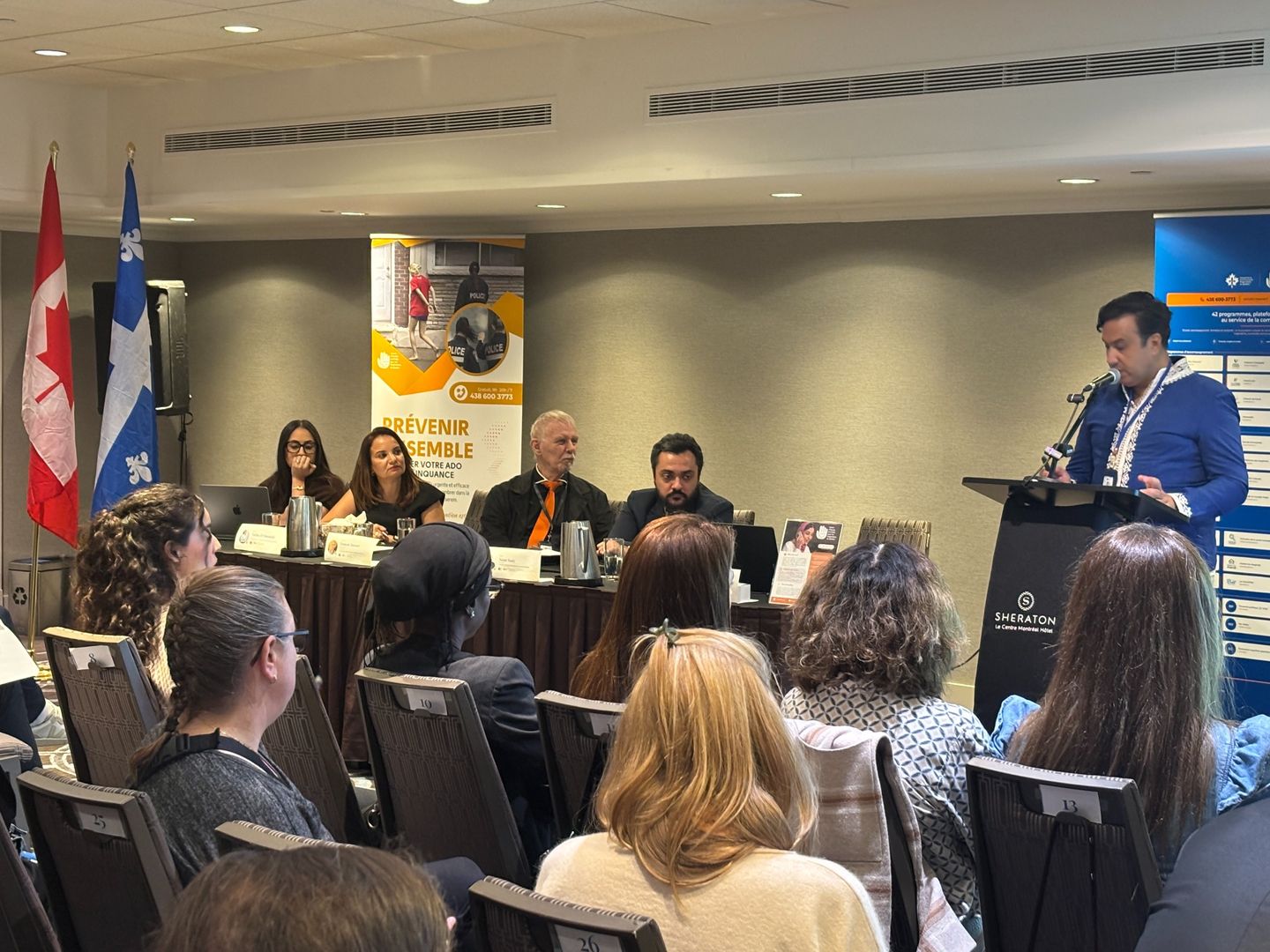
It was to denounce this reality that several of them spoke out in early December 2025 at a press conference organized by the Centre for Immigrant Workers (CTTI), marking the launch of the report Women Without Status in Action: Working Conditions and Health.
After the cameras and speeches, the tension eased in the kitchen of the Y des femmes de Montréal. Far from microphones and official presentations, the atmosphere softened, allowing more fragile, more intimate voices to emerge—those of women like Cindy* and Sara*.
Around them, volunteers from the Women’s Committee share a meal. The murmur of their conversations, still charged with what had just been said publicly, creates a temporary refuge.
It is in this improvised space that Cindy*, 39, finally removes the mask she had worn since the beginning of the event. Her face appears—cheerful, radiant, almost at odds with the harshness of her story. Small Christmas earrings sparkle on her ears.
A few steps away, Sara* tends to the final preparations for the lunch that the migrant support organization offers to participants. She does not remove the mask covering her face. Her eyes are like open windows onto her sadness; deep dark circles testify to the insomnia she has endured “for years.”
Cindy and Sara are the human—often invisible—face of the statistics revealed by the CTTI after five years of research.
Cindy has the energy of those still searching for “the positive side of life,” as she puts it. Sara embodies the exhaustion of a decade spent in the shadows, as she describes her situation. Together, they tell the story of everyday life in a city—Montreal—that also lives thanks to their work, yet too often refuses to recognize their contribution.
%20(1).avif)
Despite their individual stories, they are part of a much broader and difficult-to-measure reality: no one knows for certain how many undocumented women live in Montreal or in Canada. According to figures cited by the federal government, the total number of undocumented people in the country could reach half a million. In December 2023, former federal Minister of Immigration Marc Miller even suggested that the figure could climb to 600,000. Regardless, this population remains extremely difficult to count due to the precariousness of its status.
The Broken Promise of the “Guardian Angel”
To understand Cindy’s defiant smile, one must know her story. She arrived in Canada in 2017 with her husband after he was the victim of a violent robbery in Mexico City.
When everything shut down during the pandemic, Cindy went out to work. “I’ve always liked helping people,” she says. That is why, in the midst of the health crisis, she decided to study and work as a personal support worker in a private seniors’ residence.
Cindy held the hands of Quebec seniors in their final moments, strictly following protocols to protect the most vulnerable.
“At that time, they needed help,” she recalls. While she was caring for citizens, she believed her immigration file was moving forward with the help of her lawyer. But in 2023, she learned that she should have left the country two years earlier.
She explains that because of the pandemic, they had not received information about their deportation in time, and the justification given for this delay was precisely that the pandemic had delayed everything.
Immigration authorities contacted them directly and told them they had a maximum of 20 days to leave the country because their asylum claim had been rejected.
“For me, it was very unfair,” she says. From 2017 to 2023, Cindy and her husband built a life: cars, taxes paid, plans to buy a home. Suddenly, they were given 20 days to settle their affairs and leave the country.
They did not leave. “We decided to stay like this, because it was really too complicated to do everything in 20 days,” Cindy explains. Returning to Mexico was not an option—the violence they fled was still there. Thus, the “guardian angel” of the pandemic became an undocumented woman.
Today, Cindy’s smile is her shield, but her reality remains precarious. She lives off “calls I get for work,” cleaning residences or helping at events for about $20 an hour, never knowing if she will have work the next day. “A daily uncertainty,” she says.
The Consequence of Negligence
Sara’s eyes fill with tears. Her story shows just how fragile a migrant’s fate can be. She arrived in Montreal 10 years ago, also from Mexico, fleeing violence.
Her son, a truck driver, was an unintended witness to an execution. Afterward, he was persecuted, forcing the family to leave the country almost immediately.
Upon arriving in Canada, Sara sought help but found none. “I had a lawyer, but I didn’t receive enough help,” she laments.
After receiving a negative response to her asylum claim, she filed, as a last resort, a Pre-Removal Risk Assessment (PRRA) to show that she could not return to Mexico. It was then that her lawyer made a recommendation that sealed her fate: he advised her to present a “made-up story,” beyond her own flight from violence, believing it would strengthen her case.
“It confused me, but he was my lawyer. I trusted him,” she recalls.
Her PRRA was refused, and since then she has lived with what she describes as “an emotional instability that affects everything.” The lack of papers is not only an administrative problem—it is also a psychological cage.
“It’s a darkness we live in,” she says in a broken voice. “We have neither peace nor tranquility… we live waiting… it’s really desperate,” Sara confides.
A Snapshot of Undocumented Women’s Conditions
What Cindy and Sara experience is confirmed by the CTTI report through data. The study, conducted with 72 undocumented women, sheds light on a hidden labour market operating with impunity.
According to the report, these women earn an average of $319 per week, for an average of 30 hours of work per week, plus about two hours of commuting per day.
Moreover, 25% of respondents have never received Quebec’s legal minimum wage, which is $16.10 per hour.
Domestic and cleaning work—the sectors where Sara and Cindy work—are fertile ground for abuse. Sara explains precisely: “They tell you, ‘I’ll pay you for three or four hours, but the house has two or three bathrooms, two floors, a kitchen… You have to work fast if you want to earn those four hours.’”
It is a race against the clock and against one’s own body. No breaks, no paid overtime, and according to respondents, wage theft is more common than one might think.
In addition, fear of dismissal is combined with stifling surveillance: 41% of women feel excessively monitored by their employers or recruiters.
It is an environment where stress is a working condition: 66% of workers report stress levels above 8 out of 10 due to their working conditions.
When the Body Breaks
The CTTI study is dedicated to the memory of Yolanda and Lulu, two women who died prematurely. The committee recalls that their deaths illustrate the reality of undocumented women. In February 2020, Yolanda González died of breast cancer at age 32. Without a RAMQ card and without access to preventive care, she was taken by the disease.
Seven months later, Lourdes Castro, known as Lulu, also died. A domestic worker, she had suffered two workplace accidents—two falls—during her last year and developed an intestinal illness that was never diagnosed.
The CTTI Women’s Committee states that Yolanda and Lulu died because they had no immigration status and were exposed to extremely difficult working conditions that deteriorated their health.
For Cindy, Sara, and many other undocumented women, health remains an inaccessible luxury: 49% of illnesses reported by participants are directly related to work.
Cindy suffers from asthma, a manageable but costly condition. In Quebec, she cannot legally buy an inhaler without a prescription and has no doctor to obtain one. Her survival depends on the black market.
“A Mexican person gets them for me; she sells me her son’s inhalers—he’s also asthmatic,” Cindy recounts. Each inhaler costs $130, and she needs two.
Sara has suffered from rectal bleeding for over a year. Fear of a hospital bill paralyzes her, but when the pain becomes unbearable, she goes to the emergency room.
She is treated, but the bill amounts to $2,000 for a few hours of care and tests, without hospitalization. For a woman who earns so little, it is a considerable sum.
Yet she shows unwavering dignity: “Whether I’m alive or dead, I don’t like owing money to anyone—that’s my peace,” she says firmly.
She gradually repays her hospital debt: $180 one month, $600 the next. “It’s not in my principles to leave without paying,” she insists, even if it sometimes forces her to sacrifice her own subsistence.
Both Cindy and Sara have repeatedly turned to Doctors of the World, an international humanitarian organization that provides medical care to vulnerable people, including those without papers. Its mission focuses on offering essential healthcare services, support, and guidance to those facing barriers to accessing the public health system, but its resources are limited and therefore it cannot always meet everyone’s needs.
The Invisible Weight: Mental Health and Family
The mental health section of the same study indicates that depression and anxiety are pervasive among respondents.
Sara lives with a heavy heart, not only for herself but also for her son. At 40, he lives with deep depression, terrified of going outside. “It’s very exhausting to see him like this; he lives in constant fear,” Sara confides.
The trauma of persecution in Mexico mixes with the trauma of living clandestinely in Canada, causing paralysis.
Many women also carry the burden of two families: the one here and the one left behind. No fewer than 65% send money to their country of origin—an average of $640 per month—often at the expense of their essential needs.
Fear has become a “second skin,” says Nina González, also a member of the Women’s Committee, echoing many testimonies. They are afraid to report sexual abuse, to demand their wages, to grow old without a pension.
“We Are Human”
Despite this bleak picture, the committee sees the study as an act of resistance. Simply presenting this research—whose full version will be published in 2026—is a political act that, according to Nina González, restores their dignity.
The committee demands access to RAMQ, access to emergency physical and mental healthcare services, open work permits, access to the Quebec Pension Plan, access to the federal pension system, access to employment insurance, and the implementation of a regularization program for undocumented people.
As participants from different backgrounds remove their masks to eat, Cindy and Sara share their reflections.
Cindy calls for pragmatism and recognition: “We need a glimmer of hope. We suffer in silence,” she says. She highlights the contribution of her peers: they speak English and French, hold diplomas, and work hard. “Let’s hope that one day the government will look at us, because we are suffering,” she states.
%20(1).avif)
Sara wants to go beyond economic considerations. If she had the Minister of Immigration in front of her, she would not speak of laws, but of humanity.
“I would ask him, out of humanity, to have compassion for all the people in our situation… that this life is truly fleeting,” Sara says. Her plea is also for young people, for her son, so that they do not burn out in this “darkness.”
“They [politicians] also have children… That’s what I would ask them… We are human—may they have pity on us,” Sara concludes.
As they leave the building, Cindy, Sara, and all those wearing a T-shirt that day with the slogan “Women Without Status in Action” blend back into the crowd. They become invisible again. To many who cross their paths, they may be nothing more than people who clean an office or care for an elderly person.
But the report left on the table explains who they are: an essential yet hidden part of the city—women of flesh, bone, and dignity who, despite a system that renders them invisible, persist in existing.
*Cindy and Sara are names used within the Committee to protect these women’s identities.
.avif)
.avif)