
.avif)
Their names are Houda, Marwa, Saliha, and Zoubida. They are Québécoises and work as teachers or are in training. They share another thing in common: they wear the hijab. Since the adoption of Bill 94, their access to the job market has been reduced. On Saturday, November 29, they joined thousands of protesters in downtown Montréal to say no to this law and a series of measures seen as restricting freedoms.
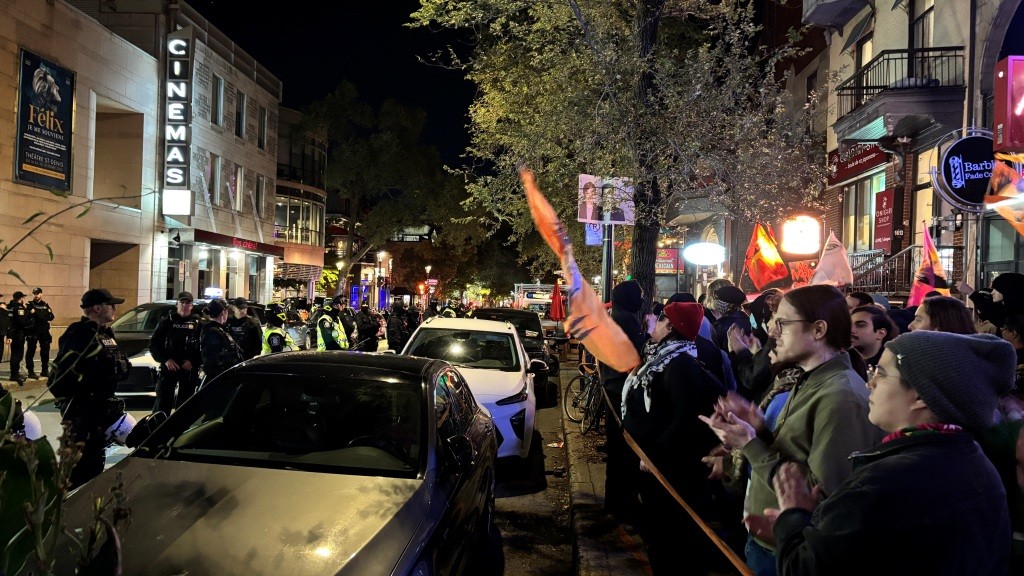
It is just after 1:30 p.m. when the “Dans la rue pour le Québec” march sets off from Place du Canada. Under the November sun, blue-collar and white-collar workers march shoulder to shoulder along Boulevard René-Lévesque. Teachers, parents, and citizens mix together, all responding to the unions’ call to denounce the CAQ government’s “authoritarian drift.”
Some push strollers, others hold flags or homemade signs. Side by side, the women we followed move through the crowd, each wearing her hijab with the same quiet confidence. Despite their different paths, they share the same concern: after being excluded from schools, Bill 94 — a Québec law adopted on October 30, 2025, aimed at strengthening secularism in the education system — now threatens their right to work in daycares and, more broadly, their place in society.
Houda Djilani: refusing invisibility
Long before the march begins, Houda Djilani stands atop the steps of the Marie-Reine-du-Monde Cathedral, sign raised, as if to say: “I am here, I refuse to be erased!” This almost strategic stance seems to directly respond to the sense of invisibility that many hijab-wearing women report feeling in the face of recently adopted laws.
At 34, this pharmaceutical production graduate has redirected her career and is completing a bachelor’s degree in early childhood education. Like many women pursuing this profession, she sees her professional future threatened. “School boards have started calling colleagues to ask them to choose between their hijab and their job,” she reports.
For her, there is no choice: “They will not remove their hijab, they will not give up their identity.”
When she talks about her colleagues, her hands move expressively. She describes them as “brave and competent,” women who are “judged because of their hijab” before their work is even evaluated. Her own path ties her to them: after years of study and career shifts, she simply wants to “contribute, like everyone else.”
.avif)
In the crowd, she senses a tolerant and supportive Québec, the opposite of the “disappointing” and “discouraging” one she hears, she regrets, in certain political speeches and on social media.
The aspiring teacher, who lives in Saint-Léonard, echoes the voices of dozens, even hundreds of women like her who chose to march to defend their rights and the future of their children: “We hope there will be change, whether it’s for labor rights or… We are here for our well-being and for the well-being of everyone.”
Marwa: “Do I still have a place in Québec?”
Further along in the crowd, Marwa* moves forward pushing a double stroller, accompanied by her husband, born in Sherbrooke, a public-sector engineer, and their two young children. She prefers not to use her real name but wants to share her story. Having arrived in Québec at age six, Marwa has lived her whole life here. Yet, she confides, “Today, I’m asking myself a question I never asked before: ‘Do I have a place in Québec?’”
This feeling, the young mother explains, arose with the CAQ coming to power. “We’ve never seen so much racism as we do under the Legault government.” Marwa dreams of becoming a psychologist, and she is not far from completing her degree. But today, she sees her professional future shrinking: “If I want to work in the public system, I will be restricted. In education, it’s already impossible. As a school psychologist, I couldn’t either.” Yet, she insists, “It’s not my hijab I explain to my clients, it’s my expertise.”
Around her, other women share the same concerns, like her sister, an education student now unable to do internships while wearing her hijab, or her children’s educator, protected by the grandfathering clause, whose career progression is now contingent on her hijab. “What does that mean? That women who wear the hijab cannot advance. So, women’s rights are being rolled back!”
Zoubida: a Sisyphean struggle
For hijab-wearing women, opportunities have steadily narrowed over the past few years: first, teaching at all levels in the public system was prohibited by Bill 21 in 2019, and now daycare work is restricted by Bill 94. Zoubida’s journey, forced to change career paths twice, illustrates how gradually the trap has closed.
After passing her exams and obtaining her teaching license, 44-year-old Zoubida Gasmi had to abandon her professional plans when Bill 21 came into effect. “Seeing that I couldn’t teach because of Bill 21, I began training in early childhood education,” she recounts. But the new Bill 94 now thwarts her plans and indefinitely delays her career return.
Walking firmly along Sainte-Catherine Street, Zoubida’s face shows a mix of dismay, anger, and indignation at what she describes as repeated injustice. For her, it’s not just a question of employment but also of dignity: “My hijab is my right. No one can force me to remove it. Québec, Canada, it’s a country of freedom. And I want to exercise that freedom.”
As she walks among families, Zoubida watches children examining signs and slogans. Her own son sometimes asks why she doesn’t teach. “He sees the injustice, he understands,” she says. The succession of laws affects not just adults; it also shapes how the youngest perceive their role models.
Saliha: marching for those who will be affected tomorrow
Further along in the demonstration, Saliha walks with a calm, measured pace. Among the group of hijab-wearing women around her, she stands out as a senior figure. Some seek her gaze as if seeking approval. She smiles gently: “I’m here a bit like the elder, I think,” she says.
An experienced employee at a school in Montréal-Nord, Saliha benefits from the grandfathering clause. She knows she won’t lose her position, but it’s not herself she worries about. “Around me, no one is affected yet, but I’m out here for the others, for our children, for our daughters,” she says, observing the crowd of strollers and teenagers chanting slogans.
She speaks of a slippery slope she sees forming: “If we let this happen now, it will end up like in France. There, they even ban the hijab for students in schools and universities.” In her voice, there is no anger, but a lucid fatigue, that of someone who has seen things deteriorate over the years.
Saliha also highlights what she considers a double standard. “If you want secularism, it has to apply everywhere,” she says, referring to Christmas trees, ubiquitous in schools and public services.
If she marches today, it is to preserve a horizon she sees darkening for the youngest. “We cannot let this close in on them,” she exhales. Her presence that day carries a protective gesture—the stance of a woman walking for those who will continue after her.
Hadjira: removing the hijab to work is not an option
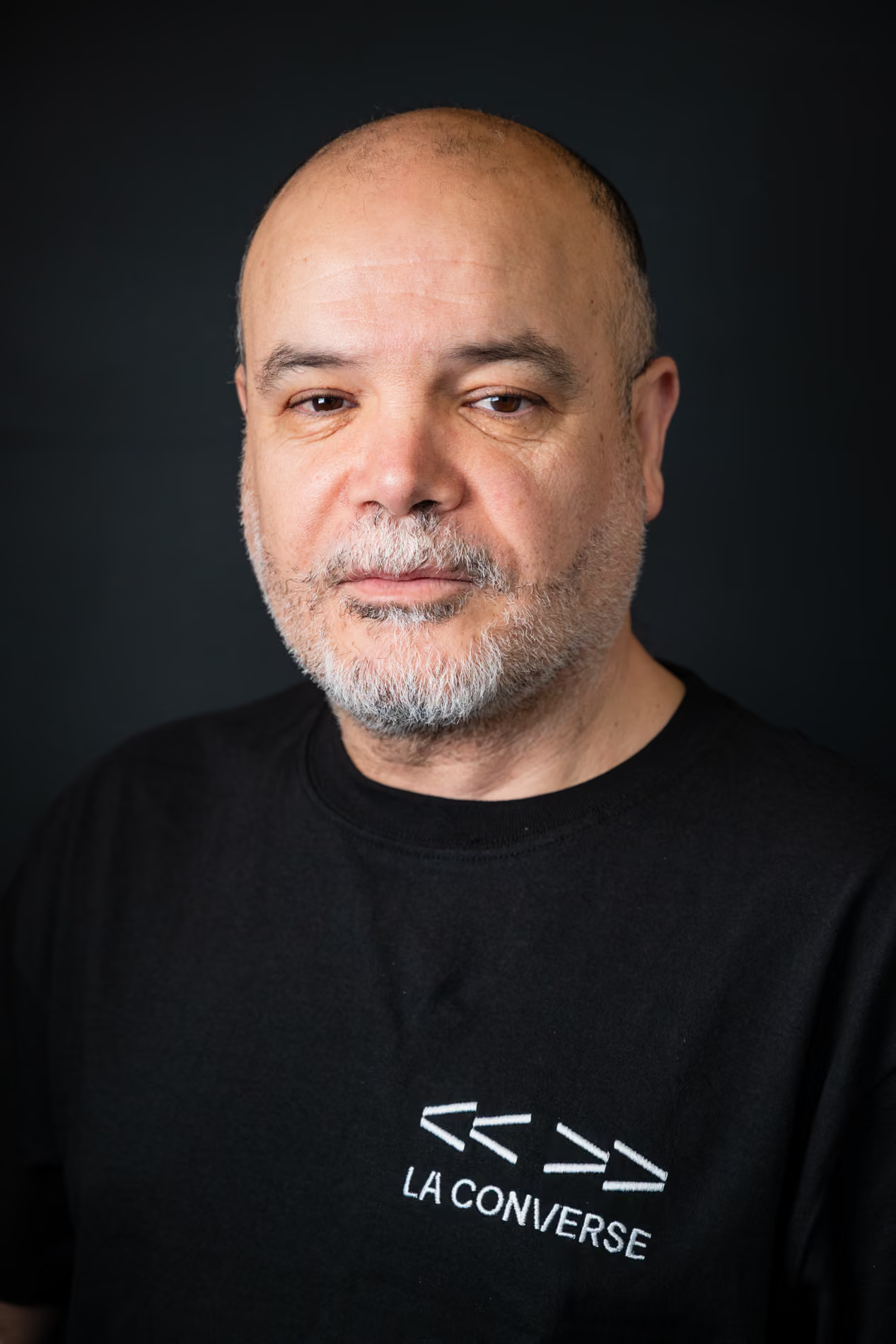
On the eve of the November 29 march, Hadjira Belkacem shares her story on La Converse’s camera. She adjusts her hijab, takes a deep breath, and begins. Her tone is calm, but each sentence carries the weight of tension accumulated over the years.
The community activist, known notably for her involvement in Muslim cemetery issues, is a professional educator who ran her own home daycare for 14 years. After a long, forced break due to illness, Hadjira planned to return to work. Then Bill 94 was passed. “I am questioning myself. Will I go back to work without my scarf? That’s impossible. I’ve worn my scarf since I was 11; I grew up with it,” she says firmly. The woman in her fifties, who arrived in Québec in 2006, sees her clothing style as part of herself. What angers her most is that “a politician would tell me how to dress!”
As she speaks, her anger surfaces. Hadjira thinks of her single-parent colleagues at risk of losing their jobs: “At least I have my husband, my children. But others have no one.” She describes a daily life made heavier by declining purchasing power, compounded by successive laws: “Life here is difficult. Adding even more weight on our shoulders is unfair and inhumane.” For her, the scope of this law goes beyond the labor market, reflecting a broader logic of the CAQ government—a minority seeking to erase Muslim women from public spaces.
In excerpts from the video below, she returns to this sense of shock, the risk of massive professional dropout, and the idea of a collective movement in response to the law.
A March for Dignity and Rights
Throughout the march, protesters mixed together. Spontaneous conversations broke out. Strangers congratulated each other on the diversity represented in the procession. Signs reflected in the building windows as the crowd moved forward with a blend of chants and slogans.
By the end, despite fatigue, the protesters left the square with palpable energy. For Houda, Marwa, Saliha, and Zoubida, the November 29 march was more than a political gesture: it was a way to claim their place in a Québec where access to employment, dignity, and freedom of conscience should not depend on one’s appearance.
Their message is clear: Québec must be a place of freedom and respect for everyone, regardless of their origins or religion.
*Marwa is a pseudonym.