
Last February 26, the day Marbens Dorelus would have celebrated his 22nd birthday Birthday, his parents launched the foundation that bears his name during an event organized in Montreal North. The young man was shot and killed in July 2025 in Anjou. Incorporated as a non-profit organization, the initiative aims to transform a personal tragedy into a collective commitment to the prevention of violence among young people, in a Montreal context where 15-24 year olds remain the most exposed to violent offenses.
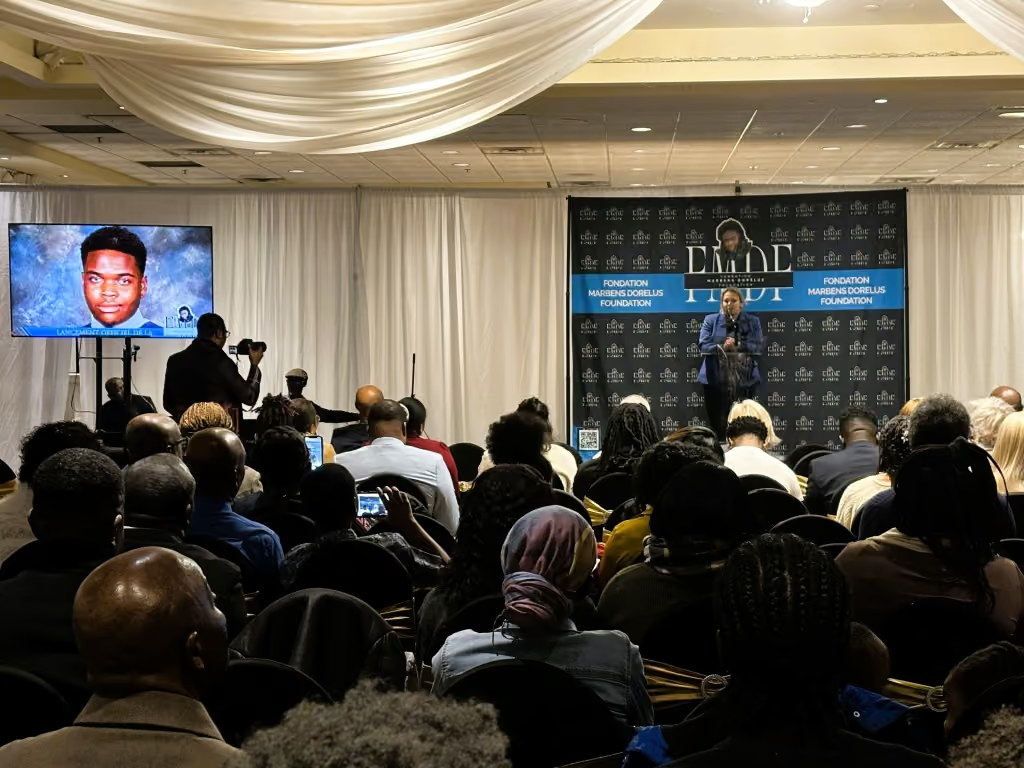
Outside, the cold of a Montreal evening in February captures the faces. Inside the Royal Empire Room, human warmth sets in as the 150 chairs fill up. Coeur de lion, the J.B. King Music song is playing through the speakers. Elected officials from the district, well-known community figures, friends, family and colleagues are there.
“We are not here to rekindle the pain, but to create something bigger than the ordeal.” At the outset, the evening's presenter, Marc Emmanuel Dorcin, sets the tone.
At his request, the room rose to observe a minute of meditation. The silence is dense. Some stare at the ground, others close their eyes to reflect. Marbens was 21 on that fateful day of July 9, 2025. He was “without a history, without a criminal record, unknown to the police”, according to his parents. But that day, he was in the home of a family member in Anjou when an individual broke into the house and shot him several times. To date, the murder has not yet been solved, Mr. Dorelus confirms to us.
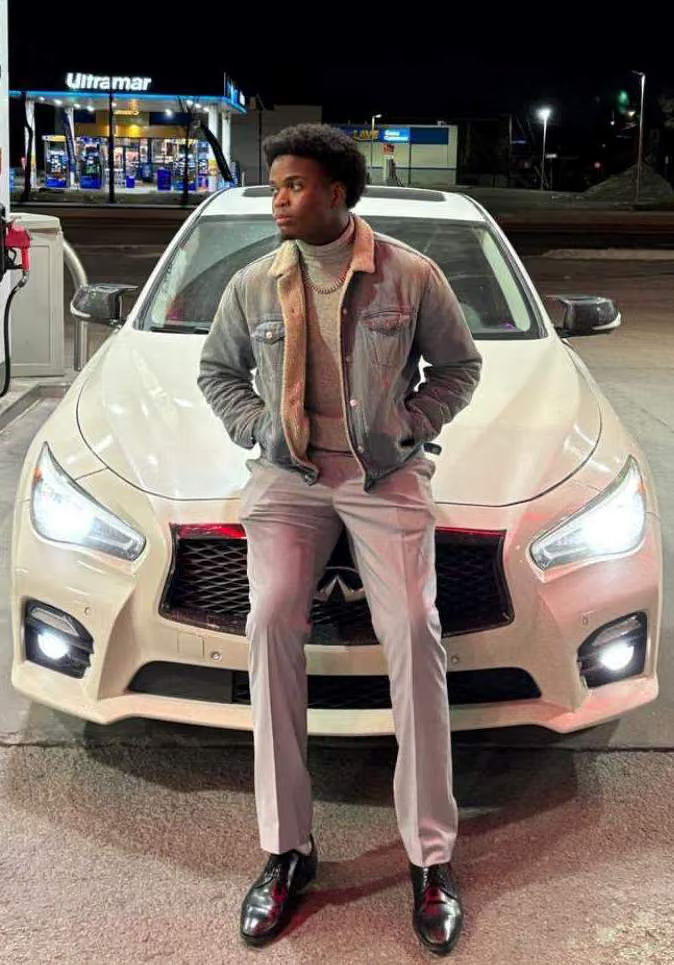
Photo courtesy of the Dorelus family
“We decided not to stay on the ground”
The pivotal moment of the evening was the speech by Obenson Dorelus, father of Marbens and chairman of the foundation's board of directors. Her voice is calm, sometimes firm, sometimes soft. He looks at the room: “On July 9, 2025, the life of our son Marbens Dorelus was taken from him by a criminal act. I shed every tear in my body on July 9 and 10; on July 11, I said to myself, “That's enough.” I made the decision to get up.” The Foundation was born out of this decision. “We chose not to let violence have the last word”, says the speaker.
The organization aims to prevent juvenile delinquency, especially among vulnerable young people aged 12 and over. “If the Foundation succeeds in diverting even one young person from delinquency, it will already be a victory. Because a life is priceless,” says Marbens' father.
“It takes a whole village...”
Recognizing that several organizations are already working with young people in Montréal-Nord and elsewhere in the city, the president says he consulted local actors before launching the foundation. “We didn't want to do another organization. Stakeholders were asked, “What is missing? What is worth doing to complement what you are already doing?” ”, he explains to The Converse.
According to him, one observation has often come up: “There is a lack of support among parents. Parents are not always equipped to recognize certain signs or to supervise their children in the face of certain realities.”
In his speech, Mr. Dorelus said he wanted to “work in collaboration with all actors concerned with the cause of young people.” Because, he continued, “it takes an entire village to raise a child.”
The foundation's strategy is therefore defined as complementary: “When a young person finds support in an organization, but comes home and is alone, something is missing. We want to use parents as a lever.” The objective, he says, is to better equip parents with the techniques of recruitment of young people by gangs and to strengthen communication within households. “12-year-old young people are recruited to do contracts,” he said later in an interview. Parents often don't know what's going on.”
In the words of a brother...
Obenson Dorelus mentions his Christian faith several times. Pastor of his church in Montreal North, he says he draws strength from his belief. “Alone, I could not do it.”
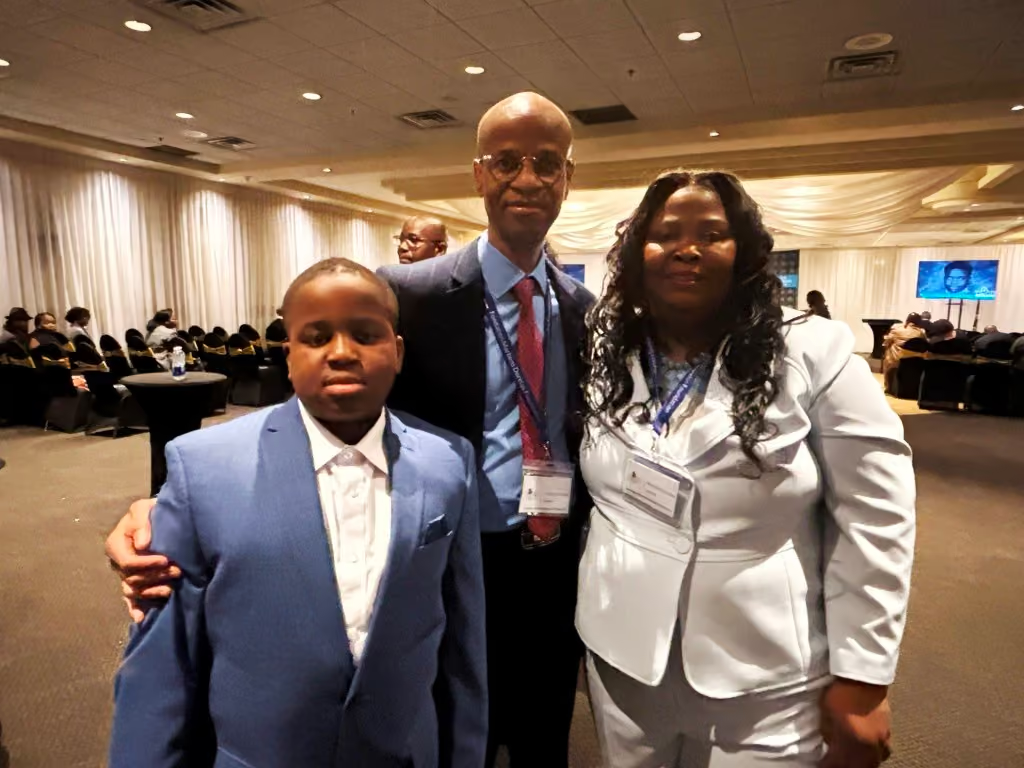
Then comes the testimony of the youngest son in the family, Garbens, aged around ten. Before speaking, he turns to his father and, with a knowing look, asks him to adjust the microphone to his height. A simple and innocent gesture that briefly suspends time. “He was not only my brother, he was also my best friend,” says Garbens, who evokes the memory of an older brother who was present, complicit, protective. “His absence left a huge void in the heart of the whole family.” His voice is calm. In the room, several are quietly wiping their eyes.
Marjorie Daniel oversees the organization of the event. She gives instructions to the volunteers, takes care of the details, welcomes the guests. “We are suffering, but we don't want to stay on the ground. It's not going to solve the problem,” she summarizes in an interview. She talks about prevention, listening to young people, and strengthening the family unit. “Often, when there is no complicity between parents and young people, the young people go outside looking for what they cannot find at home.”
A portrait painted by others
On the screens installed on both sides of the room, the videos start to scroll. Filmed with telephones, sometimes in a bedroom, sometimes in a car or in front of a neutral wall, they have the simplicity of messages sent between loved ones. The voices shake sometimes. Phrases are finding their way. But all converge on the same portrait.
Alain Nathan Dineland discusses the shock of the announcement. “It put me in a dark place. Not just because my friend was gone, but also because I saw the sadness of his family... and all of our friends.”
“He was a brother. Truly a brother, summarizes another of his friends. We grew up together... and when I came back to Canada, he was still there. It's always the same. I never felt alone.” He talks about a “pure” friendship, without competition. “He always said, “If you win, I win.””
Memories are real. Mechekaiana Michel imagines him “playing basketball”, “making noise with his car” or staying at home “playing on his PS5”. Tweussy Joseph talks about his “joy of life”, his “projects”, his “dreams to achieve”. “No longer having a text message that comes out of nowhere to say “how are you?” , it leaves a void.”
Alain-Nathan broadens his point: “We have to stop the violence with young people in Montreal. This summer, a lot of other young people like my friend passed away. Several families have experienced the same sadness.”
In the room, parents listen silently. Each testimony adds a line to the face projected on the screen. A brother, a friend, a support, a presence, a young person whose absence continues to be felt in the daily lives of those who remain.
Preventing rather than curing
Christine Black, mayor of the borough of Montreal Nord, but also a family friend, is also present at this evening. “There are no words to describe what you are going through. We learn to live with it, but it stays with us until the end of our life,” she confides as she speaks.
She highlights the resilience of parents and the importance of local prevention initiatives. “As mayor, in the past year, I went to two funerals for young people under 20. It's terrible.”
Recent data confirms that the issue goes beyond the neighborhood in which we are located. According to the report Violence committed and suffered by young people in the Montreal agglomeration, carried out in 2023 by the International Center for the Prevention of Crime, 15-24 year olds remain the group most exposed to violent crimes in the city. The study also notes an increase in offences involving firearms from 2018 to 2022, in a post-pandemic context marked by increased social tensions.
In Montreal, the prevention of youth violence is based on a combination of municipal, community and police initiatives. Boroughs have budgets dedicated to supporting local organizations, but access to these funds requires formal recognition and a certain history of activities.
Asked about the borough's concrete commitments, the mayor recalled that Montreal Nord already supports several community prevention initiatives. Last December, The borough announced the allocation of just over $1 million from provincial and federal sources and $217,000 from its own operating budget. This funding will support 12 local organizations in 2026 so that they carry out projects to prevent and combat neighborhood violence and keep youth away from it.
In this context, the Marbens Dorelus Foundation is a new player in the start-up phase, seeking to find its place in an already structured ecosystem.
On August 11, a resolution was adopted by his council to pay tribute to Marbens's involvement in the community. This resolution does not include financial assistance as the foundation was not yet incorporated at the time.
A name that becomes action
Administratively, the Marbens Dorelus Foundation is set up as a non-profit organization (NPO), which works directly with people in the field, says Obenson Dorelus. “I can't bring my son back,” he says. But I can prevent other parents from going through what we are going through.”
Created about six months ago, the organization is still in the structuring phase. She does not yet have a charitable number with the Canada Revenue Agency or the necessary administrative recognition. “We are working with an expert to finalize the administrative procedures. There are rules, deadlines. We are new, there are still things to do,” he summarizes.
For the moment, the activities are financed by the family and by a few one-off donations, and no grant request has yet been submitted to the borough or the City, says the president of the Board of Directors.
At the end of the ceremony, the presenter invites the room to get up to greet the parents. The ovation was sustained. In the rows, emotion circulates without brilliance. The hugs are multiplying, the conversations are getting longer. The community is gradually leaving the room, for many, with the feeling that they have witnessed not only a tribute, but also a starting point.
Did you like this article?
Every week, stories like this are sent directly to your inbox.