


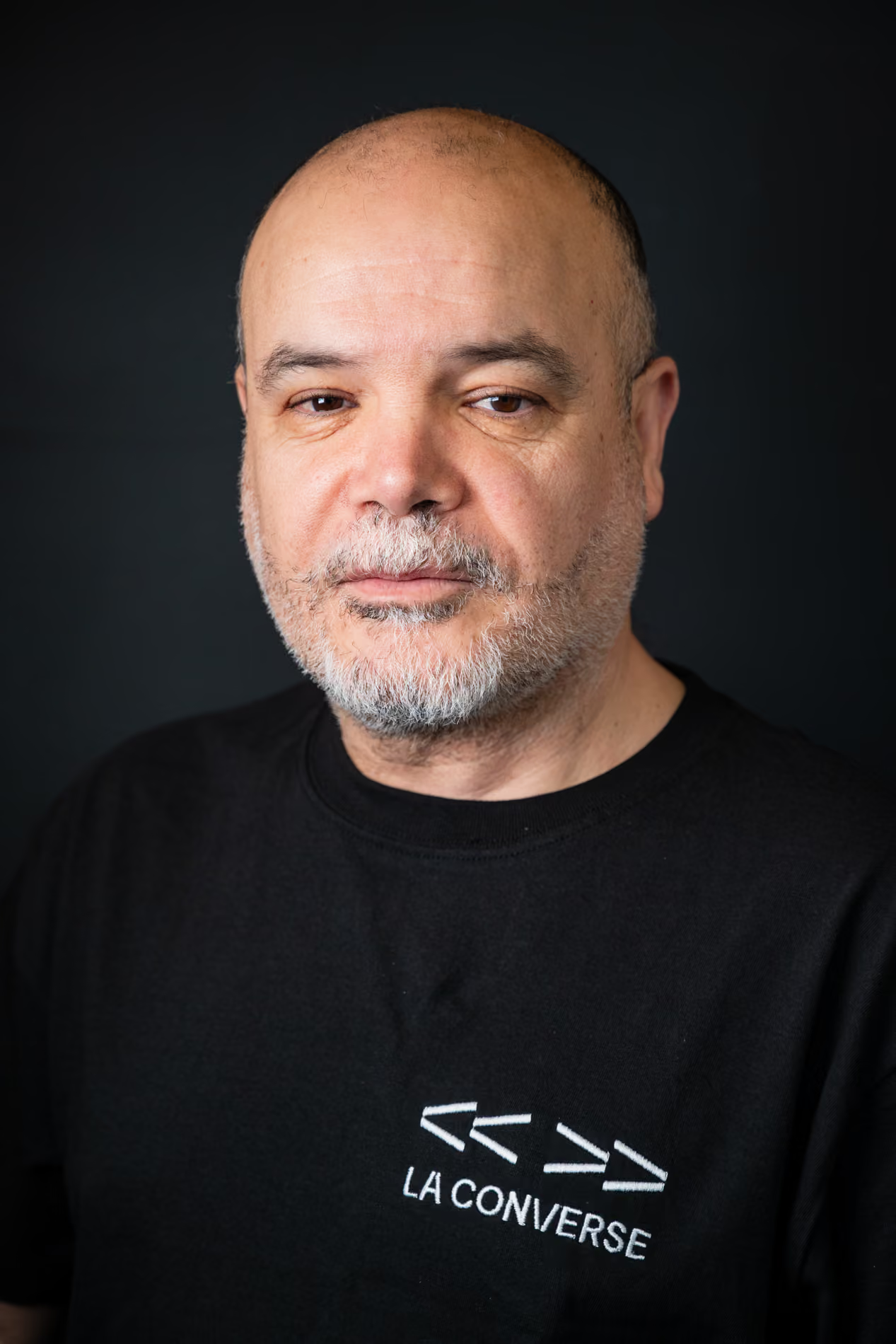

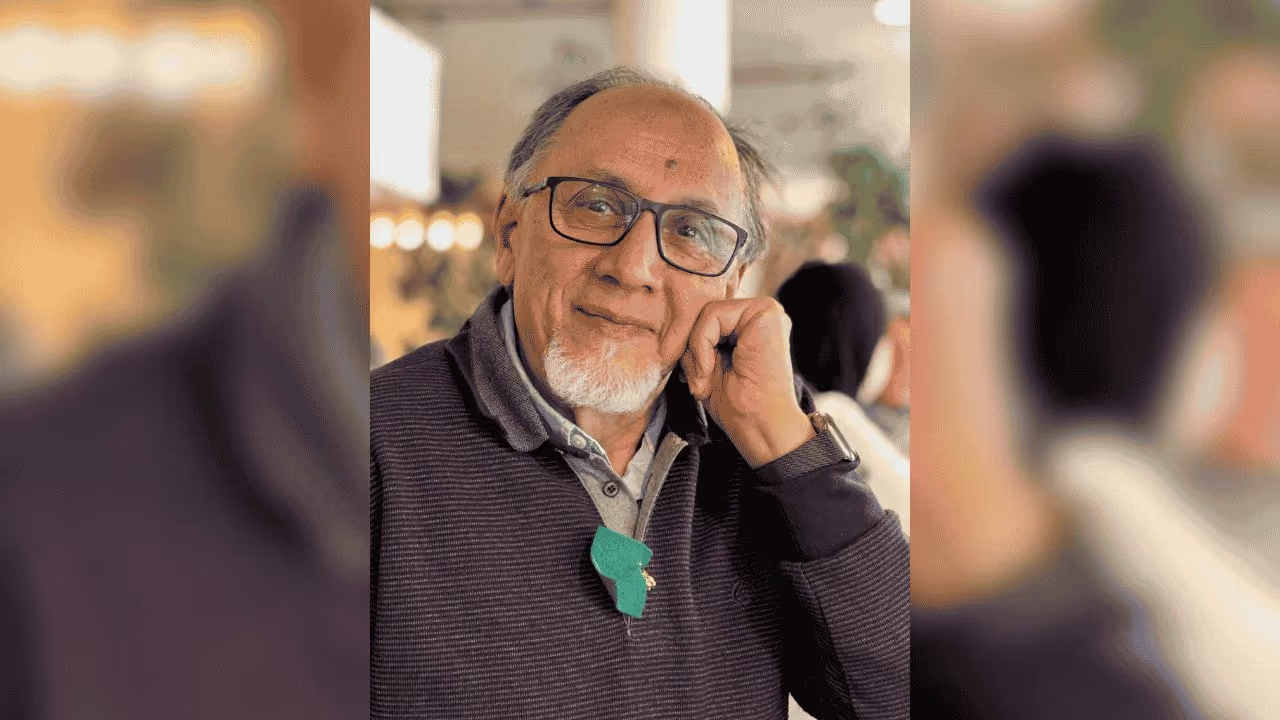
In Quebec, the name Boufeldja Benabdallah almost instantly evokes the same constellation of references: the Islamic Cultural Center, on January 29, 2017, a measured voice in a debate that is rarely measured. He is credited with restraint, a capacity for dialogue, a kind of quiet consistency in the face of polarization. But the man, on the other hand, is overflowing on all sides. Its story does not begin with the attack or with the visibility that followed. It takes root in Tlemcen, in western Algeria, and extends over several decades, several continents, through bifurcations that nothing really predicted.
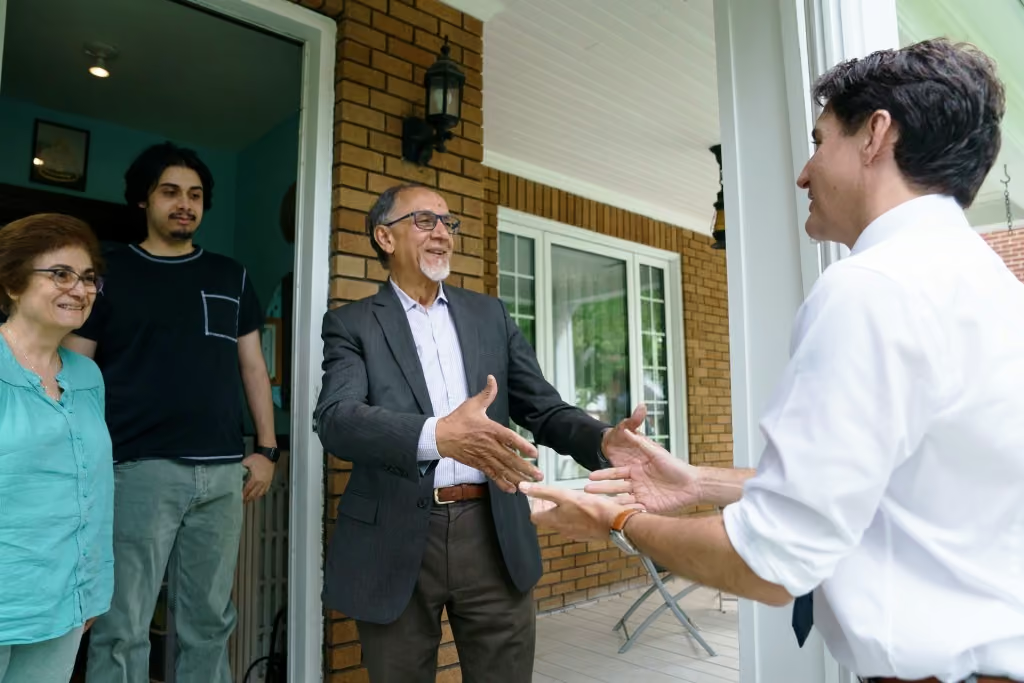
At La Boîte à Pain, where he usually does, Boufeldja Benabdallah is already settled, waiting for our appointment. Straight silhouette despite age, a sober suit, a lively look behind thin glasses, his presence exudes a sense of calm. In some photos, in particular alongside Justin Trudeau, we see him smiling widely, in a warm, almost familiar attitude. During more than two hours of interview, this same availability comes up constantly: he listens for a long time, then answers accurately, taking the time to go over the details. The voice is calm, sometimes punctuated by a discreet smile, sometimes crossed by an emotion that he does not try to mask.
On this day, the bakery is lively. Conversations intersect, orders follow one another. He stays focused, as if he were setting up a zone of calm around him. The venue is located in front of the Islamic Cultural Center of Quebec, on Chemin Sainte-Foy, and recalls another scene, much heavier. On January 29, 2017, after the attack, worshipers found refuge here and were welcomed spontaneously by the owner. He speaks of it as a gesture that cannot be forgotten — an immediate human response to violence.
Tlemcen, origin of a journey
Boufeldja Benabdallah was born in 1948 in Tlemcen, in Algeria. He insists little on dates, more on places and atmospheres. The neighborhood where he grew up is very old, made up of narrow streets and houses built using techniques inherited from Roman times. “Solid bricks, arranged horizontally and obliquely to give strength,” he describes, as if going back in time.
His family is modest. It evokes a mixture of origins Amazigh, Arab, Mediterranean, without making it a central element of its identity. “All this makes North Africa a melting pot”, he summarizes. He is mainly talking about a territory brimming with influences, languages and stories.
His childhood was also marked by scouting, which he discovered afterIndependence of Algeria in 1962. The experience structures him deeply. “Living a year of scouting is like living 10 years in civilian life,” he says. Camps, travel, collective learning: these are all elements that broaden her horizons well beyond Tlemcen. He travelled across the country, discovered its regions, and captured its contrasts. This early mobility gives him a form of ease in the face of displacement that will come back later.
Independence, in fact, remains a strong point of reference. He talks about it as a rare, almost unreal moment of intensity. “We celebrated for a week. I didn't even go home anymore.” Behind this sentence, there is a generation that is changing, moving from colonial domination to a sovereignty that has yet to be built.
Quebec, a land of learning
At 21, he left Algeria for the first time and arrived in Canada, where he obtained a scholarship. At the end of summer 1969, he first arrived in Montreal, then moved to Quebec City to study at Laval University in forestry and geodesy.
The start is seamless. When he arrived on campus, his room was not ready. What to do, he who doesn't know anyone? An employee then suggests that he turn to a nearby church. He goes there, knocks on the door and is welcomed by a nun who offers him a room, then lets him settle in. He will stay there for a week, fed and housed, without compensation. This welcome will mark him forever. “I was completely happy to see this generosity,” he says. The episode comes up often in his story. Not as an anecdote, but as a starting point. A first concrete experience of what he would later call hospitality.
The rest follows, in successive layers. First summer, then autumn, which he describes as “a fairy tale”. The maples, the colors, the campus surrounded by woods. The winter then, harsher, but not entirely foreign. In Tlemcen, he says, snow exists, even if it does not fall in the same quantities.
At the university, its integration is rapid. His mathematical skills surprise his classmates, “especially when there were courses in physics, mathematics, material resistance... all the calculations, I played with”, he recalls. Quebec students are adopting it, exchanges are multiplying, in and out of class: theater, outings, discussions. He is learning local expressions and sharing his own. Traffic sets in.
But he's not talking about belonging yet. “I felt like a guest who has everything in my hands,” he says. The expression “at home” seemed too strong to him at that moment.
Distance and nostalgia
Nostalgia is gradually appearing. It is more insistent on specific occasions: religious holidays, periods of fasting, family events in which he cannot participate. The link with Algeria then passes through letters.
He describes a specific ritual: in the entrance to his pavilion, a row of metal lockers. The student always slows down at this point, then he makes a gesture that becomes a reflex: look, check, wait... and most of the time, his box is empty.
When a letter arrives, the emotion is immediate. “When I was reading, it ended in tears,” he confides. The words of the family, the greetings, the news: everything brings him back to a distance that cannot be fulfilled.
“There is always a little something that is fundamental and that cannot be found in the country that welcomed us”, he says, speaking of the family atmosphere, smells, voices. Quebec offers opportunities, study conditions, and stability, but for young students, part of reality remains elsewhere.
An encounter that brings lives back
At La Boîte à Pain, the interview progresses, punctuated by memories and silences, when something unexpected happens. At the next table, three people in their fifties are talking. A woman, sitting opposite Mr. Benabdallah, seems to listen at times. Then, she gets up, barely hesitates and approaches, before simply asking him if he is Boufeldja Benabdallah.
When he agrees, she shows up. She said they met several decades ago, when her father worked in the wood industry. As soon as the words are spoken, something changes. The faces come to life, the eyes are fixed differently, and the memory opens suddenly, to let out sweet memories of friendship.
One of the two men at his table, his brother, joins them. He too recognizes the name, the places, the times. Very quickly, the sentences follow one another, the names of countries appear, the fragments of trajectories stick together. We are talking about construction sites, trips, a time when roads led to Algeria. The brother and sister then recount these trips, made with their father, across the country. The landscapes, the stages, the impressions left by these stays come back with precision. “Magnificent memories,” she says, almost as if it were obvious.
Around the table, time contracts. What was in the distant past suddenly becomes the present. The conversation overflows, crosses generations, connects trajectories that nothing seemed likely to bring together here.
Returns, bifurcations and an international career
After his studies, Boufeldja Benabdallah returned to Algeria with the idea of settling there. There he works in the forest sector, participates in projects related to the fight against desertification, especially in the Djelfa region. It is part of a time when the country is seeking to structure its resources, to experiment, to produce knowledge.
At the same time, her personal life is changing. In Quebec, he meets a Quebec student, whom he marries, and together, they decide to settle in Algeria. The family welcome was initially tense in the face of this unexpected marriage, but then things quickly changed. “They found an extraordinary person in my wife. She was adopted, and my father loved her, even though he did not speak French,” recalls Mr. Benabdallah. But the context complicates things. Regional tensions, the constraints of military service, and cultural distance weigh on the balance of the couple. A few years later, it was necessary to return to Quebec.
The rest of his career is less visible, but remains structuring. He began an international career in the wood industry. He works for projects in Africa, Latin America, and South East Asia, and leads programs and negotiations.
He describes an intense period, made up of constant trips, hotels, and quick decisions. “I was always in my suitcase,” he summarizes. It contributes to the development of projects, to the structure of networks, to the circulation of resources. This experience enriched her eyes, but took her too far away from her family. “My wife was very unhappy. I had three kids too, so I went home.”
Speak up, in spite of yourself
It was also during this period that he participated in a scientific collaboration that would contribute to the dissemination of stevia, a sugar substitute, on a large scale. Mandated as part of exchanges between Quebec and the University of Chiang Mai, in Thailand, he discovered researchers who were looking for an alternative to poppy cultivation in the Golden Triangle region. It makes it easier for them to come to Quebec laboratories in Saint-Hyacinthe and Montreal. “From that moment on, the world knew about stevia,” he summarizes.
At the same time, the international context is changing. Wars, crises, tensions involving Muslim-majority countries. In Quebec public spaces, questions are multiplying. “You Muslims... why? ” He regularly finds himself in a position to respond, explain, and contextualize.
In fact, he was already involved in politics at university. “We were doing politics without being politicians,” he says. The debates are sometimes lively, and even tense with some professors, he recalls, and his positions are assertive. A way of being part of the public space that foreshadows its future role.
From community involvement to public figure
Over the years, her community involvement grew. He participated in the founding of the Islamic Cultural Center of Quebec, which became a structuring place for the Muslim community in the region. In addition to being a place of worship, the space plays a social, educational and cultural role.
Then came the attack at the Quebec mosque — and the tipping point. The event unwittingly throws him into the center of political and media attention. It becomes a voice that is listened to, requested, expected. Since then, his participation in public debate has remained constant: avoid escalation, maintain a space for dialogue, and recall the complexity of trajectories.
Today, Boufeldja Benabdallah recounts her journey without trying to alleviate its contradictions. Memories pass from Algeria to Quebec, from professional trips to community commitments, with constant back and forth between times and places.
But as the interview progresses, a thread always comes up: Algeria. The country that left in 1969 remains present in the way he speaks, in the details he remembers, in the emotion that ends up winning his voice. The landscapes, the family, the atmospheres, the smells: everything still seems close, despite the decades and the distance.
In the end, the sentences slow down. Emotion is becoming more difficult to contain. As if, behind the public figure shaped by the years in Quebec, the young man who left Tlemcen one day with a scholarship and the idea of coming back remained intact.
.jpg)
.avif)
.avif)