

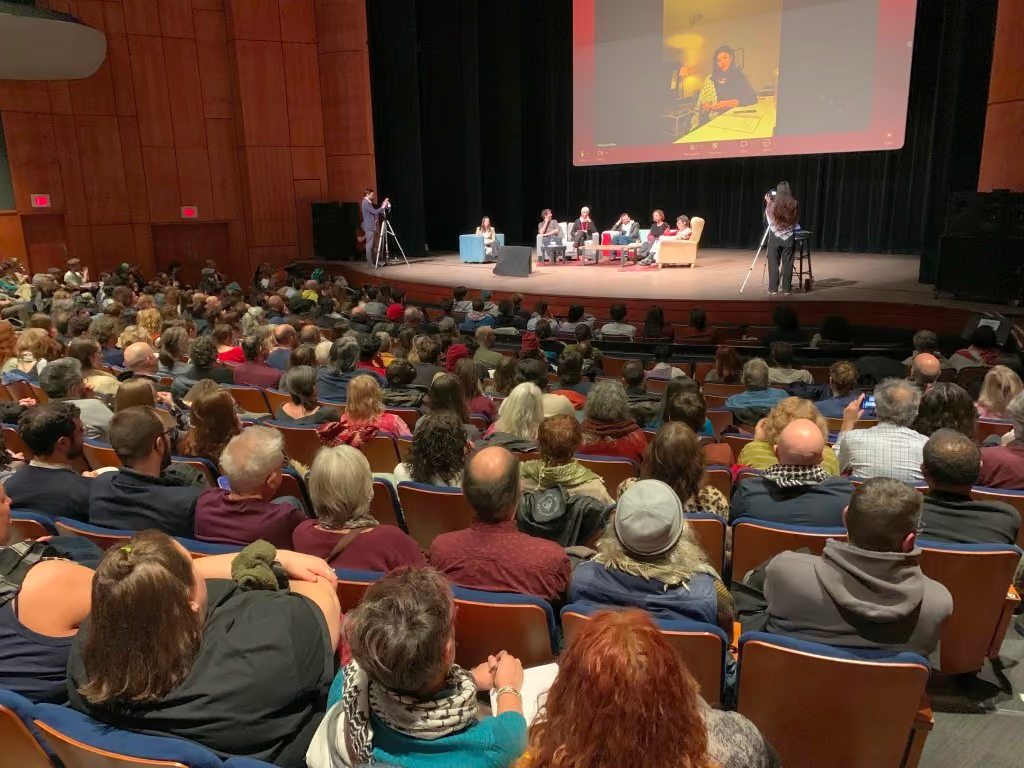
Unable to travel to Montreal, MEP Rima Hassan spoke by videoconference in front of nearly a thousand people gathered at the Pierre-Mercure Hall on 31 March. Between denunciation of the rise of the extreme right, criticism of the shortcomings of international law and the centrality of the Palestinian cause, the speakers called for a convergence of struggles, in a context marked by geopolitical tensions and debates on the positioning of the left in Quebec.
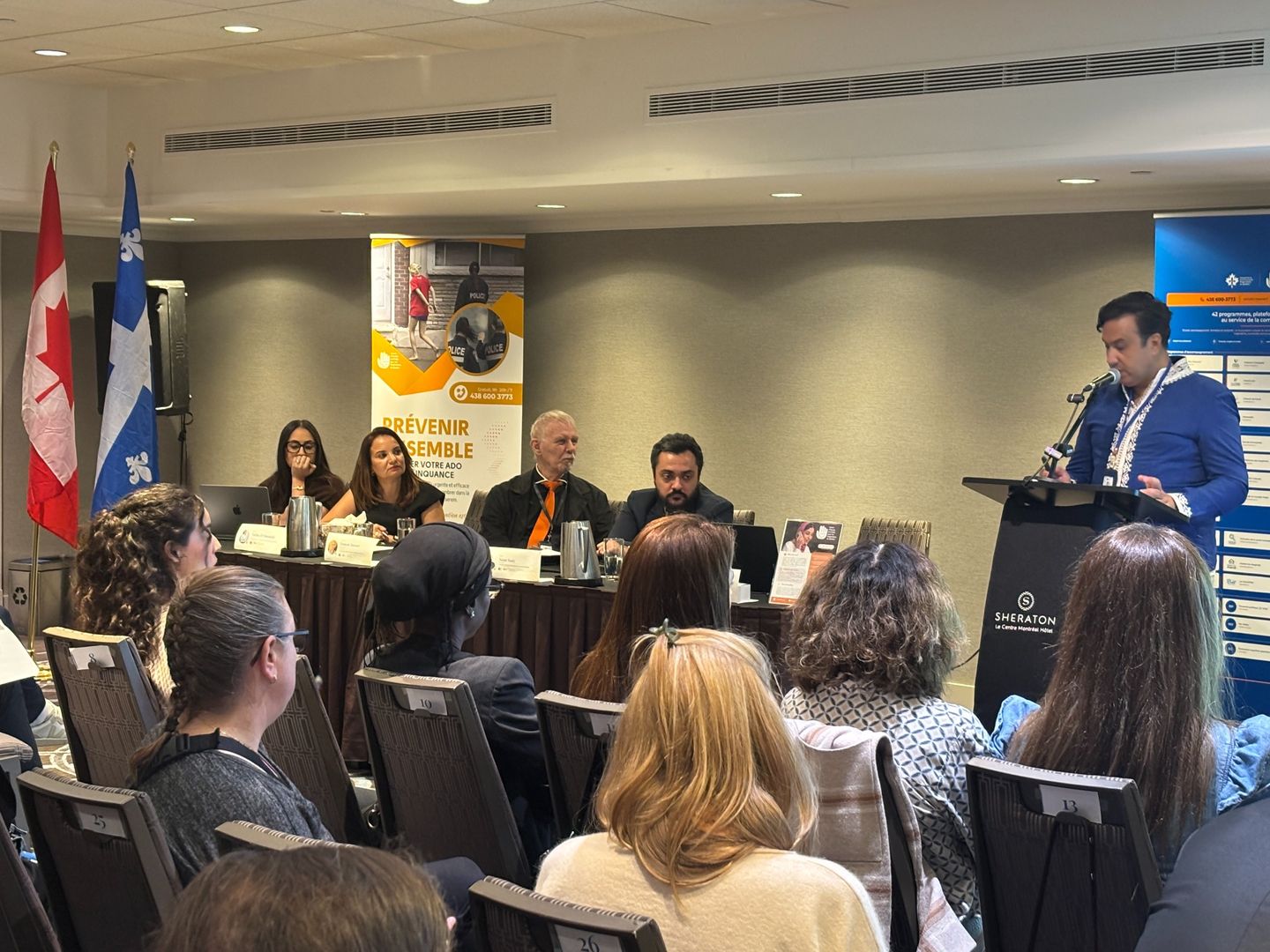
That evening, nearly a thousand people filled the Pierre-Mercure Hall at the University of Quebec in Montreal. A diverse crowd, dominated by numerous young people and students, attentive and responsive. Outside, in the lobby, mobilization begins even before entering the room. Kiosks are lining up: the Ripositions collective, the UQAM student union and Palestine solidarity groups are there. Alternatives activists distribute their newspaper, the collective, for free Global Sumud Flotilla is collecting donations for a humanitarian flotilla leaving for Gaza in a few days, and Amnesty International is seeking signatures against GardaWorld's collaboration with ICE, American immigration services.
Inside, the interventions are punctuated by applause, sometimes laughter. At a distance, the Franco-Palestinian Rima Hassan intervenes several times. Born in a refugee camp in Syria, she is now a member of the European Parliament under the banner of the left-wing party La France Insoumise. For nearly three hours, she addressed the audience and exchanged with the members of the panel, often adjusting her keffiyeh, which she chose to wear on one shoulder. Despite the distance imposed by the screen, the audience reacts with enthusiasm and complicity to his analyses and his humorous traits.
But everything is reversed when L'Insoumise abandons the light tone and affirms, with a tremolo in her voice that she struggles to hide: “It's too late for the Palestinians.” In the room, the room was stunned by these emotionally-charged words. However, she qualified her words by immediately refocusing the idea on The Gaza Strip, 90% destroyed, she said. Far from any resignation, she immediately shifts the burden of responsibility: “It is precisely up to the States [...] to take stock of their policies”, calling on governments to “ask for forgiveness” and warning for the future: “The next territory is the West Bank.” At the same time, she criticizes a “complacent left [...]”, reinserting her words in a logic of political confrontation rather than abandonment..
Blocked from entering Canada
Due to the lack of a visa, it is through her cell phone that Rima Hassan speaks. Her electronic travel authorization (AVE), although validated at the beginning, was the subject of a last-minute review. “The reasons given are the absence of mention of a refusal of a visa or entry into the territory of a country (Israel), as well as the absence of mention of an alleged criminal offense, arrest, indictment or conviction,” she said in a post on social networks.
From the start, she describes a “Kafkaesque situation.” Arriving at the airport to take her flight to Montreal, she is told by the border police that she must first produce a certain number of documents: all the evidence of her professional experiences for 10 years, all her bank statements for two years, all her proofs of residence for 10 years, etc. She must also fill out a family file, as well as give evidence and court documents, in addition to a copy of the locker. “Clearly, it was impossible for me to produce them in half an hour, an hour before the counter closes for boarding.” She decides: “It was really done [...] to make it impossible for me to travel”; then, she denounces “a question of censorship or intimidation”.
Interviewed on the sidelines of the event, Amir Khadir, former deputy for Quebec Solidaire, directly links the impediment of Rima Hassan to a wider political climate. “It is unfortunate to see that Canada continues to suppress any speech independent of Palestine,” he said, adding this episode to a dynamic that he considers to be systemic. He denounces a contradiction between the discourse and the practices of the federal government: “The Canadian government bombs its torso to pretend that it is independent from the United States, and is going to make nice speeches in Davos. In fact, we are continuing the same absolutely despicable routine.” According to him, this continuity is reflected in an absence of concrete measures: “Not doing anything concrete against Israel [...] doing nothing concrete to disassociate ourselves from the actions carried out by the United States.”
He also links this impediment to internal political pressure: “Everyone deplores the ability of the Israeli lobby to dictate things.” Canadian Jewish organizations welcomed the fact that the guest was prevented from entering Canada on their social networks. B'nai Brith even alleged that the decision of the Canada Border Services Agency (CBSA) was made based on information he had provided.
Contacted by The Converse, the Department of Immigration, Refugees and Citizenship of Canada indicates that it cannot “comment on individual cases” due to privacy laws. In a written response, however, the department states that “decisions concerning the issuance of travel documents are made [...] on a case-by-case basis” and that applicants must “meet the requirements set out in Canadian law.” He recalls that an eTA “does not guarantee entry into Canada” and can be cancelled, especially in the event of information considered incomplete or inaccurate. The ministry does not respond to the case of Rima Hassan, and avoids confirming or denying having responded to requests from Jewish organizations. He notes, however, that “a person cannot be refused entry to Canada based on personal beliefs or political opinions,” adding that travelers can reapply once the reasons for the refusal have been resolved.
On the same question, Nimâ Machouf, the presenter of the conference, denounces a “double standard” that she considers “appalling”. On the sidelines of the conference, she pointed to a direct contradiction: “The Canadian government does not allow Rima Hassan to come, but allows Israeli soldiers to give courses and conferences in Quebec schools [see box below].” For her, this situation calls for accountability.
It should be noted, however, that not all Canadian Jewish organizations have adopted this position. Besides, Independent Jewish Voices (VJI) is one of the organizers of the conference in which Rima Hassan was supposed to participate.
Convergence of struggles, Palestine and the crisis of international law
As soon as the conference opened, Vanessa Gordon, a member of the Alternatives collective, co-organizer of the event, set the tone: “The expansion of the extreme right and fascism calls for the construction of a strong political movement [...] emancipatory, decolonial, inclusive.” She links this need to a historical trajectory: “More than 40 years of neoliberalism have led to social fragmentation and a generalized feeling of powerlessness.” She links this need to a historical trajectory: “More than 40 years of neoliberalism have led to social fragmentation and a generalized feeling of powerlessness.”
In this context, Palestine becomes central. “We are generally stuck in the throat of the world, no one will be able to swallow us up,” says Rima Hassan, quoting the Palestinian poet and diplomat Elias Sanbar about the place occupied by the Palestinian cause today. Based on this idea, she redefines the issue: “Palestine really needs to be understood as a collective liberation struggle rather than as a national liberation struggle.”
This articulation leads to a criticism of international law. “The problem is not the law [...] everything depends on political will”, she says, denouncing the lack of action against Israel, as well as the double standards used by Western powers in resolving conflicts: “There is a political will to stop crimes in Ukraine. There is no will for Israel.”
The diagnosis is shared: international law is weakened, even instrumentalized. The journalist and essayist Émilie Nicolas takes up the idea by affirming that international law presents “blind spots”, having been designed “when very few nations were independent” and now producing a “collective dissonance”.
Gaza, Western responsibilities and the transformation of the right
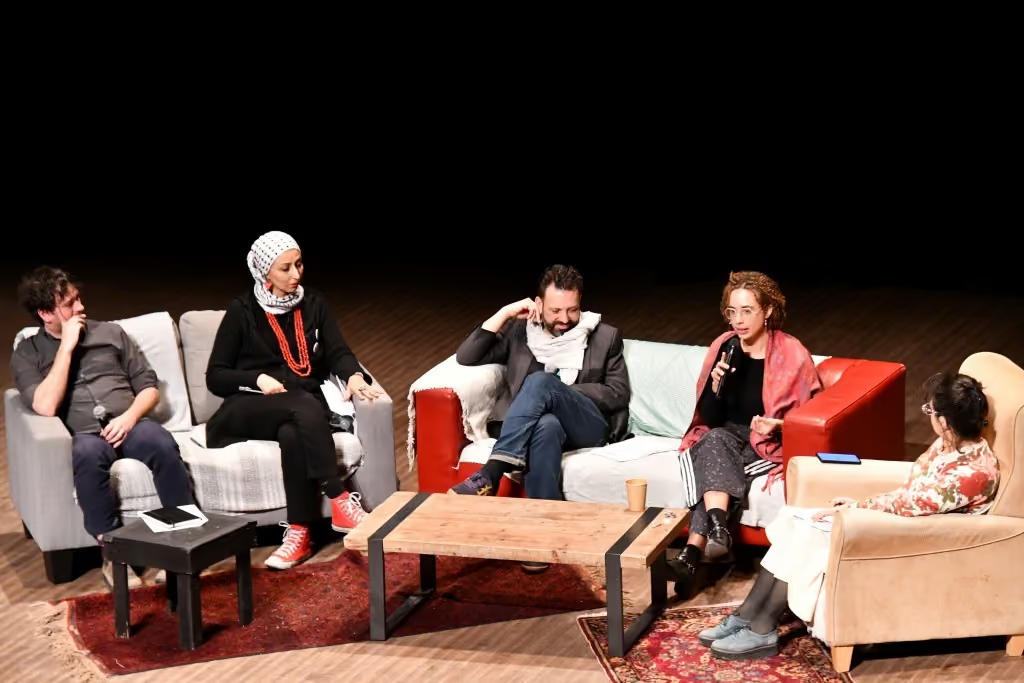
In addition to Émilie Nicolas, the presenter of the debate, Nimâ Machouf, leads a panel composed of Jonathan Durand Folco, an essayist and university professor, the deputy of Quebec Solidaire and representative of the Maurice-Richard constituency, Haroun Bouazzi, and Haroun Bouazzi, and Safa Chebbi, director of the Quebec Observatory of Racial Inequalities. Half of the panel, namely Rima Hassan, Nimâ Machouf and Safa Chebbi, were part of the Freedom Flotilla, organized in 2025 to break through the Israeli blockade of Gaza. The ships had been intercepted.
Exchanges on international law then refer to the discussion on Gaza and the concept of complicity, which, for Rima Hassan, is based on two criteria: to have knowledge and to provide logistical assistance. “These policies are made in our name”, insists the MEP, to demonstrate that the argument transfers responsibility to citizens.
Safa Chebbi anchors this statement in the Quebec context: “There are arms companies [...] in which public money is invested.” She underlines an indirect reality: “We do not provide weapons directly, but parts that make it possible to manufacture them.” Her demonstration, supported by figures, presents a war economy integrated into local economic logic through entities that she names.
At the same time, Jonathan Durand Folco analyzes the evolution of the right and distinguishes several strategies: “There are some who use the language of law to discriminate”, while others do away with it. In the case of Trump, he says, it is rather: “I don't give a shit about the rules.” He also warns that international coordination is under way. “They are in the process of organizing themselves,” says Mr. Durand Folco, speaking of Western regimes that are transforming into “authoritarian democracies.”
These interventions converge on the same observation: weakening of legal frameworks and recomposition of power relationships at the international level.
A committed room, between local roots and international dynamics
More locally, a question from the public questioned a certain “reluctance” of the Quebec left in the face of an extreme right considered offensive. To this critical reading, Haroun Bouazzi takes a more nuanced view, rooted in local mobilizations. “For me, I am very optimistic because there are a lot of courageous leftists in Quebec,” he says, citing the camps in front of the Caisse de Depot, the massive strikes in public services or even the mobilizations of the community sector. However, he distinguishes civil society from the partisan sphere: “I won't talk too much about the political left [...] but it needs this base in order to be more and more courageous.”
The testimonies collected in the room indicate an attentive reception, but also full of concerns and questions. A student, who prefers to remain anonymous, is enthusiastic “to see that there are several people fighting for the Palestinian cause”, but says she sees “a rise of the right, of the extreme right [...] as much locally as in the world”, an evolution that, according to her, makes it necessary “to come together” and to “think collectively” about the answers to be provided. Another student mentions, for her part, a need for clearer political references, believing that the evening allows “to better understand the links between what is happening elsewhere and here”, in particular on the issues of racism, colonialism and student mobilization.
In the discussions, the same concern comes up: how to translate these observations into concrete actions? Houssam Sabouni, who came to attend the conference to hear Rima Hassan, expresses this concern in direct terms: “If we do not meet, if we do not try to think of ways to counter the rise of fascism, it will come, it will affect everyone.” Between the desire to get involved, the need for tools and questions about the forms of action to be preferred, these voices sketch the portrait of an audience in search of structures. in the face of a context perceived as increasingly unstable.
The evening is coming to an end; the atmosphere is a mixture of concern and mobilization. The reactions of the public reflect a strong involvement. When Haroun Bouazzi launches” Siamo all... ”, the room answers in chorus:” Antifascisti ! The slogan, which means “We are all anti-fascists! ”, originated in Italy in the 1920s, at the heart of the mobilizations against the Benito Mussolini regime.
Arrest in France
Two days after the conference, Rima Hassan was arrested in France and then released. His arrest was not related to this conference, but was linked to an accusation of promoting terrorism for relaying a quote by Kozo Okamoto talking about the Palestinian cause and the resistance to oppression. This member of a militant organization called the “Japanese Red Army” had carried out a massacre at an Israeli airport in 1972.
Rima Hassan has been released in preparation for her hearing, which will take place on 7 July. Jean-Luc-Mélenchon, founder of La France Insoumise, denounced this arrest, citing parliamentary immunity. Friday, the MEP Denounced the multiplication of proceedings against him, considering that he was the subject of “judicial harassment” because of his political positions.
Israeli soldiers invited to Montreal schools
The presence of Israeli soldiers in two Jewish private schools in Montreal recently aroused political controversy in Quebec. According to an article published on February 26 in The Press, active or former members of the Israeli army have been invited several times to give lectures to students, sometimes as part of activities that include simulated military training.
The Minister of Education, Sonia LeBel, considered the situation “extremely worrying” and launched audits to assess the nature of these interventions and their compliance with the rules governing subsidized institutions.
On the political level, several opposition parties have denounced these visits, considering them incompatible with the role of educational institutions, especially in the context of the war in Gaza.