

In several Montreal neighbourhoods where issues of violence and high dropout rates persist, a number of crime prevention organizations have seen their funding applications rejected under the Quebec Program for Crime Prevention. In Saint-Michel, for example, out of about ten locally submitted projects, only one was selected, and it was only partially funded. On the ground, the consequences of this instability are already being felt: services are suspended, activities are cancelled, outreach workers are leaving. And in the background, young people are left without support in already fragile neighbourhoods.
In the large hall of the Chalet Kent youth centre in Côte-des-Neiges, around thirty teenagers shout, laugh, and call out to each other in an almost deafening uproar. “Simon says!”—or rather, “Fabou says!”—a revamped version of the game, strings together instructions. Bodies move, voices rise, bursts of laughter erupt.
In one corner, others watch a soccer match. Some chat while sitting in armchairs. Here, time stretches differently. “It’s a place for young people. We feel comfortable here—it’s better than home,” says 15-year-old Youcef, who has been coming here for five years. “We talk with others, we play… and we’re safe.”
A few metres away, facilitator Mohamed-Hazer Berhouma watches over the room while chatting with a group. He describes his role simply: “We listen to them, we help them… sometimes, some of them talk to us about situations linked to crime.” Then he sums up the issue: “If they don’t come here, they go out into the street.”
That afternoon, the facilitator has planned an activity involving rewards such as snacks and small gift cards, which, incidentally, will be paid for out of his and his colleague’s own pockets. “We even pay out of pocket so they stay here, so they spend less time in the street,” says Berhouma.
A space that fills a gap
The youth centre is not just a recreational space. It is a pivotal place between school and the home. “We’re here to fill that gap,” explains coordinator Marilia Beltrame. “Parents often work late. Young people finish school at 4 p.m.… and there are hours left to fill.”
In this neighbourhood, one of the most multiethnic in Montreal, many families are newly arrived. Anchors are still being built. “There’s a mix of everything here,” the coordinator notes. “People who are well established, others just starting their lives in Canada. And that creates different needs.”
To meet them, the youth centre operates as a “drop-in”: an open space where teenagers can come and go freely, play, talk, or simply be.
But behind this apparent simplicity, the system is fragile. “There’s a lack of staff. Everywhere,” Marilia says bluntly. “The needs are clear: to supervise about thirty young people, you legally need two outreach workers. Ideally three—because in the summer, we can have up to 60 youth… and sometimes we’re only two.”
Projects make it possible to hire temporary staff. As soon as they end, positions disappear. “We train young people, we hire them… then we can’t keep them.”
The result: constant staff turnover, which weakens relationships with the teenagers. “We’ve had incredible outreach workers. They leave because it’s better paid elsewhere.”
Salaries, meanwhile, stagnate. “We’re not competitive,” she admits.
In Saint-Michel, services are disappearing
A few kilometres away, in Saint-Michel, the situation is even more unstable. Mohamed Mimoun, director of Forum jeunesse, explains it bluntly: “We’ve reached a point where we might not even be able to pay for the space anymore.”
His organization welcomes youth others turn away: “Those with behavioural issues, those who don’t have a place elsewhere.” But due to lack of funding, services are shrinking. “We lost our only outreach worker. He found another job.”
Immediate consequences: a weekly cooking activity cancelled, a youth radio program shut down, a space open only intermittently. “When I’m there, they’re there. When I’m not… there’s no one.”
What worries Mimoun most is not just the loss of services, but what happens outside of the centre. “If we close too much, young people will go elsewhere. And that ‘elsewhere’ worries us.” In his work, he has observed early warning signs: boredom, lack of opportunities, economic pressure starting at age 13 or 14. “A young person tells me, ‘I want to work.’ But they don’t have the networks, the skills… and sometimes there’s discrimination.” Two elements then become decisive: a sense of future success and a sense of belonging. “If they don’t have that, they become vulnerable.”
Projects rejected despite the needs
Like other organizations in the neighbourhood, Forum jeunesse submitted several funding applications under the Quebec Program for Crime Prevention (PQLC). None were successful. “We meet the criteria, we start from the needs of young people… but apparently, that’s not what the government wants,” says Mimoun.
His project, titled Parcours trajectoires (Trajectory paths), proposed meetings between youth and former inmates so the former could reflect on the consequences of certain life choices. “These are magical encounters. Young people understand which paths to avoid.”
Out of about ten projects submitted by Saint-Michel organizations under the program’s prevention stream, only one was funded, according to information shared during a March meeting of the Urban Prevention Committee (CPU), led by the neighbourhood roundtable Vivre Saint-Michel en santé (VSMS). The figure circulated and fuels frustration.
Participants spoke of ever-increasing needs in crime prevention, especially among youth. Unfortunately, these needs are not quantified, regrets Ingrid Fanéus-Lefebvre, coordination officer responsible for safety and education files at VSMS, who notes that this measurement work “will be part of the next funding application.”
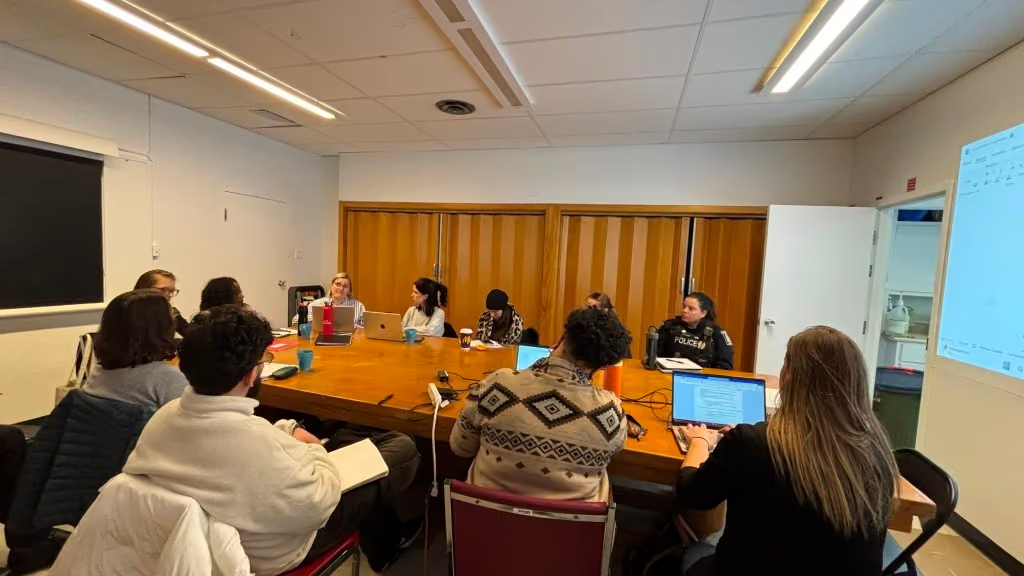
When asked by La Converse to explain the many rejected applications—especially in a neighbourhood where youth crime issues are significant—the Ministry of Public Security, through its communications department, sent over “useful” links, stating that “all eligibility criteria are outlined in the program’s online standards document and were covered during two public information sessions.”
Even the SPVM calls for sustainable funding
According to Mimoun, the problem is structural: “Without core funding, we depend on projects. And if projects don’t get approved… we shut down.”
Core funding is more stable and ensures a certain continuity. It would make it possible to pay rent, fixed costs, and a minimum level of staffing. Without it, organizations chase projects just to survive—as is the case for many in the neighbourhood.
“There’s no more core funding. Organizations operate from one project to the next,” explains Fanéus-Lefebvre. “And yet, a social project takes time. Two years is often what’s needed to implement it.”
As funding instability persists, the services these organizations provide suffer greatly: “These are projects that end, relationships that break,” she notes. “Young people get involved… then funding stops, and they’re left with nothing.”
While Fanéus-Lefebvre stresses the importance of long-term trust-building, Montreal police chief Fady Dagher points out that “street workers […] show up consistently for years.” As a guest on a 98.5 FM radio show, he acknowledged that the community sector strike directly affects policing, citing concrete impacts on youth prevention efforts.
Some aspects of the SPVM’s anti-discrimination and anti-racism plan, launched last week, rely on “strong partnerships with community and institutional sectors based on proximity strategies.”
In his view, these workers play a role the police cannot fulfill: “The person who has a connection with that young person […] is the street worker, the social worker.”
Conversely, he acknowledges that youth “don’t want to talk to the police—they distrust them.” That is why he advocates for “more regular” and “sustainable” funding for the community sector.
Une mobilisation sous pression
À Saint-Michel, les discussions au sein du CPU témoignent d’un épuisement. Les organismes évoquent des refus répétés de financement, une compétition accrue entre projets, des tentatives de « bricolage » pour maintenir des services. « Beaucoup de demandes, peu d’argent, résume Ingrid Fanéus-Lefebvre. Et des appels à projets complexes, parfois difficiles à adapter à la réalité du terrain. » Faute de solution de rechange, certains envisagent de se tourner vers des volets de financement moins adaptés à la prévention. Ainsi, les organismes réunis au sein du Comité de prévention urbaine (CPU) se tournent vers d’autres facettes du programme, même si elles ne sont pas à proprement parler destinées aux projets de prévention.
La complainte du CPU s’inscrit dans un contexte plus large, à savoir celui du mouvement Le communautaire à boutte, qui dénonce le sous-financement chronique des organismes communautaires et les conditions de travail précaires des travailleurs du secteur. Le problème n’est pas nouveau, mais les revendications demeurent d’actualité.
Dans plusieurs régions du Québec, des services fonctionnent au ralenti ou sont suspendus dans le cadre de journées de grève, qui ont eu lieu entre le 23 mars et le 2 avril. Un rassemblement devant l’Assemblée nationale du Québec est prévu le jeudi 2 avril.
Il faut savoir que le gouvernement affirme avoir majoré les budgets accordés aux organismes communautaires québécois, ceux-ci atteignant 2,2 G$ en 2026. Une enveloppe qui aurait doublé depuis l’arrivée de la CAQ au pouvoir. Le plus récent état du Soutien financier gouvernemental pour le communautaire, date cependant de 2023-204, avons-nous confirmé auprès du ministère de l’Emploi et de la Solidarité sociale.
Une partie du décalage tient à la manière dont les sommes sont présentées. « Le financement qui est annoncé […] est ventilé sur cinq ans. Ce n’est pas de l’argent neuf », explique la chargée de communication du mouvement Le communautaire à boutte, Émilie Marchand. Selon elle, les montants avancés par Québec paraissent importants, mais changent d’échelle une fois détaillés : « Quand on ramène ça sur un an, ça donne 20 M$. Puis, pour 3 500 groupes, ça donne 6 000 $ par année par groupe. »
Des sommes jugées insuffisantes sur le terrain, où certains organismes ne profitent même pas d’une indexation. « Ça paraît gros dans l’absolu, […] mais dans les faits, c’est pas tant que ça », ajoute-t-elle. Une lecture similaire est faite par le Réseau québécois de l’action communautaire autonome, qui a récemment détaillé ces écarts dans une entrevue à Radio-Canada.
Interrogée sur la suite du mouvement, la chargée de communication affirme que la mobilisation ne s’essoufflera pas. « Assurément que le Communautaire à boutte ne s’arrêtera pas après le 2 avril », dit-elle, évoquant la volonté d’obtenir « une table de négociation avec le prochain chef ou la prochaine cheffe du gouvernement du Québec ». Si les modalités restent à définir, une chose est cependant déjà claire : « Vous allez entendre parler du Communautaire à boutte encore longtemps, jusqu’aux élections. » Les responsables du mouvement comptent se faire entendre durant la campagne électorale et maintenir la pression « tant qu’on n’aura pas des engagements clairs ». Portés, dit-elle, par « l’appui de la population », les groupes prévoient « mobiliser encore plus » dans les prochains mois.
Mobilization efforts under pressure
In Saint-Michel, discussions within the CPU reflect a deep fatigue. Organizations speak of repeated funding refusals, increased competition between projects, and makeshift attempts to maintain services. “Lots of applications, little money,” summarizes Fanéus-Lefebvre. “And complex calls for projects, sometimes difficult to adapt to realities on the ground.” In the absence of alternatives, some consider turning to funding streams less suited to prevention. Thus, organizations within the CPU are applying to other program components, even if they are not specifically intended for prevention projects.
The CPU’s grievances are part of a broader context: the Le communautaire à boutte movement, which denounces chronic underfunding and precarious working conditions in the community sector. The issue is not new, but the demands remain current.
Across several regions of Quebec, services have slowed or been suspended during strike days held between March 23 and April 2. A rally in front of the National Assembly of Quebec is scheduled for Thursday, April 2.
The government maintains that it has increased funding for community organizations, reaching $2.2 billion in 2026—an amount that has reportedly doubled since the CAQ came to power. However, the most recent official report on government funding for the community sector dates back to 2023–2024, as confirmed with the Ministry of Employment and Social Solidarity.
Part of the discrepancy lies in how the figures are presented. “The funding that’s announced […] is spread over five years. It’s not new money,” explains Émilie Marchand, communications officer for Le communautaire à boutte. According to her, the amounts seem large but shrink when broken down: “When you bring it back to one year, it’s $20 million. Then for 3,500 groups, that’s $6,000 per year per group.”
These sums are considered insufficient on the ground, where some organizations do not even benefit from indexation.
“It sounds big in absolute terms […] but in reality, it’s not that much,” she adds. A similar discourse was made by the Quebec Network of Independent Community Action, in a CBC/Radio-Canada interview.
When asked about what comes next for the movement, the communications officer insists that the mobilization will not lose momentum. “Le communautaire à boutte will certainly not stop after April 2,” she says, pointing to the goal of securing “a negotiation table with the next premier of Quebec.” While the specifics remain to be defined, one thing is already clear: “You’re going to keep hearing about Le communautaire à boutte for a long time, all the way to the elections.” The movement’s leaders intend to make their voices heard during the election campaign and maintain pressure “until we have clear commitments.” Backed, she says, by “public support,” the groups plan to “mobilize even more” in the coming months.
Une collecte de fonds pour tenir
Dans une modeste salle de Saint-Michel, une centaine de personnes assistent, ce samedi 28 mars, à un gala de boxe organisé par l’organisme Ness Martial, qui propose un programme sport-études pour lutter contre le décrochage scolaire. Dans le ring, des jeunes enchaînent les combats amicaux. Dans les gradins, des parents offrent des encouragements. Pour Grégory Élie, membre du conseil d’administration, l’objectif est double : « Valoriser les jeunes… et aller chercher du financement. »
Sa notoriété, l’organisme l’a bâtie depuis des années grâce aux résultats concrets obtenus auprès des jeunes. C’est ce que confirme Billy Barbier, résident de Saint-Michel. Dans la foule, ce dernier observe sa fille, qui pratique le kick-boxing et monte dans le ring ce soir. « Ça l’aide à s’épanouir. À prendre confiance », explique-t-il.
Au-delà du sport, l’organisme agit aussi en amont, sur d’autres leviers. En tant qu’inspecteur en sécurité incendie et parent, Billy Barbier y est intervenu pour présenter son métier aux jeunes. « Il y a des gens qui viennent régulièrement parler de ce qu’ils font dans la vie. Ça permet aux jeunes de voir différentes options », explique-t-il.
Ces rencontres, poursuit-il, jouent un rôle discret mais structurant en proposant des modèles accessibles, auxquels les adolescents peuvent s’identifier. « Ils voient des personnes qui leur ressemblent, qui travaillent. Ça leur montre que c’est possible. »
Mais il s’inquiète des coupes. « Ça fait de la peine. Ce sont des choses qui devraient être financées. » En vérité, certains services ont déjà disparu. « On offrait des cours de francisation. Ils ont été coupés », s’alarme M. Élie. Deux postes ont été supprimés en effet, et « ce n’est pas juste les employés qui sont affectés – c’est la relève ! » prévient-il.
A fundraiser to stay afloat
In a modest hall in Saint-Michel, about a hundred people attend a boxing gala on Saturday, March 28, organized by Ness Martial, which runs a sports-study program to combat school dropout. In the ring, young people take turns in friendly bouts. In the stands, parents cheer them on. For Grégory Élie, a board member of the organisation, the goal is twofold: “To showcase the youth… and raise funding.”
The organization has built its reputation over the years through tangible results with young people. Billy Barbier, a Saint-Michel resident, confirms this. In the crowd, he watches his daughter, who practices kickboxing and steps into the ring that evening. “It helps her grow. Build confidence,” he says.
Beyond sports, the organization also works upstream on other fronts. As a fire safety inspector and parent, Barbier has spoken to youth there about his job. “People regularly come to talk about what they do. It lets young people see different options.”
These encounters play a quiet but fundamental role by offering accessible role models with whom teenagers can identify. “They see people who look like them, who are working. It shows them it’s possible.”
But he worries about the funding cuts. “It’s sad. These are things that should be funded." In fact, some services have already disappeared. “We used to offer French classes. They were cut,” Élie warns. Two positions were eliminated, and “it’s not just employees who are affected—it’s the next generation!”
A fraying social safety net
From one neighbourhood to another, the observations are similar. Organizations lose staff, reduce services, struggle to keep their spaces, outreach workers fund activities out of pocket and juggle limited resources—and young people search for guidance, caught between their support systems and the street.
For those on the ground, the issue goes beyond the organizations themselves. “The community sector is the social safety net,” insists Mimoun. “During the pandemic, we supported the most vulnerable.” Today, that net is becoming more fragile.
And in neighbourhoods, the effects of that fragility are measured less in numbers than in absences: one fewer outreach worker, a closed door, a cancelled activity. Small withdrawals that, taken together, reshape everyday life.
.jpg)