

In Quebec, as in France, the Muslim veil is criticized in the name of secularism, the protection of women, Western values, and gender equality. Conversely, lines of defense are forming around individual liberty and against the invisibilization of those who wear it and their exclusion from certain jobs, notably due to Bills 21 and 94.
With The Hijab, Their Obsession, and Us, researcher Liza Hammar attempts to break the vicious cycle. At the invitation of her Quebec publisher, La rue Dorion, the author met her audience on April 9 at Bâtiment 7, and offered a critical reading of "fixed" conceptions regarding the choice to wear the hijab, the fantasy of "unveiling," and analyses that exclude issues of race, gender, class, and religion.
In Letter to My Hijab, the last chapter of this work, she thus summarizes her intimate position: "You are not the most favorable option for my material comfort; to be tied to you is even unreasonable given the Islamophobia in the world, but life cannot always be guided by the quest for security. Life is mostly made of God, the search for justice, resistance – and abdicating has never freed anyone."
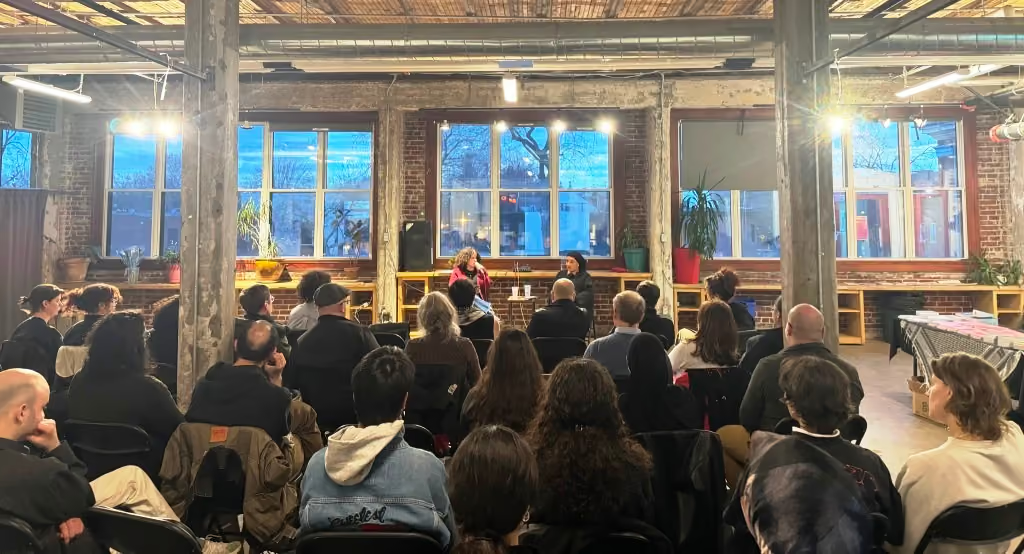
In the Grand Atelier of Bâtiment 7, about forty people take their seats on chairs arranged in rows. The venue, marked by years of community struggles and self-managed initiatives, immediately lends a political tone to the gathering. This evening takes the form of a dense, almost confrontational dialogue between author Liza Hammar and political scientist Fella Hadj Kaddour, before an attentive audience familiar with the debates sweeping across Quebec.
Liza Hammar speaks with a restraint that commands attention. Nothing in her demeanor is left to chance, but as the discussion progresses, the researcher's rigor gives way to a more soulful, almost intimate voice. This tension between rigor and sensitivity is not insignificant: she claims The Little Prince by Antoine de Saint-Exupéry as her bedside book, a text she says she has never abandoned since adolescence, and in which one finds a certain way of linking apparent simplicity and depth.
Born in a Kabyle village in Algeria, she immigrated to France at the age of seven, where she grew up, studied, and became involved in various activist circles. Today, a PhD candidate in literary studies at UQAM, she conducts research on the notion of reparation in feminist, decolonial, and auto-theoretical fields. Her journey spans various registers (academic, political, and literary) that she refuses to dissociate. Her book extends this approach, which brings together theoretical analysis and lived experience.
Escaping the Trap of Individual 'Choice'
Immediately, Liza Hammar questions the relevance of the hijab debate, which she calls an "intellectual dead end" when it is reduced to a question of individual choice. For decades, she explains, Muslim women have been summoned to prove their ability to choose. But, she asserts, "I don't want to prove to my tormentors that I am free; I turn my back on their cynicism."
The demand, which forces women wearing the hijab to constantly justify themselves, imprisons more than it liberates, according to her, especially since "no one is truly concerned about whether we are truly free or not – because, incidentally, we are not for other reasons, but strangely, no one cares about that."
This shift is central: instead of questioning the social, political, and economic conditions in which this choice is made, the debate focuses on individual validation and, she says, masks the concrete effects of the laws. "These are extremely violent laws," she states in an interview, referring to Quebec measures like Bill 21 and Bill 94. "They don't have the same histories as those in France," she clarifies, "but they have the same effects and target the same women."
Last fall, the Coalition Avenir Québec government adopted Bill 94, which aims to tighten the rules of Bill 21 to ensure the religious neutrality of the state in the public sphere. In response to numerous criticisms, the then-Premier, François Legault, had responded by writing, on November 27, 2025, on his social media: "Why? Because in Quebec, equality between women and men, and freedom of conscience and religion, are non-negotiable. Because secularism is part of who we are. It's a principle that unites us, true to our values. Because, yes, that's how we live in Quebec."
The Supreme Court of Canada examined last March the validity of invoking the notwithstanding clause in the passing of Bill 21 in Quebec.
Unveiling: A Dominant Narrative to Deconstruct
Another central aspect of the discussion challenges the media's valorization of "unveiling" as a universal symbol of liberation. Stories of women removing their hijabs are omnipresent in the media and are often presented, according to the guest, as experiences of emancipation.
During the interview, she clarifies: "What interests me is not judging these women, but understanding how their narratives are used." According to her, "unveiling in the name of freedom corresponds exactly to the white patriarchal fantasy." She speaks of a form of instrumentalization: "These stories are celebrated, but at the same time, they are used without truly acknowledging the violence they recount."
Liza Hammar deconstructs this narrative, detecting in it a normative storytelling, "almost a literary genre in itself," that does not correspond to real experiences and the multiplicity of situations: forced unveiling in legal contexts, occasional unveiling in intimate spaces, non-politicized daily gestures... Situations deliberately erased from the dominant discourse, according to her, because they would prevent maintaining a simple opposition between oppression and freedom.
Liza Hammar confides that she was forced, as an adolescent, to remove her hijab to go to high school in France, as part of the application of the 2004 law. "I unveiled every day for three years in front of my high school. It wasn't a liberation; it was a humiliation," the guest testifies. Unveiling, in this case, she concludes, is far from a liberation and becomes a constraint on the body, under the control of an institution that imposes the norm and verifies its application.
The Hijab to Escape Norms?
Adolescence was a turning point for Liza Hammar, who recounts wearing the hijab during that period of her life, but not under duress. "At 14, I wanted to remove myself from the male gaze," she confides.
She describes an environment marked by early sexualization and pressure to conform to heterosexual norms. In this context, and contrary to popular belief, this gesture does not, according to her, express submission to social norms, but rather an attempt to escape them. "I wanted to be met beyond my body."
Drawing from her own experience, Liza Hammar encourages refusing simplifications and questioning the complexity of individual paths. Because families of origin, like her own, can hold diverse positions: religious, secular, atheist. She also emphasizes that so-called "origin" societies are themselves heterogeneous, and that "the West does not have a monopoly on rejecting the veil."
Critique of Blind Spots in Progressive Circles
Fella Hadj Kaddour then questions the guest about the critique she reserves in her work of contradictions that, according to her, run through the left and certain feminisms, particularly in France. Liza Hammar indeed describes progressive circles capable of recognizing Islamophobia as a form of racism, but incapable of fully integrating the spiritual dimension of the individuals concerned.
In these spaces, she says, being a believer exposes one to a form of intellectual disqualification. Moreover, "I was perceived as an idiot because I adore God," she quips with a touch of humor. On the ground, she criticizes a segment of the left for not fully grasping the consequences of the laws on Muslim women. This is the case in France, but also in Quebec, where unions, she illustrates in an interview, advise women wearing the hijab who are affected by Bills 21 and 94 to wait to be dismissed rather than resigning. "We are facing employment discrimination. The fact that it is legal changes nothing."
Liza Hammar, however, qualifies her statement by admitting that the field is not entirely empty and that "there are individuals and collectives doing this work." She believes, however, that it is not enough: "I think the efforts of these organizations and activists are not frankly enough supported by the rest of the left."
In the chapter dedicated to solutions, she writes: "Faced with an extremely violent exclusion from far too many spaces and a terrible precarization affecting Muslim women wearing the hijab, the emergence of Muslim feminisms responds to political isolation." Feminisms that, according to her, refer to a spectrum of feminist struggles undertaken by women "who not only see no opposition between their Islamicity and their feminism, but advance with these two affiliations concomitantly and in a politically enriching way. Approaching Islam from feminist perspectives."
A Publishing House as a Space of Coherence
The choice to publish with Éditions de la rue Dorion fits into this logic. Founded in 2012 in Montreal, this independent house holds a unique place in Quebec's publishing landscape. Its catalog includes political essays, decolonial thought, critical works, writings stemming from social struggles, or even translations like that of the enlightening work The Ethnic Cleansing of Palestine by Ilan Pappé. Publishing The Hijab, Their Obsession, and Us in this context demonstrates political coherence, but also constitutes an editorial risk.
Liza Hammar explains that she refused several offers in France so as not to sacrifice the integrity of her message for an editorial offer that "wanted to reduce my book to the issue of discrimination." Here, the collaboration with La rue Dorion was built differently, because, she says, "they let me pursue my ideas to the fullest."
She also emphasizes the importance of independent publishing spaces: "Participating in these spaces is also a way to circulate other ideas."
The Audience Asks: Between France and Quebec, Differences… and Similarities
Once the floor was opened to the audience, several interventions shifted the discussion towards a direct comparison between France and Quebec. One question kept coming up: what does it mean to publish such a book in two contexts that are both distinct and increasingly similar?
Liza Hammar first responds with a nuanced observation. "I have the impression that there are unfortunately fewer and fewer differences between France and Quebec," she states, while refusing to conflate the two. She mentions her experience in France, where forms of Islamophobia remain, according to her, more overt, unlike Quebec, where racism, she says, sometimes seems more difficult for her to grasp: "At first, I had trouble reading it... I didn't understand why it made me uncomfortable."
As the discussions progressed, an idea emerged: Islamophobia is not limited to national contexts. "It circulates internationally," the author insists, referring to broader dynamics, where political discourses, colonial legacies, and the rise of certain ideologies intersect.
The evening ends without a clear break. Discussions continue around the author, who signs copies of her book and discusses certain nuances with the audience. There are fewer certainties here, and more complexity. The debate, here, does not close: it unfolds.