

.avif)
In Chameran, in the Saint-Laurent borough, tenants are refusing to leave their homes despite notices of major work requiring their relocation as early as this summer. Many state they want to stay and are challenging these actions, which they associate with a possible renoviction. On site, the affected buildings show signs of degradation documented for years, while rents have already sharply increased in renovated neighboring buildings. Between poor housing conditions, serial departures, and collective organizing, a power dynamic has emerged between residents, the landlord, and local authorities.
In the lobby of 1270 Quenneville Street, the conversation stops when an elderly woman exits the elevator and slowly approaches, a piece of paper in her hand. In a barely audible voice, she asks if her mover has arrived. The name and number are written in large print, as if to ensure no essential information is lost. Her clothes bear the marks of daily life, without pretense or explanation. Marouane Cherifi, coordinator of the tenants' defense committee, immediately understands: "That's a third departure in a short time," he says with a heavy heart. One more in a building already largely emptied. Here, departures don't always stem from official notices, but also from an accumulation of untenable conditions (incessant work, noise, dust, uncertainty) and a pervasive pressure that ultimately displaces the most vulnerable.
Last January, the landlord sent notice letters, stating that "major renovations are necessary [...] to ensure the safety of occupants." The form and content of the mail raised suspicions, and some residents consulted lawyers.
Starting in early April, suspicions were confirmed when some began receiving notices from the Administrative Housing Tribunal (TAL) for major renovations that, according to Orem Capital – the new owner – require vacating the units for a period of five months, effective July 1,st 2026. For the tenants, there is no doubt: this is a classic case of renoviction. They are now organizing to defend themselves against what they consider an imminent threat.
"You wouldn't think I'm in Canada!"
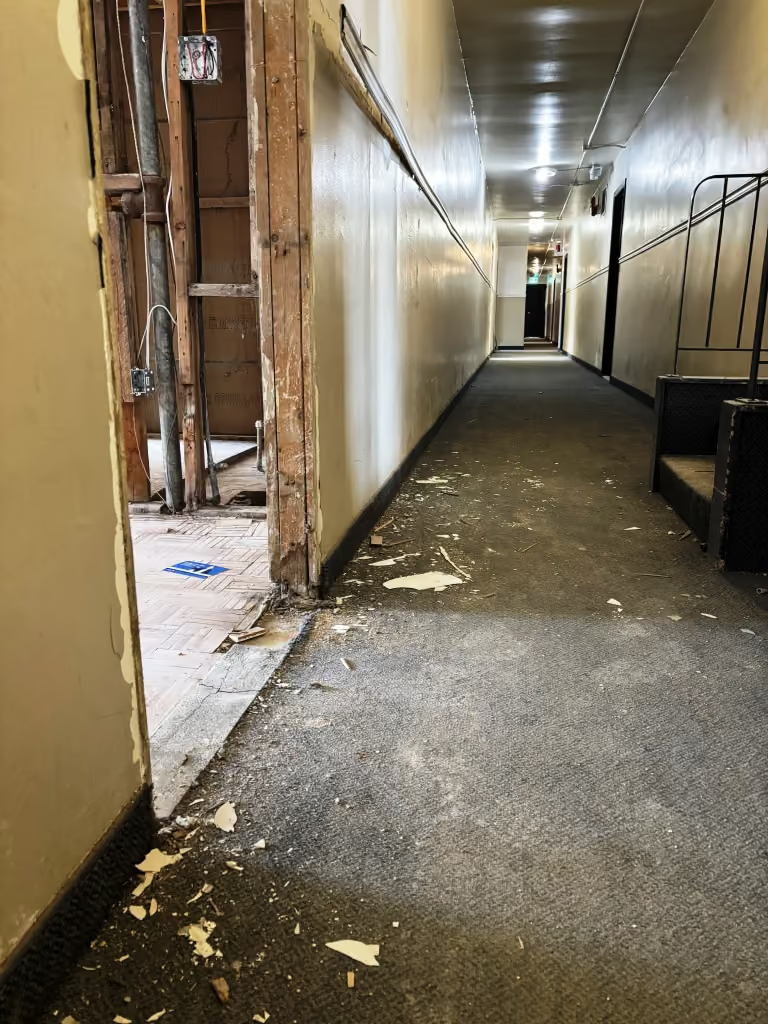
Photo: Nouri Nesrouche
We begin our tour of this complex, made up of five buildings (two on Quenneville Street and three on Jules-Poitras Street), in front of 1315 Jules-Poitras Street. The contrast is striking. Under a spring sun that gives the neighborhood a village-like feel, the buildings hide a sordid reality. Only 1310 Quenneville Street, whose units have just been renovated and are awaiting new tenants, is an exception.
In the other four buildings, the smell of dampness hits you at the threshold of the apartments: water-swollen walls, crumbling ceilings, cockroaches inviting themselves into kitchens, and all the rest! The City's assessment is unequivocal: seven major non-compliance issues, as indicated in one of the non-compliance notices that La Converse was able to consult.
In April 2025, the former owner, Banvest, sold the five buildings to Orem Capital without meeting the City's repair requirements. Tenants' daily lives continued amidst unsanitary and unsafe conditions, compounded by inconveniences over the past few months. "I've lived here since 2019. And honestly, you wouldn't think I'm in Canada! What I see here are things I wouldn't even expect to see in a third-world country," Mr. Cherifi exclaims.
In the visited apartments, signs of infiltration, damaged materials, and partial repairs are visible. Some tenants say they perform repairs themselves in common areas. Others mention problems that have persisted for months, even years.
In the common areas, the consequences of a lack of maintenance are accumulating. Residents take turns guiding us through this desolation. Only Mr. Cherifi speaks openly. The others prefer to remain anonymous. At 1315 Jules-Poitras Street, a flood in December 2024 left lasting traces in the garage: abandoned vehicles, persistent dampness, and a lack of complete restoration. Access to the buildings is described as faulty. "Anyone can get in," says one resident, mentioning unlocked doors and entry codes "that all delivery drivers know."
In addition, there are many vacant units. Each building has 76 apartments. According to the defense committee coordinator's estimates, the number of occupied apartments per building does not exceed thirty, with several units left open or under construction, as we observed.
Furthermore, La Converse learned from the Montreal Fire Department that firefighters from Station 73 carried out no fewer than 40 interventions in these 4 buildings from April 2025 to April 2026, also noting some false alarms.
Pressure to Leave
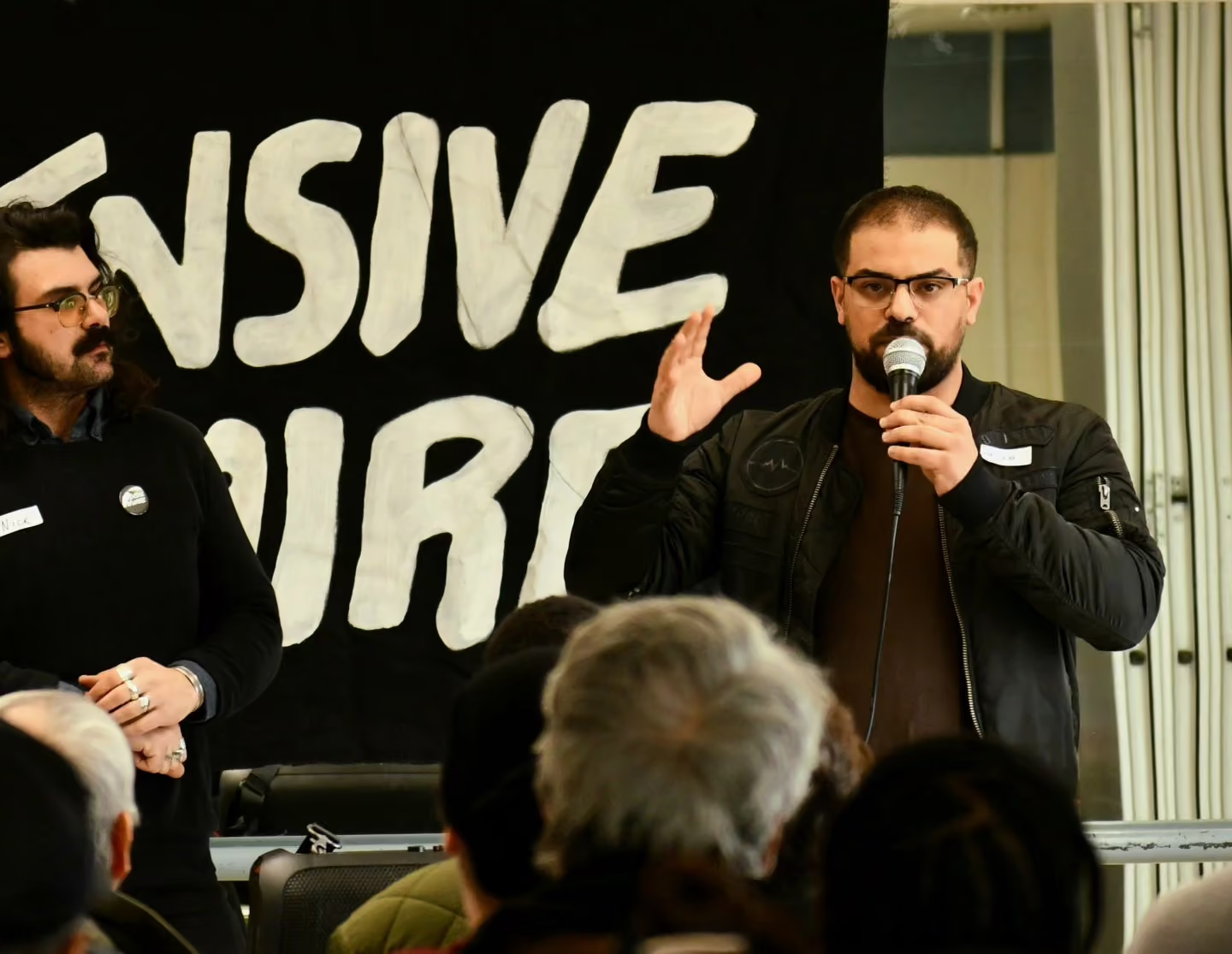
Photo: Offensive populaire
Several tenants also describe repeated approaches, often in the form of home visits. According to Marouane Cherifi, a door-to-door phase preceded the sending of official documents. Mandated by a subcontracting firm, representatives knocked on tenants' doors to "explain" the renovation project and offer amounts for them to leave. "They come to your home, tell you the owner will invest millions, that you need to relocate, and then they offer an amount," he describes.
Agreements are then proposed, with amounts generally ranging from $1,500 to $4,000 for temporarily vacating the premises for announced periods of approximately five months.
As the discussion progresses, the approach adjusts: "When they sense the person might give in, they ask if they would be willing to leave their home permanently."
These proposals are accompanied by documents that some tenants say are difficult to interpret. On his lawyer's advice, Mr. Cherifi refuses to sign an agreement that, in his opinion, would limit possible recourse in case of a dispute. Others say they signed without understanding all the implications, particularly due to language barriers. "Some were given something to sign, but they didn't understand," a neighbor reports.
Several tenants we met described a more diffuse climate of pressure. They reported repeated visits, sometimes without clear notice, technical interventions announced vaguely, or attempts to enter units. "They say they'll come by during the week, without giving a specific time," states one resident, who says he lost several workdays waiting.
According to the testimonies gathered, these practices occur in a context where living conditions are constantly deteriorating. For some, this accumulation makes it difficult to remain in their homes. "At some point, people just leave," summarizes one tenant.
Popular Offensive and the Emergence of a Defense Committee
But some choose to stay, and their mobilization takes shape in early spring. Several dozen residents from the four buildings participate in an initial assembly. Following this meeting, a defense committee is formed, with an elected representative to coordinate discussions and structure actions. "We needed to centralize information and respond collectively," explains Marouane Cherifi, chosen by his neighbors for this role.
The collective Offensive Populaire – Montréal then gets involved in the neighborhood. This activist group intervenes by going door-to-door and preparing assemblies and organizational support. Its spokesperson, Nicholas Harvest, describes their approach as an attempt to structure local responses to housing-related conflicts. "We don't come with a ready-made solution. We primarily try to create the conditions for tenants to organize among themselves and collectively decide what they want to do," he explains. Specifically, the collective participates in organizing initial meetings, supports information dissemination, and encourages coordinated actions.
On the ground, this involvement coincides with a shift in scale. Tenants are no longer responding to the landlord's proposals alone: collective refusals are being made, trips to the borough council are organized, and information circulates between buildings. "We started acting together," summarizes one resident.
This organization, however, remains rooted in the neighborhood. Several tenants interviewed emphasize the existence of a dynamic that emerged among neighbors, prior to the arrival of external support. Offensive Populaire acts as a relay and a framework, without replacing the residents. In a few weeks, this combined effort by residents and activists has established a real power dynamic where, previously, there were only scattered efforts.
Orem Capital: Between Renovation Discourse and Accelerated Gentrification
In a notice sent to tenants on January 20, 2026, obtained by La Converse, Orem Capital presents its intervention as a necessary operation. The company cites a "lack of maintenance by the former owner" and announces major work aimed at ensuring "the safety of occupants" and providing a "comfortable and sustainable" living environment. Plumbing, electricity, windows, balconies – the announced renovation is comprehensive. The document also specifies that tenants can remain on site or be temporarily relocated, but warns them that there will be service interruptions and nuisances due to the construction.
From the tenants' perspective, however, these works are associated with a broader transformation of the rental housing stock. One case recurs frequently: that of a resident whose rent will increase from $860 to $1,800 after the work scheduled for July. For the spokesperson of Offensive Populaire, it's clear: "What we see here is not an isolated case. It's a logic where degradation and renovations become levers to transform a rental stock and change its occupants."
This logic is observed in another building in the area, 1310 Quenneville Street, which has been emptied, renovated, and recently put up for rent. During a call we made to inquire about availabilities, the agent on the line told us that rents for a 4½ apartment started at $1,600. A double increase. The old rents, still in effect in neighboring buildings, ranged from $800 to $1,000.
La Converse contacted Orem Capital multiple times to get their side of the story. A response deadline was granted before publication, but the company never replied.
When the City Relies on the Courts
Municipal documents show that the deterioration of the Chameran buildings has been known for several years. As early as 2024, inspections revealed problems with unsanitary conditions, water infiltration, and vermin, leading to non-compliance notices addressed to the former owner. In this context, the residents interviewed express their great fear: that they will not be able to return after the work. Many associate the ongoing renovations with a renoviction strategy, supported by the rent increases observed in neighboring buildings already back on the market.
When questioned about these concerns, borough mayor Alan DeSousa does not endorse this interpretation of the facts and asserts that the City intervenes, "when there are reports," to enforce regulations. Furthermore, regarding rent increases and evictions, he consistently refers to the Administrative Housing Tribunal (TAL). "It is the TAL that decides if an increase is compliant," he emphasizes to La Converse.
And when asked about possible gentrification in the neighborhood, the mayor of Saint-Laurent prefers to emphasize the City's role in informing tenants about their recourse options.
Nevertheless, he attended the tenants' assembly on April 4, initiated by Offensive Populaire, to directly hear their concerns about the announced work. A few days later, during the borough council meeting on April 7, several dozen tenants went to City Hall to address the council again. They demanded concrete measures regarding the deterioration of the buildings and the eviction notices received. However, due to a lack of what they considered satisfactory commitment, they left the session early as a sign of dissatisfaction.
What the Legal Framework Allows (and Doesn't Allow)
The Civil Code of Quebec governs the procedure a landlord must follow in the event of major work (arts. 1922 and 1923). The landlord must send a detailed notice indicating the nature of the work, its duration, and, if evacuation is required, offer compensation covering the tenant's reasonable expenses. Consulted by La Converse, Me Ré Poulin-Ladouceur, a housing law attorney, reminds that the law stipulates that evacuation must be at no cost to the tenant, meaning it must cover moving and storage fees, as well as the rent difference if the temporary housing is more expensive. "Tenants are entitled to equivalent housing in the same sector, and the difference must be borne by the landlord," emphasizes Me Poulin-Ladouceur. In his view, the amounts proposed in some notices (around $2,600 for five months) appear insufficient. However, based on the documents sent to tenants, Me Poulin-Ladouceur believes that the notice received by Chameran tenants is not regular. "The notice was signed in March but sent in early April, less than three months before the start of the work, in contravention of Article 1923," he states. This, he concludes, is fatal to the procedure initiated by the landlord and will prevent the issue of compensation from being reached.
The Power Dynamic Crystallizes
With only a few weeks until the deadline, the atmosphere is electric. In the still-occupied apartments, those who remain stand together, discuss strategy, and refuse the checks offered by the landlord. "We won't leave," is the refrain heard on Quenneville and Jules-Poitras streets. It's no longer just about walls and ceilings; it's a fight for the right to live in one's own neighborhood. In Chameran, the battle has just begun.
.jpg)
.jpeg)