.jpg)

In Trois-Rivières, an Eid al-Adha prayer was enough to spark a wave of hateful comments. In Shawinigan, a few days later, the slogan about a "white Quebec" appeared on the street. As a provincial election approaches, where identity, secularism, and immigration are likely to once again serve as political shortcuts, Eid al-Adha becomes a subtle indicator of a broader tension. In Quebec, certain actions taken by Muslims are still not perceived as ordinary acts of collective life. This report tells what it does to a celebration – in living rooms, families, and mosques – when it still has to endure the scrutiny of others before it can simply exist.
An almost ordinary evening
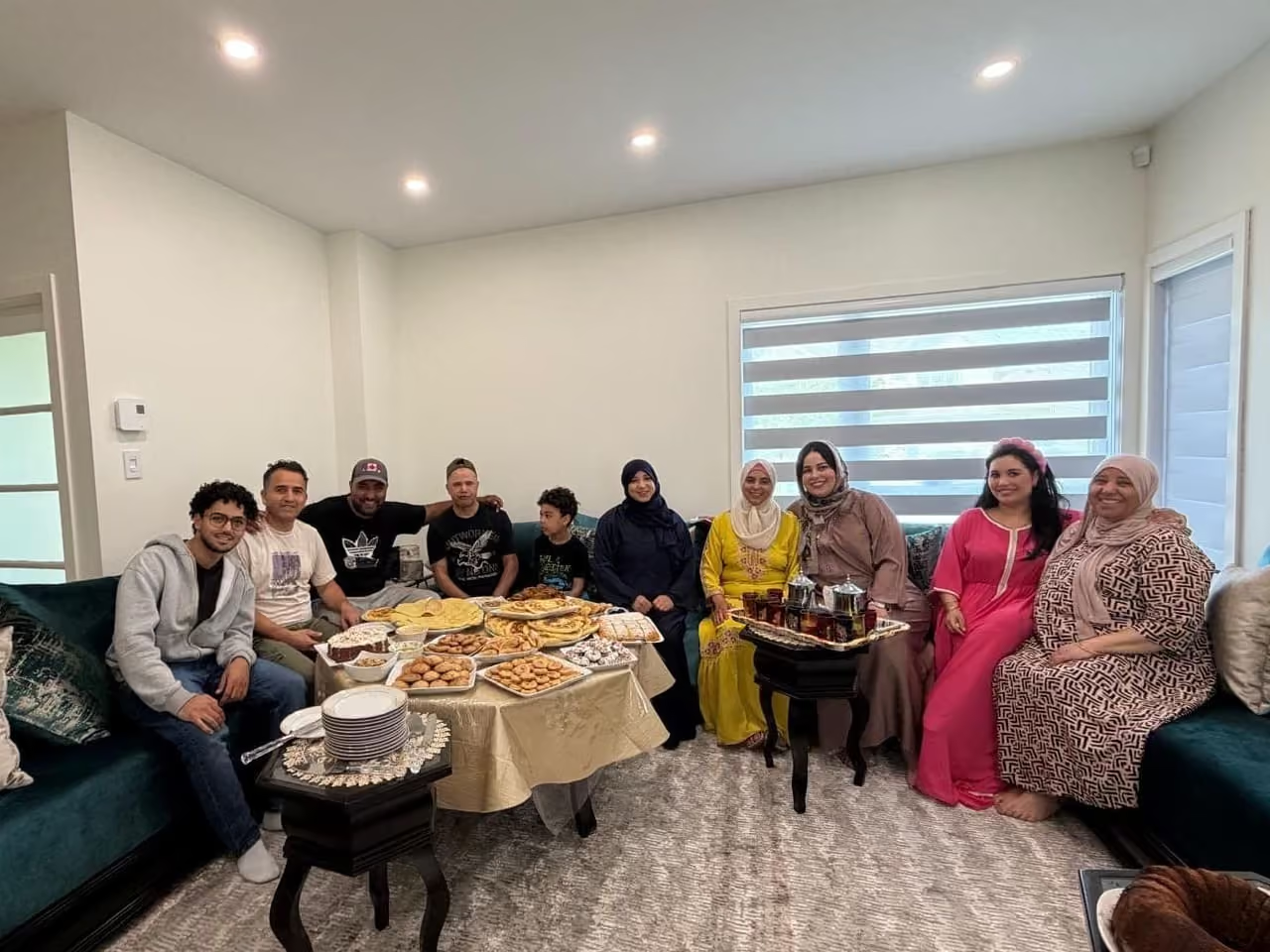
At Nadia and Hassan's home in Mirabel, the television is already on in the living room.
The Canadiens are losing, the children are running between rooms, and someone is looking for a plate that disappeared in the kitchen. Then, Nadia looks at Hassan, absorbed in the game, before telling him: "Drop the game Canadiens game. Today, play with the kids!"
Everyone bursts out laughing.
The scene could unfold in any Quebecois family on a holiday evening. A game in the background. Children taking up too much space. A full house. Adults trying to juggle dinner, conversations, and the living room mess.
But that evening, while Muslim families celebrated Eid al-Adha in their homes, mosques, or community halls, the holiday was also the target of hateful comments elsewhere in Quebec.
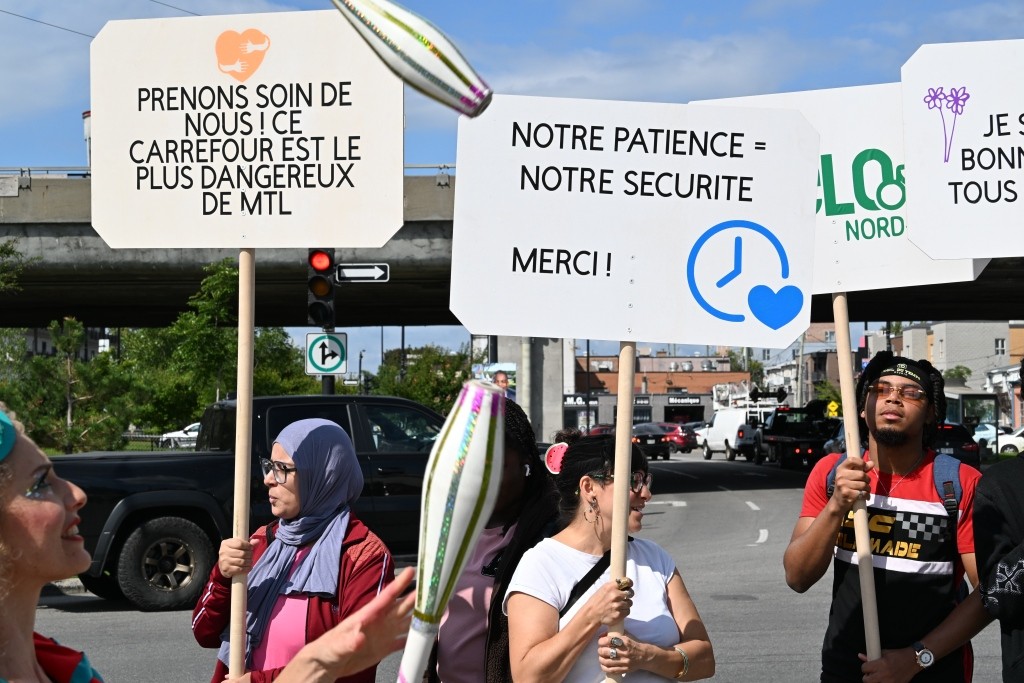
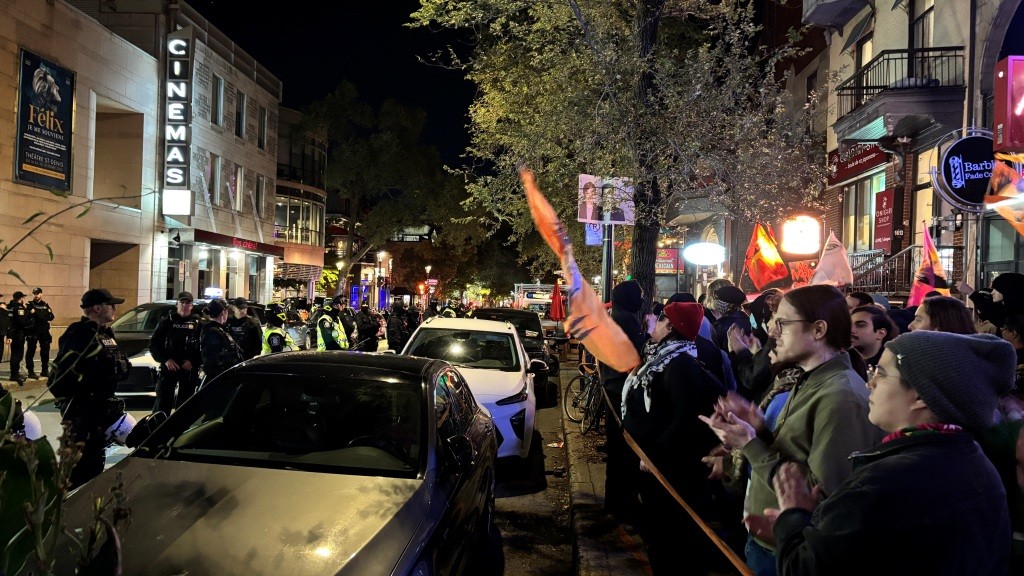
In Trois-Rivières, an Eid prayer held in a private location sparked a wave of racist reactions and online threats. A few days later, in Shawinigan, masked protesters unfurled a banner with the following phrase written on it: "I remember a white Quebec."
Between the intimacy of a living room and the public uproar, a disconnect emerges.
For the families interviewed, Eid is not primarily a societal issue. It's a day of reunion, tradition, and love. Yet, current events always find their way into homes, one way or another. Through a notification. Through a video. In a question asked at school. In the eyes of a child who understands too quickly that their celebration can become a problem for others.
When Children Bring the World Home
Nadia has been a foster parent for several years. In her home, she often observes how much children grasp what adults believe they are hiding from them. "Children absorb everything," she says. "Even when we think they're not listening, they are."
What they hear doesn't just come from their parents. It also comes from school, social media, and overheard conversations. Her 12-year-old son recently told her about videos that mock Muslims. They laugh at the sacrifice of the sheep. A religious practice is turned into an easy joke. Eid is presented as something strange, almost suspicious.
The tone is sometimes meant to be humorous. But for a child watching, the effect is far from a joke. They understand that what is normal at home can become a target for mockery when they leave the house.
Her daughter, meanwhile, came home from school with another question. A student had called Eid weird. She wanted to understand why. "Before, children just thought about gifts and cousins," Nadia recounts. "Now, they're asking questions a child shouldn't even have to ask."
This is perhaps how current events penetrate homes most deeply. Not always through major headlines, but through a phrase brought home from the schoolyard. Through a word that forces a parent to explain too soon what they would have preferred to keep out.
Nadia doesn't want Eid to be a day of justification. She doesn't want to spend this holiday correcting others' perceptions. She wants the children to play. To laugh. To keep simple memories from this day.
But in a climate where Muslim practices regularly re-enter the public sphere as controversy, protecting this simplicity already requires effort.
The Celebration Under Public Scrutiny
This year, the context has given a particular dimension to this tension.
In Trois-Rivières, images of an Eid prayer organized in a private location were widely shared online. The post triggered a series of hateful and racist comments, to the point where the Canadian Muslim Forum asked authorities to act.
A few weeks earlier, in Gatineau, a man had been arrested after sending death threats to the imam and worshippers of the Aylmer mosque. The incident rekindled concerns in several communities deeply affected by the 2017 attack on the Grand Mosque of Quebec City.
In the United States, the attack on the Islamic Center of San Diego, in which three worshippers were killed, also circulated on news feeds. Even from afar, this type of violence affects families through the same channels as everything else: WhatsApp groups, video clips, conversations among loved ones, phone alerts.
Taken separately, these events do not tell the story of the families interviewed. But their accumulation creates a certain climate.
A climate where a family celebration can be experienced as a party in a living room and commented on elsewhere as a threat, an anomaly, or a sign of too much.
With provincial elections just a few months away, this issue goes beyond mere religious matters. Secularism, immigration, identity, and the place of religion in the public sphere are never simple topics of debate. These questions involve symbolic boundaries. They draw, sometimes implicitly, the line between those whose belonging is taken for granted and those whose presence remains conditional, always subject to discussion, regulation, or scrutiny. However, these boundaries don't stay confined to politicians' speeches or TV talk shows. They seep into Facebook comments, condense into short videos, echo in schoolyards, and appear in neighbours' glances. Ultimately, they lend a political dimension to actions that should remain simple: preparing for a celebration, opening a mosque door, reassuring a child, or simply saying that one is celebrating Eid.
This is where Islamophobia becomes harder to grasp. It doesn't just manifest as direct insults or threats. It also operates by making certain presences constantly debatable. As if families always have to be prepared for their most everyday actions to become subjects of public opinion.
Before the Celebration, Silence
For Nicerine and her family, disconnecting begins even before Eid.
For the past few years, she has dedicated the days leading up to the celebration to fasting. In the Muslim tradition, the first days of the month of Dhul-Hijja, especially the Day of Arafat, are times for reflection. Many believers fast on this occasion, pray more, and seek to slow down.
For Nicerine, this slowing down also has a very contemporary resonance. “It helps me recenter myself,” she explains. “I try to be less on my phone, less caught up in the news. It’s a good time to refocus on my spirituality and my family.”
She laughs softly before adding, “Otherwise, we go crazy.” Her statement speaks to this era where every crisis demands a piece of our attention. We have to see. React. Understand. Share. Take a stand. And start all over again.
But for many Muslim families, this fatigue has an additional layer. It's not just the world's crises that enter their homes. It's also the constant reappearance of their own religion, its celebrations, prayers, or places of worship in the news as subjects of debate.
For Nicerine, slowing down means choosing what deserves to be protected before returning to the noise.
A Counter-Space in the Chaos
Known by the pseudonym Malik Shabazz, Malik is a political content creator on TikTok in Montreal. A single father to a nine-year-old girl, his daily life involves dissecting current events, analyzing power dynamics, and discussing Gaza, Iran, the United States – everything that's wrong with the world.
So, when he talks about Eid, his voice changes. It slows down. “We’re constantly bombarded with bad news; it feels good to detach from that,” he says.
Not to escape. To breathe.
His family is “very politicized,” he says. Current events are taking “more and more space in discussions.” His nine-year-old daughter is starting to hear things on TikTok: discussions about war, hateful comments that exclude her, violent oversimplifications about Islam and immigration. Images and words she shouldn't have encountered so early.
So Eid, for Malik, isn't an escape. It's a counter-space, as he calls it. “It’s not about ignoring what’s happening in the world,” he clarifies. “It’s to remind my daughter that, despite the chaos, you still have family. You still have moments of happiness. You still have religion. You still have stability, right ? »
He insists on this right, as if to make sure we understood. It's not denial. It's a declaration of continuity. A way of saying: the world might be on fire, but we're holding on.
"I think all parents are looking for a bit of that right now, regardless of their religion."
What he describes is a silent shift that many immigrant families experience. The celebration becomes an emotional necessity. A need to remember that before being political subjects, before being scrutinized, questioned, mocked on TikTok, they are first and foremost a family.
"We remain deeply attached to Quebec, to our life here," he says. "But we're going to keep certain family traditions that remind us where we come from."
Closing Doors
In Montreal, Myriam observes this transformation in a more subtle detail: the doors of mosques.
An Arabic language and Quranic studies teacher, deeply involved as a volunteer in Montreal mosques, she arrived in Quebec over 20 years ago. She remembers a time when mosques were more accessible, almost integrated into the ordinary rhythm of the day.
"Before, mosques were open all day," she explains. "I'd be shopping, hear the call to prayer, and just pop into the nearest mosque for a few minutes before continuing my shopping. Now, often, the doors are closed. You have to ring. Sometimes you need a code to get in. These security measures have been strengthened since 2017."
She doesn't recount this with anger. Rather, with clarity. As if vigilance had become a habit.
Here too, current events leave a tangible mark. Not just in discourse, but in the organization of space: locked doors, codes, stricter hours, a caution integrated into daily life.
Yet, Myriam emphasizes what remains.
Families still gather. Children learn Arabic to speak with their grandparents. Women still organize get-togethers after the celebration. They cook. They laugh. They carry on. "We carry on anyway," she simply says.
The Right Not to Be an Issue
Myriam's "anyway" hangs in the air.
In Trois-Rivières, the Eid prayer organized on May 27 at the racetrack by the Minhaj-as-Sunna mosque gathered approximately 200 people in a private and authorized location. After images were shared online, some comments referred to Alexandre Bissonnette, the perpetrator of the attack on the Great Mosque of Quebec, while others suggested setting fire to the gathering. The mayor, Jean François Aubin, stated he was deeply shocked by these unacceptable remarks, reiterating that the event was legal and had not disturbed anyone in the vicinity.
The next day, the Canadian Muslim Forum asked authorities to take these messages seriously and conduct an investigation. The organization stated that these comments could not be dismissed as mere online outbursts, emphasizing that they were part of a collective memory still scarred by anti-Muslim violence that had already occurred in Quebec.
At the National Assembly, reactions were swift. On June 2, 2026, all parties unanimously passed a motion by Québec solidaire condemning racism and supremacist ideologies. Premier Christine Fréchette stated she was "deeply shocked" by the Shawinigan gathering. "Such remarks are unacceptable and have no place in our society," she affirmed. Sol Zanetti, co-spokesperson for Québec solidaire, didn't stop at condemnation: "We must also act," he declared, highlighting the government's inaction against racial profiling. A rare political front. It remains to be seen, for the families encountered in Mirabel and Montreal, how these words will concretely translate into their daily lives.