
The motion tabled by Projet Montréal calling on the City of Montreal to recognize the genocide in Gaza and suspend its institutional ties with Israel was ultimately not adopted in its original form. Following significant amendments proposed by Soraya Martinez Ferrada’s administration, the opposition voted against the changes, arguing that the text had been "heavily modified." The amendments were nonetheless accepted by a vote of 38 to 22, and the amended motion was subsequently passed by a vote of 54 to 6.
The debate pitted two visions of the City’s role in an international conflict with local repercussions against each other. For the mayor, Montreal must recognize the severity of the humanitarian crisis in Gaza, uphold international law, and protect civilian populations, but the city council should not become a place where "international conflicts are imported." For the opposition, however, silence was not an option. Its leader, Ericka Alneus, stated that the public expected elected officials to "call things by their name" and that, despite the changes made to the motion, the fact that Montreal held this debate was a signal in itself.
A deeply overhauled motion
Before the motion was tabled, Councillor Nathalie Goulet invoked Montreal’s tradition as a "peace city," recalling the position the City took against apartheid in South Africa. "Are we still capable of that courage?" she asked.
Mayor Soraya Martinez Ferrada acknowledged the severity of civilian suffering in Gaza but challenged the city council’s legitimacy to legally classify the situation as a genocide. "The city council is not an international court of justice," she reminded those present. In her view, Montreal’s role is to act within its direct jurisdiction: security, prevention of hate crimes, intercultural dialogue, and social cohesion. She also allowed members of her team to vote freely, acknowledging the existence of "different and legitimate convictions" within the majority.
The version of the motion that was ultimately adopted no longer includes the two main demands of the original version: the City’s recognition of a genocide against Palestinians in Gaza and the suspension of institutional and commercial ties with the State of Israel, its institutions, and its municipalities. Instead, the new text affirms the city council’s solidarity with the Palestinian people and civilian victims of the hostilities, reiterates the importance of fighting antisemitism and Islamophobia, and reaffirms Montreal’s commitment to international law and international humanitarian law.
However, the adopted motion explicitly supports the work of judicial bodies and international organizations tasked with examining allegations of international law violations in Gaza, including ongoing proceedings before the International Court of Justice regarding the application of the Genocide Convention. It also calls on the governments of Canada and Quebec to demonstrate "increased leadership," particularly by upholding international law and imposing sanctions against parties and individuals responsible for serious violations of international humanitarian law and human rights.
The opposition rejected the amendments. For Ericka Alneus, while the motion was indeed "heavily modified," the debate itself was important. "Montreal had this debate," she declared, emphasizing that international conflicts have very real repercussions on Montreal communities.
"Calling things by their name"
Nathalie Goulet expressed disappointment with the administration’s position and its refusal to recognize the genocide in Gaza. She specifically cited Montreal’s precedents regarding human rights, including the severing of ties with apartheid-era South Africa.
For her, the argument of social harmony cannot justify inaction. "Montreal’s social harmony [...] cannot mean living in harmony with apartheid and genocide," she stated.
The issue of antisemitism was also addressed during the debate. Earlier in the session, the administration had passed a motion aimed at combating antisemitism. Projet Montréal voted against it, while still explicitly condemning attacks on Jewish schools and a synagogue. Their opposition was based on the political scope of the text and its potential effects on the freedom of debate within the council.
Regarding Gaza, Projet Montréal councillors also insisted on a distinction they deem essential: criticizing the decisions of the Israeli government is not the same as targeting Jewish people. Olivier Demers emphasized the need to distinguish between "criticism of a state, its policies, and its military actions" and "hatred toward Jewish people."
A demonstration in front of City Hall
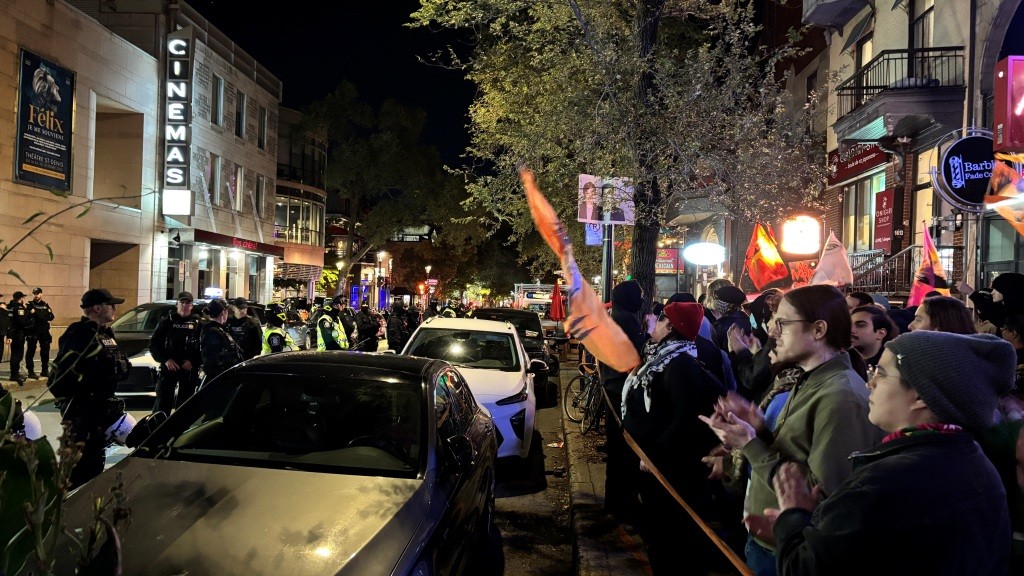
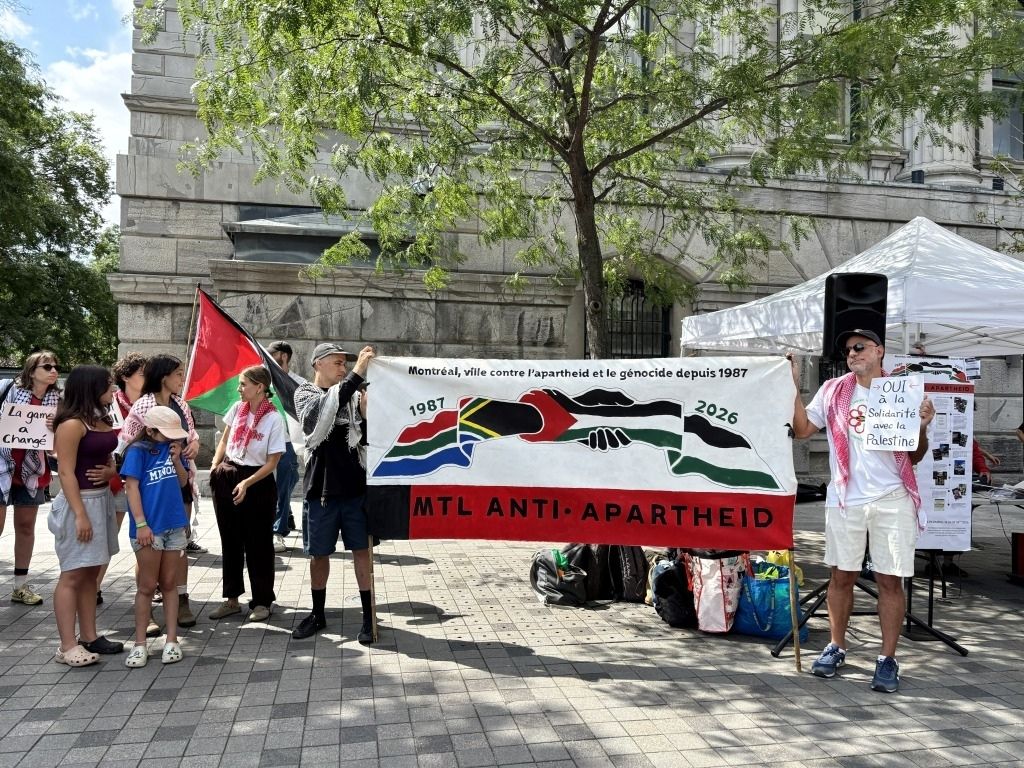
The debate took place following a demonstration by about a hundred people in front of City Hall. At noon, in persistent rain, activists, artists, union members, and human rights defenders took turns at the microphone to demand the adoption of the original motion.
The gathering was organized by Montreal Anti-Apartheid and the Ligue des droits et libertés. The motion had the support of over 130 organizations, more than 1,100 Quebec artists, and nearly 1,500 citizens. For Zev Saltiel, a representative of Montreal Anti-Apartheid and a member of Independent Jewish Voices Montreal, the expected vote was not to be considered a mere symbolic gesture. "The decision you are going to make today is not a symbolic decision," he told the elected officials.
References to 1987 were omnipresent. Actress and author Nathalie Doumard recalled the artistic mobilization in favor of breaking ties with South African apartheid. "In 1987, Montreal cut all ties with apartheid in South Africa. I am here today to ask Mayor Martinez Ferrada to do the same for Palestine," she declared.
Diane Lamoureux, president of the Ligue des droits et libertés, rejected the idea that Montreal could avoid the debate by citing its municipal jurisdiction. "Montreal’s elected officials cannot shirk their responsibility by saying it is not up to cities to take a stand," she asserted. According to her, "the City, whether it likes it or not, is already involved," particularly through its own institutional and commercial relationships.
Bertrand Guibord, president of the CSN’s Conseil central du Montréal métropolitain, reminded the council that the conflict also directly affects Montreal families. "We cannot turn our eyes away from the genocide happening before us," he declared. Finally, Rama Al Malah, of the Palestinian Youth Movement, placed the mobilization within a broader international movement.
At the end of the gathering, she was most struck by its scale despite the rain: "We haven’t seen a mobilization like this in quite a while."
For the organizations involved, Monday's vote does not settle the matter. Instead, it marks a new phase in a campaign that has been calling for years for Montreal to turn its stance on human rights into institutional action.