
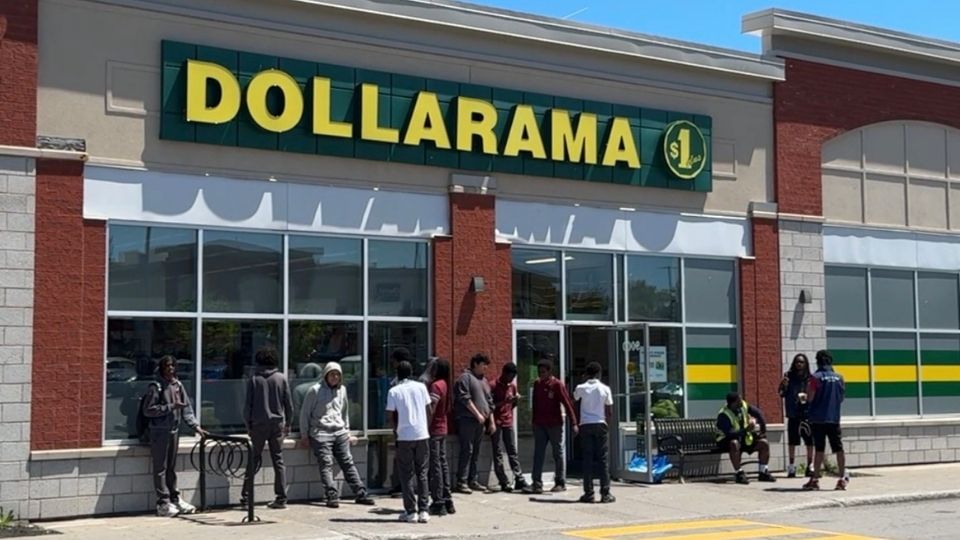
At lunchtime, dozens of students from Jean-Grou High School in Rivière-des-Prairies line up outside the local Dollarama to buy food. For about three years, they have only been allowed to enter two at a time. The scene repeats itself, in both heat and cold. For a law professor consulted by La Converse, the practice, based on the reported facts, constitutes age-based discrimination.
It is past noon on Boulevard Perras in Rivière-des-Prairies. About thirty students from Jean-Grou High School are waiting in line outside the local Dollarama. The sun is at its peak this June, and the heat is overwhelming for the teenagers. Entry into the store is filtered by a security guard. The youth are allowed to enter, but only two at a time. Inside, chocolate bars, chips, and sugary drinks for under $5—the essentials that many of them can afford before heading back to class.
Since the store opened about five years ago, this scene has repeated itself every school day, rain or shine. For many of the youth we met, the restriction sends a clear message: they are perceived as a threat before they even step through the door. Yet, as Eyana points out: "We are literally customers like everyone else. We come to pay."
"They treat us like thieves"
Wait times vary from day to day. Natalia says she stands in front of the store for about ten minutes when she arrives early, but up to half an hour when the line is longer. "Especially when the weather is extreme, when it's too hot or too cold, I find it pointless," she says. "It's a waste of time." For her friend Eyana, the wait can be even longer. "With this kind of line, we can wait 30 minutes or more. Some people wait an hour." Zoé claims that some students sometimes end up arriving late to school.
But the time spent waiting outside isn't what bothers them the most. When asked why they think they are subject to this restriction, the answers often come back to the same idea: by adopting this measure, the business is trying to prevent the theft and rowdiness that some students might cause.
That is the reason the students are challenging. "Anyone can steal," Eyana continues. "Adults can steal just as much as children. It’s not up to us to suffer the consequences for those who do steal."
Laurianne describes the discomfort differently. For her, waiting in line outside while adults walk in normally makes her feel like she is being publicly identified as a problem. "It’s like being humiliated in front of everyone," she says. "Adults can go in, but we can’t." Tristan also feels that young people are treated as suspects before they have even done anything. "They should give us a chance to prove that we aren't stealing."
Several students say they also have to drop off their bags before entering and feel watched once inside the store. Zoé makes a direct connection to the background of many young people who attend the school and frequent local businesses. "I think it’s because we are Black and Arab, and they are afraid we’ll steal," she adds. She doesn't claim that no one commits theft. But, she insists, just because some people do it doesn't mean everyone else should be treated the same way.
The sentiment expressed by these young people is not enough, on its own, to legally conclude that racial profiling is taking place. However, it adds to another, more easily observable finding: that the restriction targets a specific group—high school students.
A collective response to individual behavior
Wesley knows the area well. As a youth worker with the Équipe RDP youth leadership program, he regularly patrols what he calls the commercial hub around the school. His role includes preventing tensions and intervening when a situation threatens to escalate. He has been watching lines form in front of the Dollarama for years, he says.
He does not doubt that the business may have experienced theft or disruptions. But for him, the solution chosen to tackle the problem is hard to justify. "It’s not true that out of 60 students, all 60 are necessarily there to steal," he says. In his view, other methods could have been prioritized, such as an increased presence of staff or security guards inside the store.
Wesley acknowledges, however, that a store of this size can struggle to accommodate dozens of teenagers arriving at the same time. "Of course it’s complicated if 60 kids start walking into the Dollarama all at once [...] But at the same time, leaving kids outside like that, especially in the winter, isn't fun."
Dollarama cites traffic management
La Converse asked Dollarama if the restriction imposed on Jean-Grou students was a local or regional decision, or if it came from corporate headquarters. We also asked what losses or disruptions had motivated this measure, whether data existed, and if less restrictive solutions had been considered.
The company did not answer all of our questions. In her written response, Lyla Radmanovich, Dollarama’s media relations manager, explained that "entry control is one of the measures used across [our] Canadian network for several years to ensure site safety, prevent losses, and facilitate smooth operations." The company stated that this measure may be used when a large number of customers arrive simultaneously. Mrs. Radmanovich then added: "When it is implemented, it must apply to all customers."
However, that is precisely what did not match the scene observed in front of the Rivière-des-Prairies store on June 9. At lunchtime, adults were entering normally. Jean-Grou students, meanwhile, were waiting in line and being admitted two at a time under the supervision of a security guard.
On-site, the manager had confirmed to La Converse that students had previously caused disruptions at lunchtime. He also explained that the presence of a security guard for the past two years had made it possible to manage the situation without pulling store employees away from their duties. The head office's response thus contrasts with what was observed on the ground, where the restriction specifically targets Jean-Grou students.
"It’s textbook primary discrimination"
"That is the very definition of age-based discrimination in this context and regarding access to public spaces," says Professor Louis-Philippe Lampron. "That is textbook primary discrimination."
In an interview with La Converse, Professor Lampron, who teaches Human Rights and Freedoms at Université Laval, clarifies that only a court could rule on a discrimination case. However, based on the facts reported to him, he believes there would be a strong case for demonstrating a violation of the right to equality, which is protected by the Charter of Human Rights and Freedoms, in the Rivière-des-Prairies case.
For him, the traffic management argument doesn't hold up if only young people are targeted, because, he continues, a business can perfectly well limit the number of people inside. But such a rule must apply without regard to age. In the case reported by La Converse, the measure is therefore not neutral. "Since there is a criterion based on age, the policy is not neutral at all. It discriminates against people," he explains.
Furthermore, the existence of theft or problematic behavior is not enough, in his view, to impose an access restriction on an entire group. "That is the whole point of the right to equality," he continues. A business may have valid reasons for wanting to ensure its security or prevent losses. But it must still be able to justify the means chosen. According to him, "there are ways to solve the traffic problem without establishing discriminatory criteria."
Louis-Philippe Lampron believes that for students who feel they are victims of such a practice, the Commission des droits de la personne et des droits de la jeunesse (CDPDJ) is the most appropriate avenue. It can investigate a situation, attempt to reach a settlement with the business, or, if necessary, bring the case before the Human Rights Tribunal.
Ten years later, the problem has moved to a new location
The lines on Perras Boulevard are not isolated incidents. For at least 10 years, similar situations have been documented in Quebec, often near high schools. The locations change and the students change, but the reasons cited and the restrictions imposed remain the same.
In 2016, students from Jeanne-Mance High School in Montreal denounced restrictions imposed at several businesses near their school. At a Dollarama on Mont-Royal Avenue, young people had to wait before being allowed to enter, while other customers could access the store normally.
Following a complaint filed by a student, Dollarama ended the practice at that branch. The CDPDJ noted at the time that it had already received several complaints regarding similar restrictions targeting young people. Most striking is that, even then, the company defended the entry controls, explaining that the measure did not target "any particular segment of the population."
Ten years later, in its response to La Converse, Dollarama once again asserts that entry controls can be used to manage traffic, while specifying that the measure must apply to all customers.
In between, in 2020, a teenager in Quebec City denounced an almost identical practice at a local Dollarama. Young people there were subject to an access restriction that did not apply to adults. The company justified the measure at the time as a shoplifting prevention tactic before committing to review it. Then, in December 2025, the same approach reappeared in Verdun, where high school students were being screened at several businesses near their school.
From one case to the next, the same scenario seems to repeat itself: a practice is denounced locally, a debate ensues, and sometimes the measure is modified. A few years later, elsewhere, teenagers report once again that they are being screened at the entrance of a store.
Louis-Philippe Lampron does not claim to know the outcome of every case or whether each publicized situation resulted in a complaint being filed with the Human Rights Commission. Nevertheless, he believes this repetition deserves to be examined. "The fact that it is recurring, to me, suggests that there may be something here that needs to be clarified," he says.
On June 9, on Perras Boulevard, this repetition took the form of a line of about thirty teenagers waiting in the sun. Some found the wait simply annoying. Others spoke of discrimination. Still others acknowledged that some students might have caused problems, while refusing to be associated with them.
All of them, however, were waiting in front of the same door. Ten years after the first publicized cases, the practice continues to be adopted. It has changed schools, neighborhoods, and students, but at the doors of these businesses, the suspicion remains the same.