
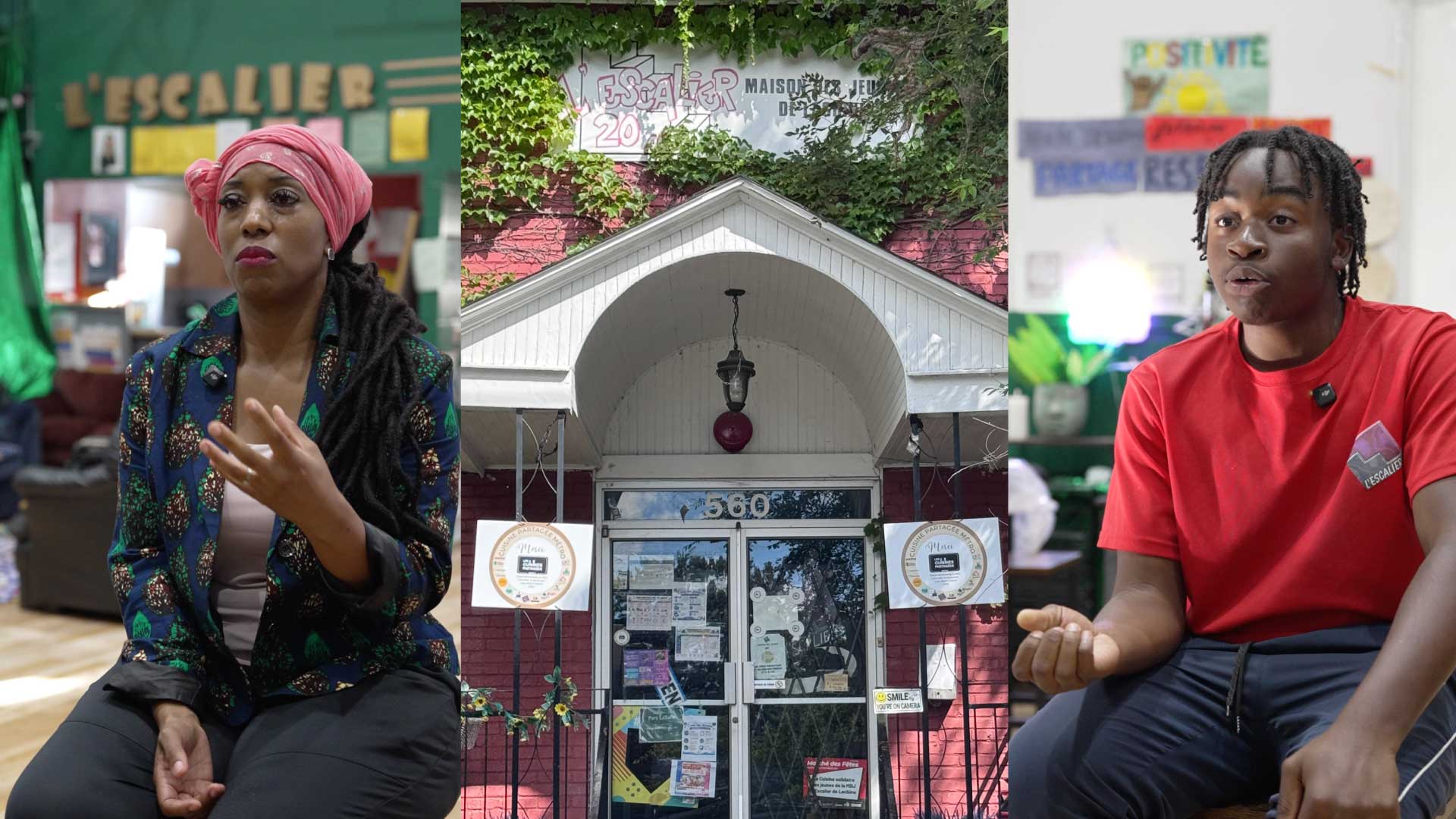
At the L’Escalier youth center in Lachine, the Les Jumelés day camp is coming to an end. Before heading home, children play together one last time under the watchful eyes of the young counselors. In some of Lachine’s disadvantaged and isolated neighborhoods, where spaces for youth are scarce, L’Escalier—which will celebrate its 42nd anniversary in November—is much more than just a place for activities for many of them.
The sun is playing hide-and-seek on this Friday, August 21. Outside the youth center L’Escalier de Lachine, the children are still bustling around a large table, laughing, eating, and finishing the summer together, set to music chosen by a DJ.
Dressed in orange shirts, teenagers trained to lead, supervise, and organize the facility’s activities keep a close watch. Some have found their first paid job here, while others are having their first experience with responsibility.
Yohan is one of them. Having arrived from Cameroon at age nine, he grew up in Duff-Court, Lachine, and today, at 18, he is a student at Cégep André-Laurendeau and works as a counselor at L’Escalier. But before becoming one of the supervisors, he was just a young person looking for a place to go.
"I was in Montreal without really being in Montreal"
Yohan discovered L’Escalier during the summer of 2024, when a friend, Wilfried, brought him there for his birthday. Once there, he found young people his own age, people who, he says, "are like you," share some of your realities, and sometimes speak the same language. Noticed for his enthusiasm and ease in communicating, he was first recruited as an apprentice cook for the day camp before undergoing training to become a counselor. His journey, he says, has above all broadened his horizons. "I was in Montreal without really being in Montreal." His world was mainly limited to Lachine. Trips with his parents were mostly for appointments or running errands, rarely for exploring the city.
Yohan’s observation also takes place within a territory in transition. While the proportion of immigrants in Lachine remains lower than the Montreal average, it jumped by 11% from 2016 to 2021, according to Centraide of Greater Montreal, whereas that increase was only 1% for Montreal as a whole during the same period.
It is thanks to the youth center that Yohan discovered other places and other possibilities. "Before coming here, I had spent maybe six years in Lachine, but I had never explored Montreal," he says. For him, this openness is particularly important when you grow up in a neighborhood where opportunities are not the same for everyone. L’Escalier thus becomes a gateway to a city that young people live in without necessarily knowing it.
One city, very different realities
For Ms.Ms. Onomo Lopes, we must also look at the city in which these young people are growing up. "Lachine is quite a unique city in how it is structured," she says, adding that very different social realities coexist within the same territory. Some sectors are more affluent, while others, such as Lachine-Est, Duff-Court, and Saint-Pierre, face cumulative challenges.
The specific features of this social geography also appear in the data. According to the Centraide of Greater Montreal neighborhood profile, the low-income rate reaches 20% in Duff-Court and 13% in Saint-Pierre, compared to 10% for Lachine as a whole. Duff-Court also has the highest proportion of single-parent families of any Montreal sector, at 62%.
Both sectors are also notable for their diversity. In Duff-Court, 52% of residents belong to a visible minority group, and the proportion reaches 43% in Saint-Pierre. In these neighborhoods, where many of the young people met at L’Escalier live, the need for an accessible place to gather goes beyond simple recreation.
For Yohan, Duff-Court presents its own set of challenges. He describes a neighborhood where many young people come from immigrant families and where certain situations can quickly overwhelm a teenager. The Saint-Pierre sector is marked by its isolation and the limited nature of available services. To enjoy certain activities or access specific services, young people have no choice but to rely on public transit.
Bernard, 18, describes Saint-Pierre as a neighborhood "apart," where places to socialize are rare. Kirkland Park is, in his view, practically the only gathering spot that comes to mind for young people.
When there is nowhere to go, the only options left are the street, the park, sports, or fast-food restaurants. In a sector like Saint-Pierre, where the low-income rate reaches 13% and isolation complicates access to resources, the proximity of locations, transportation, and family means also determine what is truly accessible.
For some, having a place to go regularly, in an accessible and supervised environment, becomes a resource in itself. Béatrice, 17, knows this routine well.
"I didn't have much to do"
Béatrice discovered the youth center through a teacher at her school, Dalbé-Viau. She was often bored and didn't know where to go or what to do with her time. "When I arrived [in Quebec], I didn't have much to do, I was bored all the time," she confides, adding that it was thanks to L’Escalier that she began to discover museums, movies, cooking workshops, and camping, among other things.
Béatrice describes herself as a shy person. For her, the youth center has also become a place where she can talk when she is going through a difficult time. "When I have problems, I don't have anyone around me to talk to," she says. Here, she knows she can reach out to someone and get a response.
For this young woman who is not yet fully fluent in French, the center has also become a space to practice and improve through interactions with other youth. Over time, her role evolved, and she found herself mentoring younger children.
For Yohan, the word that keeps coming up in his story is simple: new. It refers to a culinary activity, an outing, an art project, or a place in Montreal he hasn't seen before. The youth center has also reignited his passions for drawing, art, and music. "It re-inspired me," he says.
Seeing your child change
Young people aren't the only ones noticing transformations. Marlène Beliz Ngala sees them at home in her daughter Hélène, who has been attending L’Escalier for two years.
When the family arrived in Quebec about three and a half years ago, Hélène was, according to her mother, much more lonely and reserved. "She was really alone. She didn't want to talk much."
Today, Marlène sees her gaining self-confidence. She notices it in small things. In the family, Hélène had long resisted her mother's attempts to teach her how to cook. Then, one day, she announced she wanted to make pasta. Her father had a hard time believing she had made it herself. "No, you didn't make that!" he said, incredulous.
Marlène feels that her daughter now comes home with a new sense of confidence. "It really gave me joy to send her to the youth center even more so she could learn a lot," she says.
For the director of L’Escalier, these experiences are not always a given for newly arrived families, where parents work long hours and are discovering their new environment themselves. Some are unaware of the available resources or are hesitant to let their children go out.
Furthermore, like many parents, Marlène says she has fears for her teenager. But she trusts the team and the director of L’Escalier, with whom she speaks regularly. For her, this trust was built by observing the changes in her daughter.
With the exception of Lachine-West, all sectors of the borough have rates of single-parent families higher than the Montreal average of 33%. In Duff-Court, nearly two out of three families are single-parent households.
These data alone do not explain how parents raise their children. They do, however, serve as a reminder that the support available to teenagers varies depending on resources and availability. In this context, the trust a parent places in a local organization can take on particular importance.
When the youth becomes the mentor
On Friday, Yohan was there, among the children, whom he now views through a different lens. He recognizes in them that need to try new things, to break from the routine, and to discover a world that extends beyond home, the park, the basketball court, or the local fast-food joint. His own journey happened in stages: he first entered the building, then he got involved. Someone noticed his commitment and entrusted him with a first task, then a job, and eventually responsibilities with the younger ones. At L’Escalier, a young person doesn’t necessarily stay in the same place.
Muriel, 13, is already at another stage. She sits on the youth center’s board of directors and says she has gained confidence since she started coming here, largely because she discovered that her opinion could be heard.
Marilou, who is the same age, talks mostly about the friendships she has made. When she started at a new school, she ran into kids she had met at L’Escalier.
For Muriel and Marilou, change doesn’t yet take the form of a job or a career plan. It starts with confidence, with having friends, being listened to, and being able to participate in activities.
Wilfried, returning from the other side
Wilfried now returns to L’Escalier with a different story. Today a police cadet, he knew the youth center at a time when his future was much less certain. He confides that shortly after arriving from his native Cameroon, he went through a particularly difficult period due to family conflict. But fortunately, Wilfried recalls, community workers from the SPVM directed him to L’Escalier. There, he found someone who listened to him, and he stayed.
Confiding in La Converse, he speaks of that time today with great gratitude. The youth center welcomed him at a moment when his life could have taken other paths. He later lived in a youth shelter and pursued his dream of working in law enforcement. Today, that dream is starting to take shape, but Wilfried hasn’t left L’Escalier behind. This afternoon, he is back, and the kids recognize him and talk to him. Some ask him questions they wouldn’t necessarily ask the director or another adult.
He wants to maintain that closeness, he says, because he knows from the inside some of the realities they face. Because he also knows what it means to find someone to talk to. His role has changed: he is no longer the one being guided. Today, he is the one playing that role.
The risk of having nowhere to go
L’Escalier also plays a role that is harder to measure: it is there before a crisis occurs, when a young person just wants to get out of the house or doesn’t know what to do with their day. Bernard sums up the problem simply when describing the daily life of the youth in his neighborhood: you can spend your time walking the streets without knowing exactly where to go. He himself recounts arriving at L’Escalier after looking for something other than the repetition of sports, home, and the same old hangouts. "I just walked, and I came to the youth center," he says.
On Friday, as the camp was ending, several generations of youth crossed paths in the same building: children still playing, teenagers mentoring them, and alumni like Wilfried, who returned to maintain a connection with those following in their footsteps. These trajectories do not take shape in a vacuum. On the contrary, they take place in areas where social difficulties are unevenly distributed and where young people do not all have the same access to resources, activities, and the city.
L’Escalier does not appear merely as a place that organizes activities, but as a local social infrastructure with concrete effects on its environment. It also reveals, by contrast, what is missing when this type of place does not exist, is inaccessible, or is stifled by a lack of funding—much like those organizations that find themselves at their breaking point.