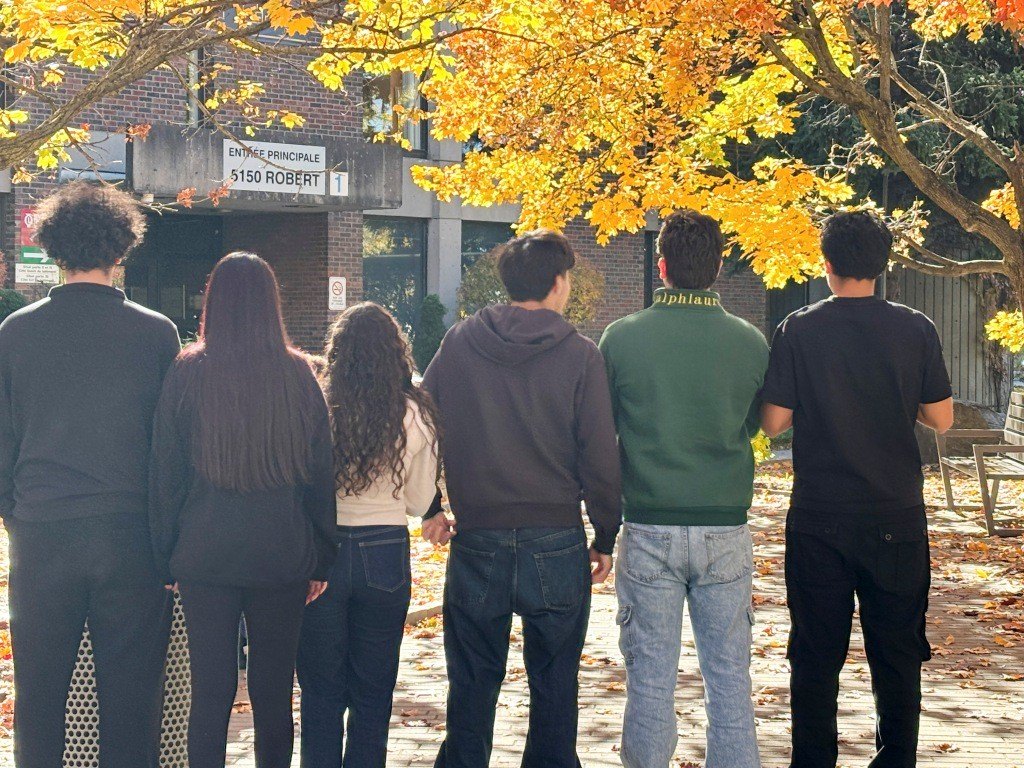

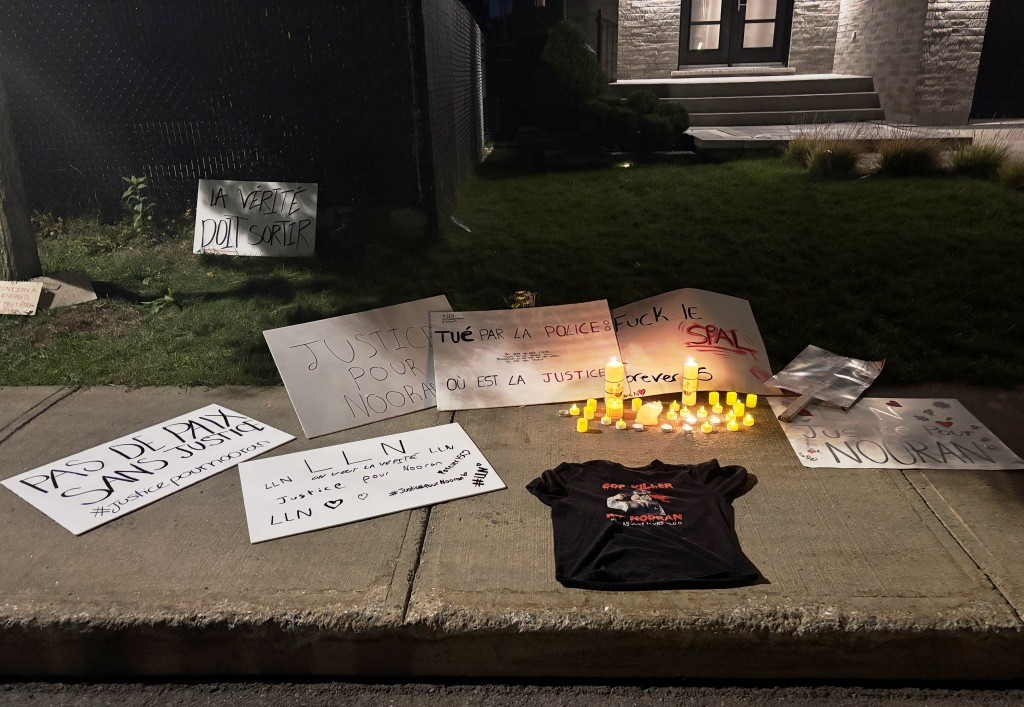
The family and loved ones of Nooran Rezayi gathered in Longueuil one year after the 15-year-old’s death during a police intervention. While the DPCP continues to analyze the Bureau des enquêtes indépendantes (BEI) report, the demands now extend beyond Nooran’s case alone: they challenge the transparency and effectiveness of police oversight mechanisms. In the midst of an election campaign, these demands pose a question to the political parties: what exactly would they change about the mechanisms meant to ensure oversight of police conduct?
The crowd is growing visibly. By 6:00 p.m., dozens are already gathered in front of 7151 Cousineau Boulevard in Longueuil, the headquarters of the Longueuil Agglomeration Police Service (SPAL). A quarter of an hour later, there are about 200 people.
On the signs, the face of Nooran Rezayi, who died a year earlier under police gunfire, appears alongside slogans demanding justice and transparency. Teenagers, loved ones, activists, and family members form a circle. From the first speeches, the memory of Nooran blends with an anger that goes beyond just his death. His cousin describes a boy who was "kind, joyful, and smiling," always ready to help others. A year after his death, she says, the pain remains as sharp as it was that afternoon on September 21, 2025. His sister also speaks of Nooran’s 15 years of life, his dreams, and the memories he should have been able to continue making with his family. For her, his absence remains "an endless nightmare."
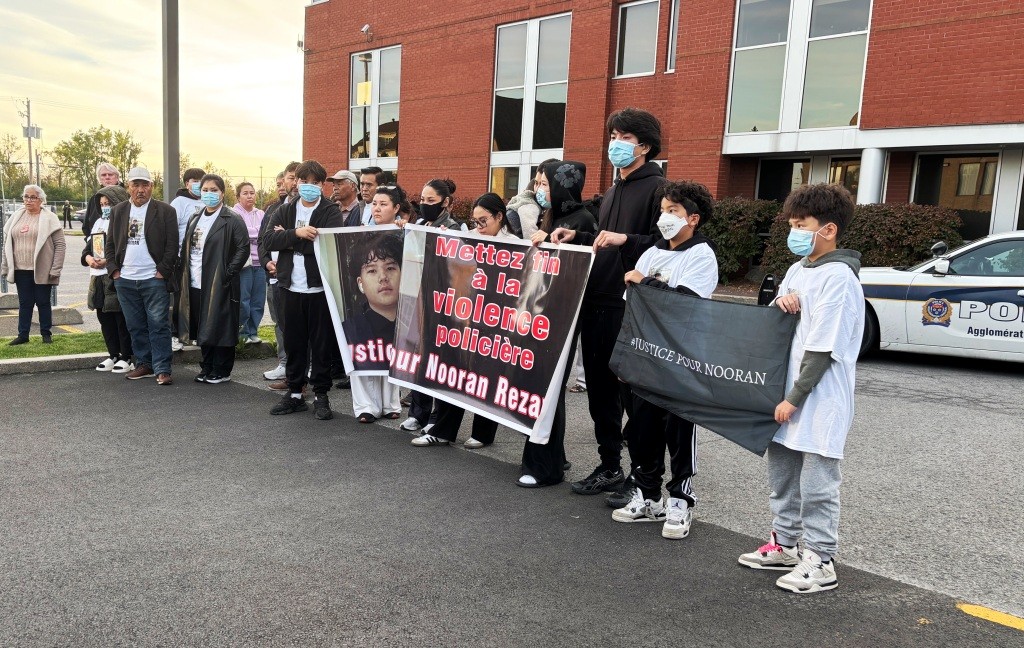
Photo: Nouri Nesrouche
Then, the floor is given to the young people who knew him. However, they yield their speaking time to rapper and youth worker Shamyr Daléus-Louis, known as Raccoon. He begins by saying that the increased police presence in the neighborhood since Nooran’s death has discouraged them from grieving in public.
Raccoon then reads a text written based on their words. "We feel that the police have always been against us because we are young and North African," he says. This detail likely stems from the fact that Nooran’s friends, while he was of Afghan descent, are predominantly of North African origin. In the same text, the youth report feeling that they are regularly perceived as criminals when they gather in groups: "You say you protect the neighborhood; we live in the neighborhood. Do you want to protect the neighborhood from us? But who protects us in the neighborhood?" The text also demands that the identity of the officer involved in Nooran’s death be made public, a request that also appears in the demands of his family.
The vigil transforms after an hour of walking. The procession heads toward the intersection of Joseph-Daigneault and Monaco streets in the Saint-Hubert borough, where Nooran lost his life. At the scene of the tragedy, candles are lit; on signs placed nearby, the word "justice" appears repeatedly. This same word returns like a leitmotif in the speeches of Nooran’s mother, Fahima Rezayi, and his uncle. A minute of silence is observed collectively, and prayers are recited in private.
After about two hours, the participants begin to disperse calmly. The anger, however, does not seem to have dissipated. Nor does the feeling, expressed by several speakers, that the answers awaited for a year have still not come. The vigil also serves as a reminder that the issue is not limited to judicial responses. In a previous report by La Converse, psychologist Imene Sta-Ali of the Centre Binetna emphasized that Nooran’s friends needed "reparations," and that these could also come through a clear gesture from the authorities—a statement acknowledging the nature of what happened.
Investigations, but still questions
On September 21, 2025, the death of Nooran Rezayi during a SPAL intervention triggered an investigation by the Bureau des enquêtes indépendantes (BEI). A parallel investigation was subsequently entrusted to the SPVM to examine the events leading up to the police intervention.
Three months later, after being informed of alleged failures in the management of the intervention, the mayor of Longueuil, Catherine Fournier, asked the Minister of Public Security, Ian Lafrenière, to launch an administrative investigation into the SPAL. On December 9, six members of the Rezayi family announced they were suing the City of Longueuil and SPAL officers for approximately $2.2 million.
On March 11, 2026, the BEI completed its investigation and submitted its report to the Director of Criminal and Penal Prosecutions (DPCP). At that time, two expert reports were still pending submission.
The administrative investigation was formally launched in June 2026 and entrusted to lawyer Michel Bouchard. The SPVM’s parallel investigation also concluded in June. The police force then announced that 11 youths, aged 13 to 17 at the time of the events, were facing charges in this related case. The file was transferred to the DPCP, which announced in August the temporary stay of proceedings against the 11 youths, citing new evidence and a complex legal issue.
For Nooran’s family, this succession of investigations has failed to dispel their questions. During the vigil, his lawyers, Mr.e Virginie Dufresne-Lemire and Me Fernando Belton, have denounced the delays and the lack of information provided to the families.
Me Dufresne-Lemire explained that the family learned through the media that the BEI file had been forwarded to the DPCP. She also stated that she does not know how long the prosecutor's review will take. "In the meantime, Nooran's family is still waiting for the DPCP's decision regarding the police officer," she added.
Me Belton indicated that the family will now turn to the courts to obtain certain documents from the investigation. A hearing is scheduled for October 8 and 9, according to the lawyer.
The DPCP carries out its duties independently and must determine, based on the evidence gathered, whether to initiate proceedings. But the Nooran case raises another question: how long should a family be kept in the dark while multiple institutions handle a case that concerns them? Who should inform them? At what point? What can they be informed of without compromising an investigation or potential legal proceedings?
It is this question, which goes beyond the Rezayi case alone, that is now at the heart of the demands made by his loved ones: the need for transparency and accountability when a police intervention results in the death of a civilian.
Uneven commitments
With the October 5 election approaching, La Converse asked the five main parties in the running what measures they intend to take to strengthen oversight of police action: the powers and operations of the BEI, the transparency of investigations, the role of the DPCP, police ethics, and sanction mechanisms.
We also asked for their position on the potential transfer of some police resources toward prevention, mental health, and community organizations.
Only Québec solidaire (QS), the Coalition Avenir Québec (CAQ), and the Quebec Liberal Party (PLQ) responded. The Parti Québécois (PQ) and the Conservative Party of Quebec (PCQ) did not follow up on our questions.
The PLQ noted that it has previously proposed making BEI investigation reports public. The party says it wants "an independent, rigorous system in which the public can have confidence," without specifying in its response what changes it would make to the BEI, the DPCP, or the Police Ethics Commissioner.
The CAQ did not respond directly to our questions. Its press secretary instead referred us to a post by Ian Lafrenière on September 21, in which the minister notes that he launched an administrative investigation into the process surrounding the notice sent to the BEI by the SPAL. Mr. Lafrenière also states that the investigation file is in the hands of the DPCP and adds that, "if the full truth is not uncovered," he does not rule out the possibility of launching a public inquiry.
The CAQ government had previously been called out regarding the shortcomings identified in the case. In December 2025, the National Assembly unanimously adopted a motion acknowledging the "serious shortcomings" raised by the BEI regarding the SPAL's actions and requesting that the government determine the appropriate follow-up in coordination with the BEI and the DPCP. In the spring of 2026, Québec Solidaire MNA for Laurier-Dorion, Andrés Fontecilla, also raised the issue of the transparency of BEI investigations in the National Assembly, specifically the possibility of making its reports public. He cited the case of Nooran Rezayi on that occasion.
Québec Solidaire provided the most detailed response to the questions posed by La Converse. In a statement to our editorial team, the party asserts that a Solidaire government would establish "an effective and transparent system for overseeing police activity" and would combat "infringements on rights and freedoms, systemic racism, excessive use of force, a lack of consideration for reports of sexual assault or domestic violence, and bias during investigations into police activities."
It should be noted that the party has already taken a position on the Rezayi case. In December 2025, Solidaire MNA Alejandra Zaga Mendez, jointly with Liberal MNA Jennifer Maccarone and Parti Québécois MNA Joël Arseneau, presented a motion requesting that the government follow up on the shortcomings identified by the BEI, in coordination with the BEI and the DPCP. The motion was adopted unanimously.
A first motion, presented in October 2025 by Andrés Fontecilla and Jennifer Maccarone, had also been adopted unanimously. It specifically requested that the circumstances surrounding Nooran's death be fully brought to light and that investigations be conducted with transparency. It also called for avoiding generalizations, particularly any association between youth and violence or delinquency.
The PQ, which did not respond to our questions, put forward a more general proposal regarding the oversight of police services. In February 2026, its public security spokesperson, Joël Arseneau, had a motion adopted unanimously requesting that the government reinstate the Conseil sur les services policiers du Québec, which has been inactive since 2013. The motion recalls that this council, provided for by the Police Act, is intended to advise the minister on matters relating to police services.
When the election campaign takes on Nooran’s colors
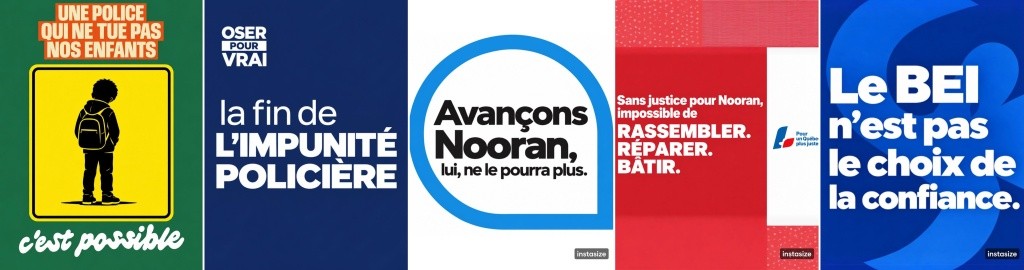
Photo: courtesy of Will Prosper
To mark the first anniversary of Nooran Rezayi’s death, activist and filmmaker Will Prosper inserted himself into the election campaign, in the style of culture jamming, whose practitioners generally use irony, visual sabotage, and satire to alter the meaning of advertising messages.
On Instagram, he published a series of five posters using the visual codes of the five main parties running in the October 5 election, subverting them to demand justice for Nooran. For Québec Solidaire, the green color and the slogan "it’s possible" become the backdrop for a direct message: "A police force that doesn’t kill our children… it’s possible." The blue circle and the "Let’s move forward" of the Coalition Avenir Québec are completed with "Nooran, however, no longer can." Another example: the Parti Québécois slogan—"The choice of trust"—is turned into an accusation: "The BEI is not the choice of trust."
For Prosper, this subversion is a way to address political parties directly, but also the voters. "It’s a way to challenge these politicians so they react, and to challenge the public as well," he explains to La Converse. He says he wants to highlight what he considers to be the "void" in certain election campaigns and bring Nooran’s death back into public conversation.
Moreover, the issue goes beyond the teenager’s case alone, maintains the author of reXistence, who questions the functioning of the mechanisms meant to investigate fatal police interventions and specifically calls for a re-examination of the BEI’s role, its independence, and the transparency of its investigations. He also wants the next government to tackle racial profiling and police stops, which he considers arbitrary. He cites the Luamba case, which concerns traffic stops without apparent cause, and mentions the possibility of a moratorium on certain police practices.
A question that remains open
Prosper acknowledges that the election campaign is currently focused on other, equally important issues, such as housing, poverty, education, and immigration. But he believes that the issue of police violence and the treatment of racialized youth belongs to the same debate. "It’s also about taking care of our population, it’s also about taking care of our youth, it’s also about taking care of people," he says.
That is precisely why he chose to launch his counter-campaign now, while parties are actively seeking votes. For Prosper, Nooran’s death and the events that followed are not just a matter of police practices. "This isn't a policing issue, it's a political one," he concludes.
A year after Nooran’s death, his name appears in his family’s demands, in ongoing legal proceedings, and now, in the election campaign. The parties' responses remain inconsistent, while the DPCP continues its review and the family still seeks access to investigation-related documents.
With his posters, Will Prosper ultimately brings the issue back to politics: what must change when a police intervention leads to the death of a young person and, a year later, the family is still waiting for answers?