


.jpg)

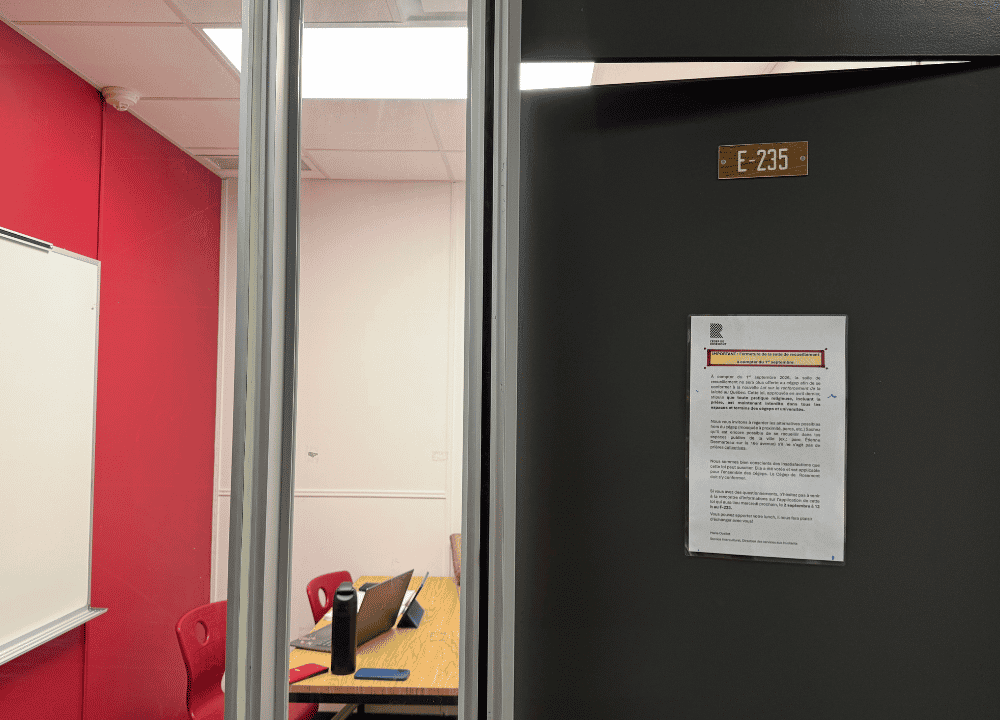
A few weeks into the semester, Cégep de Rosemont has found its rhythm again: schedules to master, rooms to locate, and breaks to plan. However, for those who used the prayer room, a 10-minute routine did not resume with classes. At both Cégep de Rosemont and the Université de Montréal, the first few weeks of Bill 9's implementation offer a look at its concrete effects on religious practices and the daily lives of students.
Adopted on April 2, 2026, the Act to strengthen secularism in Quebec notably changes the rules applicable to colleges and universities. Since September 1st, 2026, its main provisions targeting campuses have been in effect. Except for exceptions provided for in the law, all religious practices are now prohibited in places under the authority of a higher education institution, where faces must also remain uncovered.
At Cégep de Rosemont, these new rules led to the closure of a prayer room used for individual practice. La Converse went on-site to understand how the law is being applied in student life. We met with people who frequented the room, others who didn't know it existed, as well as representatives from the Cégep de Rosemont General Student Association (AGECR) and the FAÉCUM. We also consulted the text of the law, the government page on the Act respecting the secularism of the State, the parliamentary debates and the briefs submitted before its adoption.
Ten minutes to catch your breath
Until it closed, the room was used in a simple way: access was individual and limited to 10 minutes, and the key could be borrowed from the AGECR office. At the start of the school year, these rules were not modified; they were abolished. The room is no longer used for prayer.
According to testimonies gathered by La Converse, the room was neither a mosque nor a gathering place. "There was no group dynamic. It really didn't bother anyone," reports Myriam*. This student and mother in her forties asked to remain anonymous for fear of being recognized.
Since she doesn't know of any prayer spaces near campus, Myriam now plans to postpone her prayers until she gets home. "It stays in the back of my mind. It’s a form of mental load," she explains.
The room also allowed her to take a break during the day. During the previous semester, Myriam had sought refuge there before an exam that was making her particularly anxious. "That break helped me regain my confidence. I was calmer afterward." Her testimony therefore links the room to her religious practice, but also to her ability to regain her composure before an evaluation.
Talia, a respiratory therapy student, also describes the room as something that was beneficial to her studies. "I am here to study, and this room would allow me to have better conditions for studying. Plus, it didn't bother anyone," she laments.
Even among those who didn't use it, this room was perceived as a space where it was possible to isolate oneself. Sarah, who is 19, refers to it as a " safe space ," a secure space. She points out that there are few places in a Cégep where a person can stop for a few minutes and be alone.
Zarah, 18, was unaware of the room's existence before it closed. Several other people met during La Converse's visit gave the same answer. For Zarah, this lack of awareness shows just how discreet the use of the space was.
Effects that vary from person to person
The law applies to all religious practices. However, the constraints described by the people we met vary according to their practice and their schedule. For those whose prayers take place at specific times of the day, several consecutive classes can now force them to choose between their academic schedule and their spiritual schedule, explains Talia.
In a brief presented before the law was adopted, the Fédération des cégeps feared that the ban on prayer would hinder accessibility and academic success. It noted that some campuses were located near religious facilities, while others, more isolated, offered no alternatives. According to the federation, this constraint was likely to lead to delays, failures, or dropouts. The organization also maintained that the requirement to have one's face uncovered would, in practice, affect certain women.
At Rosemont, Samira, 18, thinks of a former classmate who wore a niqab. She participated in class and, Samira insists, "she didn't bother anyone." Not having seen her in her classes anymore, the student doesn't know what became of her.
When questioned by La Converse, the communications advisor for Cégep de Rosemont, Marie-Ève Robitaille, indicated that the three students who wear the niqab had been met with so that the situation could be explained to them. They are still enrolled at the Cégep, she specified. Psychosocial support services are also offered to those for whom these changes cause discomfort or anxiety.
But beyond the support offered by the institution, these changes have deeper repercussions on how some students perceive their place in Quebec. For Talia, the debate also touches on a sense of belonging. "I was born here and, sometimes, I don't even feel like I'm in my own country. These are days like today." She mentions a French friend who came to Quebec to better reconcile her studies and her religious practice. This friend now feels like she is watching "the movie repeat itself."
A practice recommended before being banned
The model used at Rosemont resembles a measure favorably presented in the 2025 government committee report on secularism. In it, the committee described rooms accessible to one or two people at a time, reserved for the student population and available for quiet reflection, relaxation, yoga, or other uses. It recommended allowing colleges to set up this type of space, provided it was not dedicated exclusively to prayer.
According to the testimonies gathered, the room at Cégep de Rosemont met several of these criteria: individual access, limited duration of use, and regulated operation. The legislature, however, opted for a general ban on religious practice in places under the authority of cégeps and universities. The Fédération des cégeps' request to exempt colleges from this ban was not accepted.
This change therefore concerns more than just the existence of a room. It also replaces a local management model with a rule common to all affected institutions. How this rule will be applied remains at the heart of the concerns expressed by the associations met.
Questions regarding communications
The closure of the room is not the only source of concern for the Association générale étudiante du Cégep de Rosemont. The AGECR, which describes itself as an entity autonomous from the institution, claims to have received instructions from the administration regarding images of people wearing religious symbols.
"It’s awkward to ask someone to leave the frame just because they are wearing a religious symbol," the association summarizes. Its representatives believe that a veil will be spotted more easily in a photo than a small cross worn as jewelry.
The provision on communications does not explicitly prohibit photographing or showing a person wearing a religious symbol. Instead, it stipulates that an institution or targeted organization cannot "highlight the representation of a religious symbol" in its communications. For the AGECR, this wording and the instructions received create uncertainty about which images it can publish.
The association also claims that the administration strongly advised against using student fees to seek an alternative solution to the quiet reflection room. It views this intervention as an infringement on its autonomy. These exchanges lead it, it says, to anticipate what might be considered an overly visible religious presence.
At the Université de Montréal, prayer moves elsewhere
At the Université de Montréal, certain classrooms had been reserved since 2024, at specific times, for individual quiet reflection. According to the FAÉCUM, no collective prayer was organized there, and no outside person could come to lead a religious practice. The university ended this measure after the new provisions came into effect.
Since the closure of these rooms, the Association des étudiants musulmans de l’Université de Montréal (AEMUDM) has been listing, on a page dedicated to quiet reflection, locations near campus where students can go to pray.
Frédéric Beaudet, secretary general and spokesperson for the FAÉCUM, places Bill 9 within a series of measures adopted by the Quebec government in the name of secularism. The FAÉCUM opposed it.
"For us, all three touch on the same principle: it’s an instrumentalization of the concept of secularism to target minorities," he asserts, referring to Bill 21, Bill 9, and the application of restrictions on religious symbols to interns.
Mr. Beaudet also believes that Bill 9 expands the scope of the principle. "Now, we are going even further with Bill 9: we are extending the principle to people who receive a service from the State, to people who set foot in a State institution," he summarizes.
The FAÉCUM does not expect the disappearance of the quiet reflection rooms to end prayers on campus. "We aren't going to erase prayer at the Université de Montréal; we are simply going to marginalize it," maintains Mr. Beaudet. Before the rooms were set up, he recalls, some people were already praying in libraries, stairwells, or isolated areas. He expects these practices to reappear.
The federation acknowledges that the university must comply with the law. However, it opposes any application it deems excessive. "That doesn't necessarily mean we need to start dispatching security everywhere on campus to hunt down prayer," warns Mr. Beaudet.
In a written response to La Converse, Geneviève O’Meara, spokesperson for the Université de Montréal, stated that the institution has informed its staff of the new rules. "Prayer is now prohibited on our campuses; we must enforce the law. Our staff, including security officers, has been notified. Anyone praying on campus will be asked to stop and move elsewhere to pray."
The enforcement of the law will thus manifest beyond the rooms previously designated for prayer. It will also depend on what institutions deem to be religious practice in hallways, libraries, or stairwells, and the reaction they choose to adopt.
The question also arises in institutional communications. For Mr. Beaudet, religious neutrality should not cause the disappearance of all religious representation. "Religious neutrality is not the invisibilization of the concept of religion," he insists. According to him, removing religious representations does not automatically make an institution more neutral; rather, it reflects a specific conception of neutrality.
In this context, the AEMUDM has published a map on its website listing mosques and prayer spaces located near campus. This resource allows students to locate accessible options when they wish to pray. While the initiative offers a practical solution, it also reveals a new constraint: the obligation to leave campus and adjust one's schedule to engage in a practice that was previously integrated into university life.
Mobilization as elections approach
The FAÉCUM plans to work with other organizations and coalitions opposed to what it describes as the instrumentalization of secularism. Its spokesperson also fears that the current restrictions will be followed by further measures.
He points out that before the adoption of Bill 21, the debate had focused in particular on the obligation to give and receive certain services with one's face uncovered. This precedent now fuels the federation's concerns. "If we go by the past, it is very possible that the next step, if we don't mobilize, will be a ban on all religious symbols as soon as you set foot in a university or CEGEP," suggests Mr. Beaudet.
This possibility is a fear expressed by the FAÉCUM; it is not included in Bill 9. Nevertheless, it explains why the organization does not consider the closure of prayer rooms to be a simple matter of internal management.
As provincial elections approach, secularism is once again becoming a subject of mobilization. Myriam* now attends information sessions on voting organized at a mosque in Laval. For her, the closure of the prayer room gives the election concrete significance. "Our vote can prevent or favor measures of this kind. It has a direct impact on our lives," she concludes.
*Pseudonym.
.jpg)