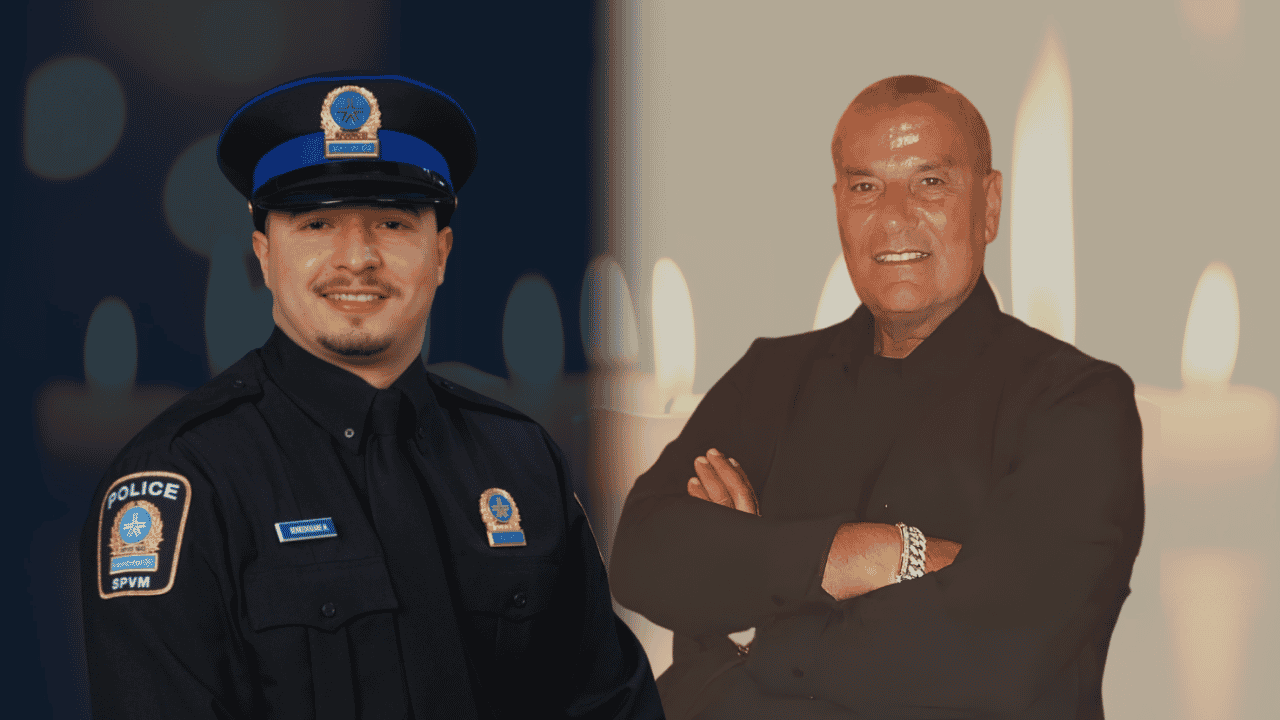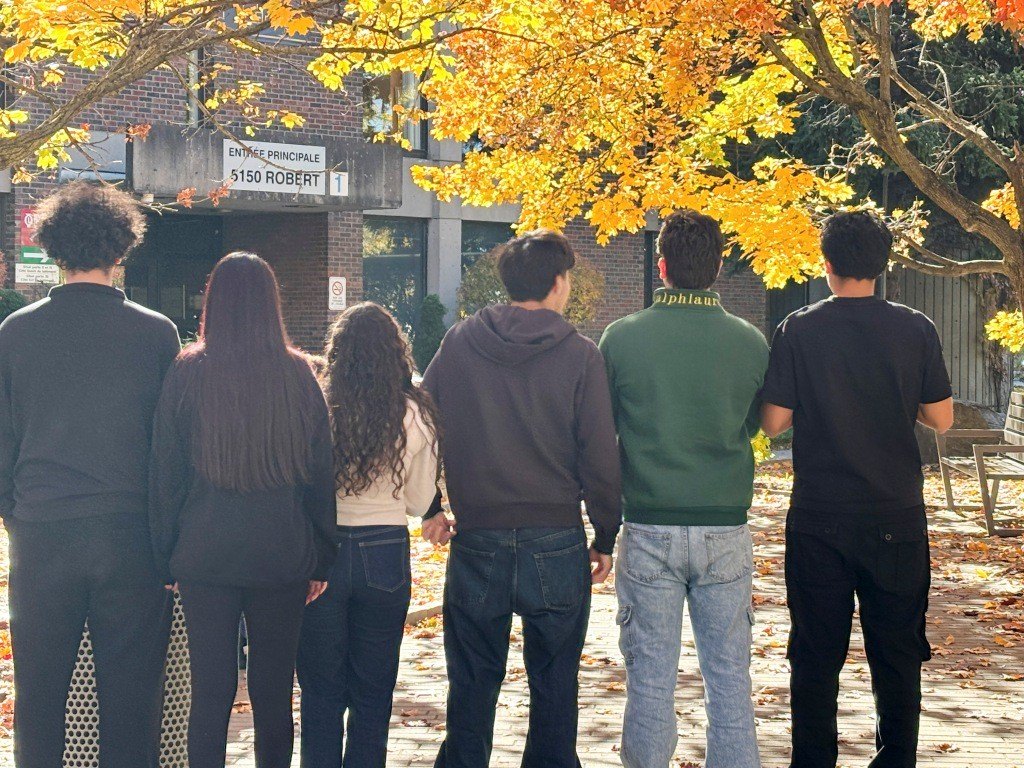

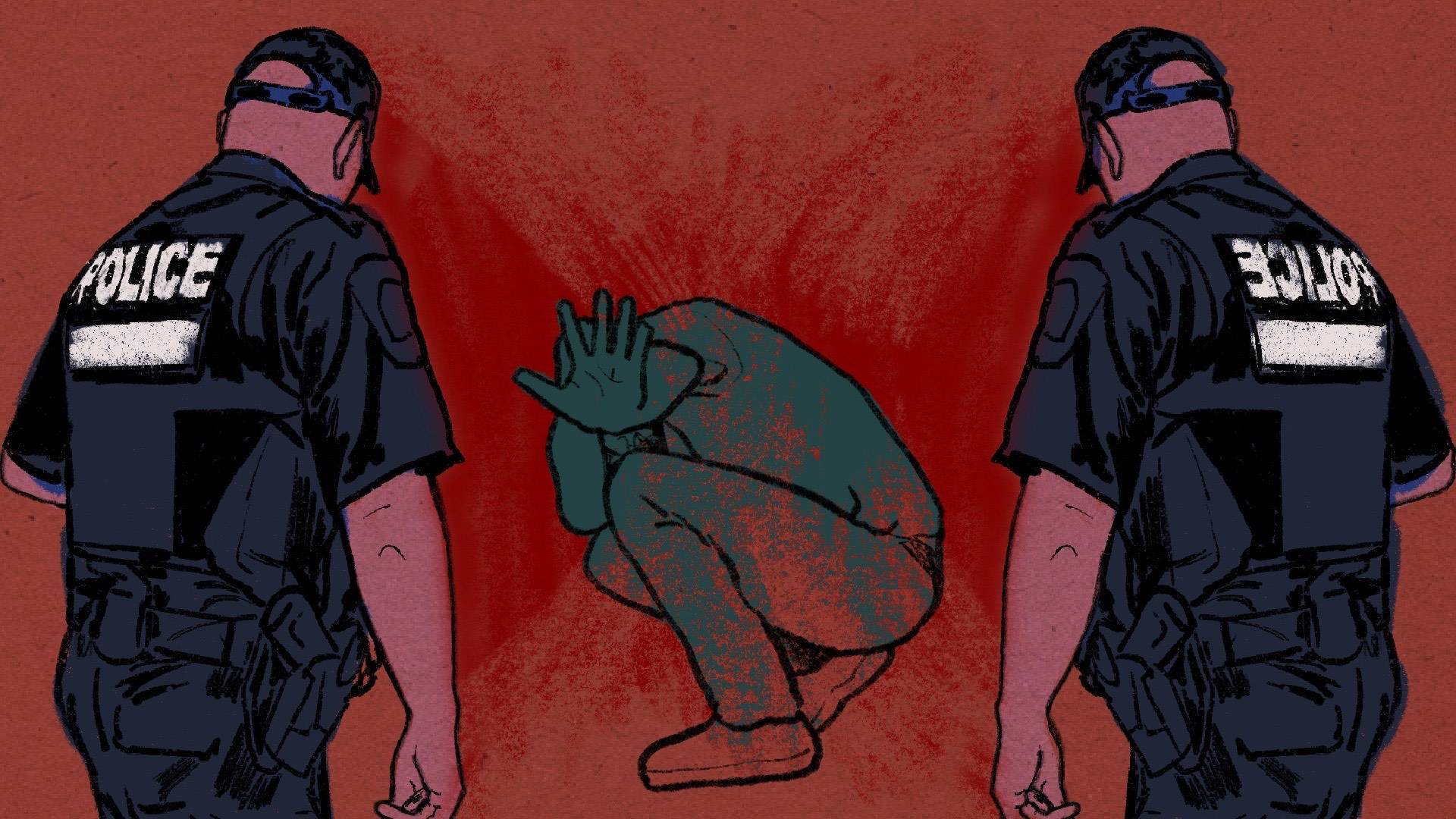
A police officer from neighborhood station 21 (PDQ 21) allegedly filmed himself urinating on homeless individuals while they slept, before sharing the footage in private far-right groups. A second officer from the same station reportedly photographed racialized individuals in humiliating positions. More than a week after these revelations, six people met at an encampment tell La Converse why they are not surprised. Their testimonies raise questions about police practices, the fear of filing complaints, and the resources actually available to them.
Sunbeams light up this encampment located near downtown Montreal on this mild late October day, before the arrival of the deep freeze. Around the few tents where fewer than a dozen homeless people live, including a few women, a hodgepodge of objects, small pieces of furniture, and camping chairs are scattered about. Boots lie on the ground, and backpacks contain the few personal belongings of their owners. Here, every object seems to have its place in a daily life organized around the necessity of getting by outdoors.
Over coffee and a box of Timbits, six of these individuals share their experiences with the police. At their request, we are withholding the precise location of their encampment, the identities of the people living there, and personal details that could lead to their identification. The people testifying here state that they fear retaliation from the police.
At the encampment, the news from October 16 brings everyone back to their own memories. Before talking about the officer whose actions are making headlines, the men recount their encounters with other officers. They speak of forced awakenings, humiliating remarks, and interventions from which they say they still bear the scars. Their stories are distinct from the PDQ 21 files, but it is through these experiences that they process the revelations.
The case became public on October 16, 2026. According to information from La Presse, a downtown Montreal police officer allegedly urinated on a homeless person while on duty. In a separate case, a second officer from the same station reportedly posed for photos in which he appeared to be ridiculing a suspect placed in a humiliating position during an arrest.
Other reports describe acts filmed by these same officers over an 18-month period, which were allegedly perpetrated against people sleeping on the street. Radio-Canada reports that at least one video circulated on social media in a private far-right group that had been infiltrated by the Royal Canadian Mounted Police (RCMP).
The statement released by the Service de police de la Ville de Montréal (SPVM) confirms neither the content of these images nor the role of the RCMP. When these revelations were made, both officers had already been suspended for several weeks. However, a suspension does not constitute a finding of guilt.
At the encampment, the conversation does not stop at the fate of these two officers. The men return to the interventions they claim to have experienced, long before this case made headlines.
"It wouldn't surprise me if it were me"
None of the men we met are surprised by what was revealed about PDQ 21. Another thing holds their attention: what would it take for such acts to be reported by those who suffer them?
In Quebec, anyone who believes a police officer has acted improperly can file a complaint. But there is a gap between the right to file a complaint and the ability to do so. This gap is made up of legal deadlines, written procedures, having one's word doubted before it is even heard, and the fear of approaching the very institution one is denouncing.
With brown hair and a thick beard, Kevin is in his thirties. Approachable and friendly, he opens up at length as soon as the conversation begins. The stories follow one another, as if he rarely has the opportunity to talk about these experiences in a space where he feels heard. When we bring up the revelations about PDQ 21, he immediately draws a parallel with a night he spent outside.
"It wouldn't surprise me if it were me," he says after hearing the news. He recounts falling asleep once near a warming center, close to the Ubisoft offices, and waking up covered in urine. Someone had either poured urine on him or urinated on him while he slept. He does not know who was responsible.
His response shows no surprise. For him, the news points to a humiliation he says he has already endured. As he continues his story, other memories surface, this time related to police interventions from which he claims to still have injuries. A few years ago, while he was doing graffiti, a police officer allegedly ran toward him before slamming him onto the concrete. Kevin acknowledges that he had a condition at the time that prohibited him from possessing markers. He says he placed his hands behind his back, expecting to be arrested.
"My femur snapped in two," he says, the pain still audible in his voice. "The police didn't believe me when I told them I was in real pain. They just left me there and walked away," Kevin adds. He explains that it took him about half an hour to cross the street without anyone's help to get to a clinic and ask for assistance. "I was hospitalized for about eight days and underwent surgery that required a titanium rod to be placed in my leg," he confides.
Kevin reports another intervention during which a female officer allegedly fractured his ribs while pinning him to the ground. "I told the officer I was in real pain. Unlike what happened the time before, the officer who had just injured me drove me to the hospital herself," he notes. When asked how he felt about these actions committed by people supposed to protect him, he replies with sarcasm: "I was so happy."
His response gives the impression that the question itself surprises him more than the actions he just described. Why ask him how he felt after such injuries? He pauses for a moment, then continues: "I don't feel safe with the people who are supposedly there to protect me. Isn't that enough to make things change? Every time I see them coming, I already know they aren't there to ask if I'm okay."
Added to the fear is the bitterness of never having received an apology. "I never got an apology from the police, not even for the fractured femur or the broken ribs," he laments wearily. He confides that he is "reduced to counting the days when the police don't humiliate him." Kevin concludes by saying he reported what happened to him, but without initiating a formal process. He explains his reluctance: "It’s too long a process. I don't even know what resources could help me, and I don't have much hope of getting justice."
The true cost of legal action
Justin Wee takes on legal aid cases for people experiencing homelessness when they are sued by citizens. "You get the impression that these people have easier access to the justice system when they are being sued than when they want to assert their own rights," observes the lawyer at ADW Avocats. Mr. Wee distinguishes between financial eligibility for legal aid and the types of proceedings it covers. In his experience, a person who wants to sue a police officer in civil court to obtain compensation for damages suffered—injuries, for example—generally cannot benefit from this aid, even if they are financially eligible. But if they are the ones being sued, they can then access it for their defense.
"I know there are special cases, but they are rare and I haven't seen any in my practice," he clarifies. The rights exist, but the means to exercise them are not equally distributed. For Mr. Wee, this imbalance does not begin at the moment a complaint is filed. It can also weigh on the relationship with the police. "What is particularly concerning about this type of abuse is that the most vulnerable populations are often the ones who suffer this kind of behavior," he states. "There is therefore a very significant power imbalance, which can foster abuses of authority," he adds, linking this vulnerability to the resources people have available to defend themselves. Respecting dignity is also a basic responsibility, emphasizes the lawyer, for whom "you shouldn't need special training to understand that this kind of behavior is unacceptable."
"I fear for my life"
Between two Timbits, Nicolas brings the conversation back to what each day already demands of him. "I’m just trying to survive. It’s hard to get mobilized when you’re just trying to survive." Tall and thin, with blond hair, Nicolas is in his thirties. Before Montreal, he lived on the streets in Toronto. At the start of our meeting, he is reserved, asking us questions about why we are there. Then, as the conversation progresses, his wariness fades, and he opens up more. He talks about his fear when police officers approach him. "I feel like they’re going to shoot me."
When asked if he fears for his safety, he clarifies: "Yes, for my life." Nicolas says that police officers regularly come to wake up the camp occupants to tell them to move. And it is rarely a humane or respectful intervention. "Often they will shake us with their feet," he explains.
He also claims to have had weapons pointed at him and to have been hit with conducted energy weapons during interventions where the use of force was clearly unnecessary. These situations have happened so often that he says he has stopped counting them. His fear is part of a history that extends beyond Montreal. In Toronto, he recounts, police officers wanted to clear a park where he was with his dog. He says he laid down over the animal to protect it and prevent it from biting anyone.
"The police kicked me so hard that it broke my ribs," he describes. He does, however, distinguish between individual officers. "Some behave badly, others don't," he qualifies. Although he acknowledges the difficulty of the job and the tensions officers face, that does not make the fear he says he feels when he sees them approaching go away.
When he talks about his dog, Nicolas recounts their travels, their routines, and the fact that the animal would pull him when he was riding his skateboard. "He’s been my best friend for 14 years," he says with emotion. He confides that his dog was taken from him by the police.
"They took him away from me by claiming he was dangerous. But I know my dog, he isn't dangerous, he just had defensive reactions." It was by reading the file that he says he understood the scale of the problem. "I was shocked by the inaccuracy of the facts reported by the police in the documents. They presented a version of events completely different from the one I experienced."
He sees it as "clearly an abuse of power." He feels that his efforts are not enough and that his word "carries less weight than that of the police officers who testified in the file." Now deprived of his companion, he is trying to get him back. The steps to find him already take up a significant part of his daily life. Filing a complaint would mean putting other efforts aside, he explains.
"Filing a complaint is the last thing on my mind. I have to find something to eat, somewhere to sleep, a way to protect myself, and a way to get my dog back." Reporting an intervention represents one more task in a day where the most pressing needs sometimes remain unmet.
Filing a complaint, but with what resources?
Annie Archambault, a content creator who addresses the realities of people experiencing homelessness and who has experienced homelessness herself, sheds another light on these obstacles. For her, the existence of legal resources is not enough to explain why a person uses them or not. She mentions the meal one risks missing or the arrival time at a shelter. She also talks about shame, the fear of judgment, and the difficulty of feeling important enough to undertake these steps. "Do we support the person so they don't feel ashamed?" she asks.
She notably points to the existence of the Clinique Droits Devant and legal aid. But she invites us to look at what precedes the filing of a complaint, when the person must still decide if they can and if they want to tell what happened to them.
The Police Ethics Commissioner provides there are several ways to collect these accounts. A complaint can be filed online, by phone appointment, or, in certain situations, verbally to staff. A community organization can also help prepare it. Therefore, the process does not necessarily involve filling out a form alone. However, there is a deadline to respect. The general rule is to file a complaint within one year of the event or of becoming aware of it. The Commissioner recommends gathering documents and witness contact information quickly, while noting that it is not necessary to have all the answers or all the evidence for the complaint to be analyzed.
These procedures exist to facilitate filing. They do not address whether Nicolas would have the time, energy, health, or necessary support to file a complaint when the time comes. It is this availability that his words and those of Annie Archambault address.
In Montreal, who holds the police accountable?
For Kevin and Nicolas, denouncing the police behavior they claim to have experienced is a difficult, sometimes inaccessible process. But beyond individual recourse, another question arises: who should hold the police accountable when such allegations are made public?
At Montreal City Hall, the revelations concerning PDQ 21 have reignited the debate on the responsibility of elected officials and the oversight mechanisms for the SPVM. On October 16, in comments reported by La Presse, Mayor Soraya Martinez Ferrada denounced an act as "inhumane" and expressed concern about a "fragile relationship of trust" between community organizations and PDQ 21 officers. She emphasized, however, that "we must wait for the results of the investigation."
Three days later, on October 19, the official opposition, Projet Montréal, tabled a motion requesting that SPVM Chief Fady Dagher and his team be heard within seven business days regarding the separate cases of PDQ 21 and 39. The opposition wants to examine officer supervision, corrective measures taken, and the SPVM’s organizational culture, without substituting themselves for the investigators.
The municipal administration, however, had the motion amended to postpone this meeting until the conclusion of the administrative,disciplinary, and criminal investigations, citing the need to preserve their integrity. The amended motion nevertheless provides that the Public Security Commission be seized of the PDQ 21 file quickly and hold both a closed-door session and a public session. Projet Montréal voted against this version, deeming the wait too long.
For the leader of the opposition, Ericka Alneus, elected officials have a responsibility to hold the police institution accountable. "We must also ensure that city actors respect and honor the safety and dignity of people, regardless of their economic situation," she stated in an interview with La Converse. Asked about the alleged sharing of the video in a group associated with the far right, she reacted: "It is extremely troubling." Beyond the alleged act, its dissemination raises questions in her eyes about how the institution functions. "It also brings up issues of understanding the organizational culture," she explained. The opposition leader compared the revelations about PDQ 21 to those about PDQ 39, which occurred, she recalled, five months earlier. While distinguishing between the two cases and without wanting to interfere in police investigations, she wants political leaders to be able to question the climate within the organization. "We just want to ensure this isn't the tip of the iceberg." According to the opposition, the wait before the meeting with SPVM leadership could last one to two years, or even longer. Asked to clarify the reasons for the postponement and to confirm or qualify this timeline, the mayor's office had not responded to our questions at the time of publication, despite a follow-up.
In a post on X dated October 25, Ms. Martinez Ferrada nevertheless welcomed the government's decision to call for independent investigations following the allegations concerning a PDQ 21 officer, while demanding answers for citizens. Beyond this debate on SPVM oversight, the testimonies collected at the encampment also raise questions about the daily interactions of police with people experiencing homelessness.
La Converse asked the City under what circumstances its teams must be accompanied by the SPVM during interventions at encampments, what protections are offered against abuse, and what alternatives are being considered. On October 20, the municipal communications department indicated that it had forwarded our request to the SPVM media relations office, without answering our questions directly. For its part, the SPVM referred us to its press release from October 16, in which it states that it takes the allegations seriously. It reiterates its commitment to treating people experiencing homelessness with humanity and highlights the mixed teams bringing together police officers and specialized workers.
Regarding training, Véronique Brunet, head of the Registrar and Communications Office at the École nationale de police du Québec, points out that future officers are trained in their duties as much as their powers. She describes a scenario involving a homeless person who presents no danger and is not breaking any rules. Aspiring police officers must communicate with this person, assess their needs, and determine if an intervention is necessary. Questioned about the testimonies collected, she limited her response to the School's mandate.
What if the police weren't always the right answer?
Beyond investigations and oversight mechanisms, the testimonies collected raise another question: is a police presence always necessary during interventions with people experiencing homelessness?
For Annie Archambault, trust in an individual officer does not necessarily mean trust in the institution. "It has happened that I've met a person experiencing homelessness who asked me to contact a specific officer because a relationship of trust had been built with him," she explains. But these individual bonds are not enough, in her view, to justify a police presence in almost all interventions.
She also reports a conversation with Fady Dagher, who asked her why people living on the street did not trust them. She replied with a question: "Had anyone asked the people concerned if they wanted this collaboration and under what conditions they might consider it?"
At the encampment, Nicolas explains exactly what he would like to see change. He wants "human-to-human" encounters, without the systematic presence of armed officers. "Why must City of Montreal employees absolutely come accompanied by the SPVM to cut our electricity?" he asks.
In Montreal, a non-police response already exists: the Mobile Mediation and Social Intervention Team (ÉMMIS), accessible by dialing 211. This municipal project is funded by the City and the Government of Quebec, and its interventions are carried out by partner organizations. However, its mandate is limited to non-urgent situations related to social coexistence in public spaces.
To go further, Annie Archambault is calling for a psychosocial emergency service accessible via 911 that is independent of both the City and the SPVM. According to her, police officers have been forced to take on situations that should be handled by other professionals. "They've had this role imposed on them over the years. [...] They aren't social workers. They don't have the same training. It's far from being the same thing," she points out. She believes it must be possible to choose a response other than the police. "I firmly believe in a psychosocial emergency team. So, let's say you call 911, you have the choice between firefighters, an ambulance, the police, or a team of psychosocial workers," she suggests.
She points specifically to the Behavioral Crisis Response (BCR) program, implemented in Minneapolis, Minnesota, in December 2021, in direct response to the murder of George Floyd by a city police officer on May 25, 2020. This service allows for unarmed mental health professionals to be dispatched via 911 to assist people in crisis, without systematic police accompaniment. Their role is to de-escalate situations, provide support, and direct individuals to the appropriate resources.
However, an official City fact sheet describes situations involving a weapon or a threat of physical violence that require police backup as "extremely rare." According to an estimate by the operator Canopy Roots, reported by MPR News in March 2024, approximately 80% of calls are handled solely by the BCR program team.
In the meantime, these changes seem a long way off for Nicolas, Kevin, and their neighbors in the encampment, as the cold weather is already setting in.