
From 2018 to 2022, 287 collisions were recorded at the intersection of Crémazie and Saint-Michel boulevards. This is the location with the highest number of recorded collisions in Montreal during the period studied. For pedestrians, especially children walking to school, danger is a part of daily life. While community organizations are calling for safer streets, a local official laments the lack of planned measures for this intersection and the uncertainty surrounding the future of the Metropolitan Expressway.
Rain is falling steadily on Saint-Michel this Tuesday, October 13. At the intersection of Crémazie and Saint-Michel boulevards, a woman pushes her stroller, picking up her pace. The pedestrian countdown has begun, and she must reach the other side before the signal changes.
A little further away, several pedestrians wait together. For those wanting to cross Crémazie heading north toward Saint-Michel Boulevard, it can sometimes take a long wait to get the walk signal. On the other side of the Metropolitan, traffic resumes and vehicles accelerate. A young woman crossing is splashed by a car. The driver has just turned right to reach the access ramp for the Metropolitan Expressway.
A few meters away, a crossing guard helps children cross after school. She is alone at that moment, managing student traffic in this vast intersection, which features seven pedestrian crossings: four to cross Crémazie and its service road, and three to cross Saint-Michel Boulevard.
In the cold rain, pedestrians must contend with traffic, honking horns, and the orange cones of a construction site. The southwest sidewalk is closed. To continue their journey, they must go to the other side of the street or walk along the cones at the edge of the road.
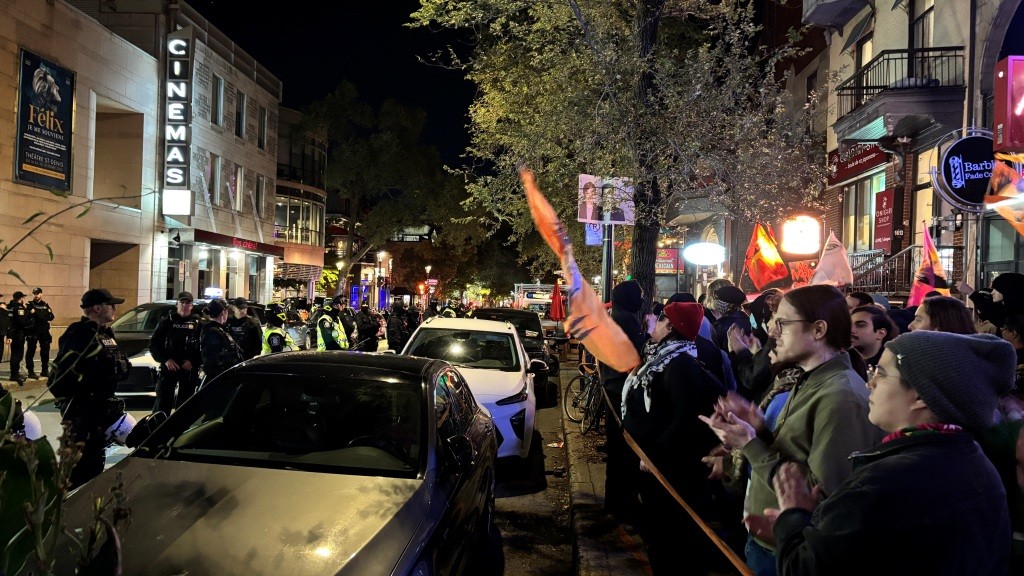
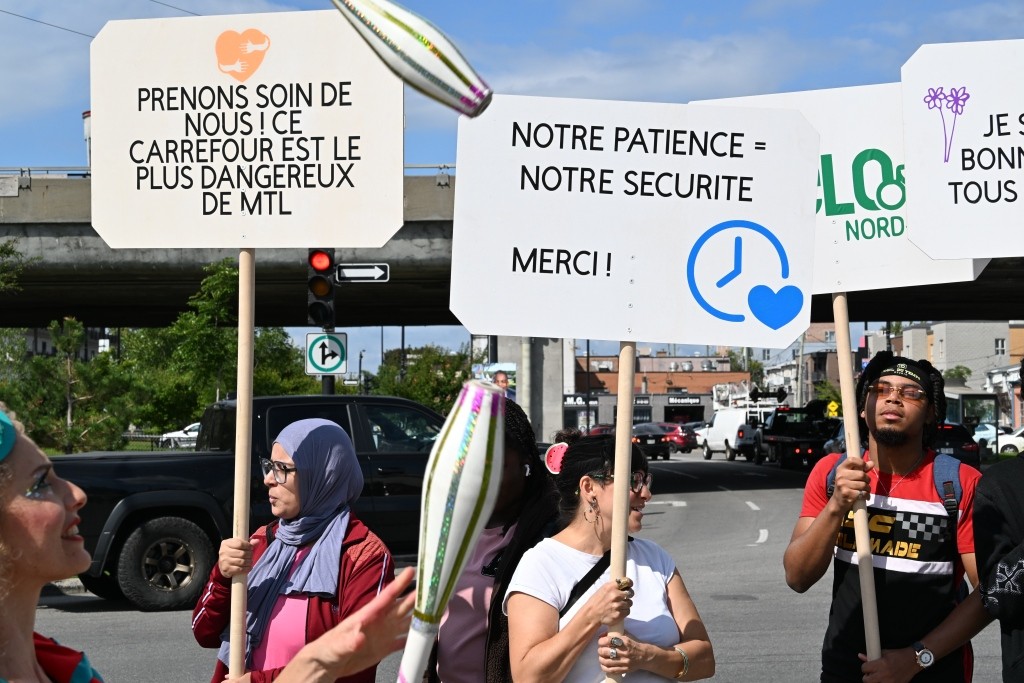
This intersection was already at the heart of civil society's concerns a few weeks earlier. On September 16, the neighborhood roundtable Vivre Saint-Michel en santé (VSMS), along with Cyclo Nord-Sud, organized the "Grande Traversée de Saint-Michel," a festive demonstration intended to draw attention to the difficulties residents face when getting around their neighborhood.
An intersection designed for car traffic
The numbers illustrate the scale of the problem. From 2018 to 2022, 287 collisions were recorded at the intersection of Crémazie and Saint-Michel, according to data from the Service de police de la Ville de Montréal (SPVM) included in the report presented by the City in December 2024.
For Sandrine Cabana-Degani, executive director of Piétons Québec, this intersection is a testament to planning choices that have prioritized motorized travel at the expense of pedestrian needs. "It meets a need for fluidity and automotive throughput, and very little for connectivity, comfort, and safety for people traveling on foot or by bike in the area," she explains.
The intersection is located at the crossroads of several major arteries, including the service road of the Metropolitan Expressway. Saint-Michel Boulevard must absorb both local and transit traffic, as well as buses and trucks, while drivers look to access the expressway ramps.
This configuration does not facilitate walking. Jonathan, a man in his forties who lives two streets away, crosses the area daily to pick up his daughters from Saint-Bernard school. He believes the presence of crossing guards is essential. "Yes, if it weren't for the crossing guards, it would be dangerous. When they aren't there in the evening, it's twice as dangerous," he says. Jonathan is particularly worried about visibility when night falls. The ongoing construction further complicates travel, he notes, especially when several lanes are narrowed.
Having lived in the area for eight years, he says he hasn't seen any significant changes for pedestrians, other than road markings and signage, which he also considers insufficient. "That's life as a pedestrian in Montreal, especially on Crémazie. We're waiting for solutions," he summarizes.
Annie, a woman in her fifties who crosses the intersection on the north side every day to get to work, describes another problem: vehicles turning while pedestrians have the green light. She is particularly wary of drivers coming from Saint-Michel Boulevard who turn without her being certain they have seen her. "The time to cross isn't long enough," she points out, referring to situations where the pedestrian signal is still on while cars are permitted to turn right.
School commutes under pressure
At school dismissal time, the challenges take on a particular dimension. Children from Saint-Bernardin and Léonard-De Vinci elementary schools, students from Joseph-François-Perrault and John-F.-Kennedy high schools, and families heading to local daycares must all contend with this traffic.
Abdou, a student at Joseph-François-Perrault met on-site, walks home with a heavy backpack. He explains that crossing is difficult for him. He used to travel by bike, he says, but one day, while pedaling through the intersection, he fell off his seat and broke his arm. He had to give up biking the route and now has to be extra vigilant.
For parents, the worry isn't limited to the intersection itself. It also concerns the ability to let children travel alone and access neighborhood amenities without having to take excessive precautions.
Jonathan feels that families don't really have a choice: for anyone wanting to get to the other side, this crossing is unavoidable. Meryem, who goes to a daycare north of the highway every day, believes that getting around is generally still possible, but acknowledges that the construction has complicated the situation. When she picks up a child with her youngest, she would particularly like to see barriers that better protect children near the roadway.
"An urban fracture"
Beyond the intersection, the Metropolitan Highway acts as a physical barrier in the neighborhood. Its service roads, ramps, and the spaces beneath the elevated structure complicate travel between residential areas and local amenities.
This is precisely what led Didier Berry, a community organizer and Saint-Michel resident, to launch the Oasis urbaines project with Chantal Smedbol. The initiative aims to rethink the spaces under and around the highway, particularly through greening, art, and better appropriation of the areas by residents. "Will this divide, the viaduct, if you will, be transformed into a kind of bridge, a junction?" he asks.
For him, the project must first meet the needs of the people who live in the neighborhood and suffer the drawbacks of this infrastructure. He envisions several possibilities, from modest interventions to improve the spaces to a broader reflection on the future of the highway. But he insists on the need to consult residents, especially young people, who use these spaces daily.
Beautification alone, however, will not solve road safety problems. "Anything that helps even a little, whether it's 5 or 10%, is already a solution," he believes, while acknowledging that interventions must be part of a larger strategy. For Didier Berry, the spaces under the highway could become meeting places rather than just transit zones. But their transformation requires collaboration between citizens, organizations, the City, and the Ministry of Transport and Sustainable Mobility, which is responsible for highway infrastructure.
Overlapping responsibilities
This division of responsibilities is precisely one of the main obstacles to rapid intervention, according to Sylvain Ouellet, city councillor for the François-Perrault district since 2013.
The elected official points out that the danger of the intersection has been known for years. He believes that the design of the highway in the 1950s helped concentrate a high volume of traffic in this area, particularly due to the layout of the entrance and exit ramps. He also regrets that the previous reconstruction of Saint-Michel Boulevard did not allow for a more in-depth review of its layout. "We were rebuilding it more or less the same way," he recalls, noting a missed opportunity to better secure the area.
According to him, the borough's room for maneuver is limited because the intersection is entirely on the arterial network, while Crémazie also serves as a highway service road. "To my knowledge, there are none," he replies when asked what interventions are currently planned for the intersection.
The councillor nevertheless mentions possible improvements during the future work on the Metropolitan Highway, including a modification of the ramps to reduce traffic conflicts. But he emphasizes that the schedule and details of this work remain uncertain.
He also advocates for better consideration of the dangers of these routes when organizing school commutes. Some students must cross multiple lanes at the intersection of Crémazie and Saint-Michel, then cross Crémazie again further along to get to their school. "There still needs to be a path that is pleasant and safe," he argues regarding walking, which is encouraged for children.
For Mr. Ouellet, securing the crossing of the 6th The avenue serves as an example of a potential intervention for a local street. There is also a desire to convince the City of Montreal to install an additional traffic light further east to better connect neighborhood facilities. However, at the intersection of Crémazie and Saint-Michel, no specific measures have been announced at this stage.
Acting before the next collision
For Piétons Québec, the difficulty is not limited to Saint-Michel. For several years, the organization has been calling for a mechanism that would allow for proactive intervention on Montreal’s high-risk arterial roads.
The strategy Vision Zero of the City aims to eliminate deaths and serious injuries on the road network. However, according to Sandrine Cabana-Degani, interventions carried out on residential streets are not enough to address the challenges of major traffic arteries. The executive director points out that, according to her organization's data, about two-thirds of deaths and serious injuries in Montreal occur on the arterial and collector road network.
Relatively simple measures can, however, improve pedestrian safety and comfort, she explains: extending crossing times, installing pedestrian islands, or reducing the number of lanes where conditions permit. She does not advocate for a single solution for Crémazie and Saint-Michel, as their configuration requires technical analysis. But she believes the tools exist and that the priority is to plan interventions based on risk. "You just need the mechanism, and then the planning that allows for intervention," she summarizes.
The mobilization does not stop at this crossing. VSMS is also continuing to reflect on the future of the Metropolitan Expressway, whose infrastructure creates a physical divide in Saint-Michel. On October 26, the neighborhood roundtable will host a lecture by Francis Lapierre titled "Tearing down the Metropolitan (A-40): dream or reality?"
Beyond safety at a single intersection, the question raised is that of the highway's place in the neighborhood and the possibility of rethinking the connections between its various sectors. In the meantime, residents continue to cross these streets. In the rain, between turning vehicles, frontage roads, and detours imposed by construction, everyone adapts their route as best they can.