
In Montréal-Nord, residents and organizations have long challenged the labels that associate their neighborhood with violence, crime, and poverty. The borough itself launched the "Mille histoires, une communauté" (A Thousand Stories, One Community) initiative to take back control of its image. As the PDQ 39 scandal reignites tensions surrounding the police, one question remains: who tells the story of Montréal-Nord? And what effect does this narrative have on those who live there?
On this August day, Le Carignan Park in Montréal-Nord looks nothing like the images its name is often associated with. On the basketball courts, players battle for every ball while spectators gathered around cheer on the teams. A few meters away, children enjoy the splash pads to cool off under the watchful eyes of their parents. It is the 32nd edition of the Street Basketball Tournament, which has become an important event over the years for the youth and community of Montréal-Nord. The event has notably featured players who went on to reach the NBA, including Chris Boucher, Luguentz Dort, and Bennedict Mathurin.
About twenty meters from the courts, sitting in the grass, Ahmad Mathi watches the young people play. He has lived in Montréal-Nord since 2022 with his wife and their three children. His experience of the neighborhood differs from what he is sometimes told by those around him. He is regularly asked why he chose to live in a "dangerous area," where there are supposedly "lots of crimes" and gangs. Yet, he confides to La Converse, "To this day, I have never witnessed a scene of violence. I have never been attacked." For him, the risk depends more on who you associate with than on your address.
This ordinary scene—a tournament, families, children playing, neighbors meeting up—does not mean that Montréal-Nord is spared from social difficulties or episodes of violence. Rather, it serves as a reminder that a territory cannot be reduced to the incidents that make the headlines.
It is precisely this gap between what is experienced in the neighborhood and what is said about it that lies at the heart of a new controversy, one that is shifting the debate sparked by the Station 39 scandal.
Two narratives for the same territory
On June 25, Patrick Lavallée, a retired SPVM inspector and former commander of PDQ 39, published an opinion piece in Le Journal de Montréal. Without minimizing the allegations against certain officers, he defended the work accomplished under his leadership from 2019 to 2022 and described a police force that was "present, professional, responsible, competent, and rooted in its community."
To illustrate the challenges his teams faced, he described the area at the corner of Pascal and Lapierre streets as a "lawless zone" where "criminals acted with total impunity." In this regard, he defended a strategy based on a sustained police presence, intelligence gathering, and collaboration with local organizations.
On August 4, the Café-Jeunesse Multiculturel de Montréal-Nord responded in an open letter. Without denying the security challenges, program coordinator Slim Hammami argued that certain terms used to describe the neighborhood reinforce the prejudices faced by its residents.
The disagreement also concerns how Montréal-Nord is portrayed. For Patrick Lavallée, the area is primarily a place that requires a police response, specifically by identifying problems and ensuring safety. For Slim Hammami, this perspective risks reducing the neighborhood to its struggles and perpetuating what researchers call a "territorial stigma." The consequences go beyond the neighborhood's image. The Café-Jeunesse notes that some young people avoid putting their address on their resumes or mentioning that they live in Montréal-Nord for fear of being judged before they even have a chance to introduce themselves.
"It’s not what the words say here"
On the ground, the gap between the image of Montréal-Nord and the experience of its residents is quickly apparent. The people we met do not deny the neighborhood's problems. Rather, they refuse to let those problems be the only things that define it.
Ryan, 17, has lived there his whole life. He acknowledges that there are problems but refuses to see them as unique to Montréal-Nord. "I think people talk about [the neighborhood] in a bad way, even though I think it’s a good place. I feel safe inside it," he says. Problematic behavior, he adds, "exists everywhere; it’s not specific to Montréal-Nord."
Hatim, 16, believes the image of the neighborhood as dangerous is largely a thing of the past. Since he has lived there, he says he has never been in a situation where he felt in danger. He emphasizes the diversity of Montréal-Nord and the coexistence of its different communities. "Personally, I think Montréal-Nord is one of the best neighborhoods in Montreal," he says.
Akram, who knows the neighborhood through his business, also describes daily life as "pretty quiet." He acknowledges that the borough’s bad reputation is persistent: "It’s true that it used to be a dangerous neighborhood here. But for a while now, things have calmed down, and a reputation doesn’t change overnight." For him, the projected image of Montréal-Nord no longer necessarily matches reality: "People will still think it’s a dangerous neighborhood [...] when that’s not really what’s happening."
Hélène, who works in a field bridging the community and administrative sectors, offers another perspective. "It’s very difficult to talk about Montréal-Nord as a monolith," she says, noting that the borough encompasses areas with different social realities. She also highlights community and cultural activities as well as initiatives for young people: "There is a lot of effort from the community side to mobilize young people and get them involved in projects."
These accounts describe neither a neighborhood without problems nor the "ghetto" portrayed in some narratives. They show a territory defined by multiple realities: those of social challenges and violence, but also those of work, families, businesses, diversity, solidarity, and community life.
Montréal-Nord wants to reclaim its narrative
For some time now, the borough has been seeking to change how Montréal-Nord is perceived. Under the banner "A Thousand Stories, One Community," it has launched a new visual identity aimed at "taking back control of its story" and fighting the prejudices that associate the borough with danger, violence, poverty, and crime.
The initiative is based on workshops bringing together residents, organizations, business people, employees, and elected officials from the borough. The stated goal is multifaceted: to change how Montréal-Nord is viewed from the outside, to end the stigmatization of its population, and to foster pride and a sense of belonging among those who live there.
In its responses to La Converse, Mayor Christine Black’s office acknowledges that this initiative is partly motivated by the image projected by the media. According to the borough, media coverage "focuses more on the bad news than the good news" and thus contributes to maintaining a negative perception of the area, even though, according to the office, Montréal-Nord is experiencing a wave of revitalization.
The borough does not present this new identity as a simple PR exercise, as it believes that a neighborhood's image can have concrete consequences on its future: sense of belonging, resident retention, investment, employment, housing, and foot traffic.
This desire to regain control of its narrative directly echoes what some residents and organizations have been calling for: to stop letting a few episodes of violence or a few labels define Montréal-Nord.
How is a territorial stigma constructed?
The debate sparked by the former commander of PDQ 39 and the Café-Jeunesse is not just a disagreement over word choice. It refers to a concept well known to researchers: "territorial stigma."
For Michel Parazelli, an associate professor at the UQAM School of Social Work, a place never has a single meaning. "The same place, with its objective characteristics, can have a different meaning for different people," he explains. He cites social housing as an example, "often connoted as something inferior, with inadequate living conditions. Whereas, for the people living in social housing, [...] it is quite simply their home, where they can recognize a bit of their life's history."
According to the researcher, it is the repetition of certain negative descriptors that eventually reduces a neighborhood to a single identity. Terms like "ghetto," "slum," or "lawless zone" no longer just describe a situation; they become categories that lock a territory into a lasting representation.
This representation is then fueled by various social actors. The media, institutions, political leaders, and even police services can, sometimes unintentionally, contribute to associating a neighborhood with a few powerful images, such as crime, poverty, and violence, at the expense of its full complexity. For the researcher, negative labels can then function as "communication shortcuts" that simplify much more complex social situations.
The professor emphasizes one point, however: acknowledging the existence of territorial stigma is not the same as denying the very real difficulties that certain neighborhoods face. He believes instead that the way these stories are told influences the responses that are subsequently prioritized. In his view, Patrick Lavallée’s text illustrates this tension. Mr. Parazelli acknowledges that, for police officers, "there is a territory here that is threatening, and we are here to defend other people who find it threatening." But this interpretation, he argues, can "fuel divisions" and overshadow the "social, economic, and cultural logic" that explains the situations being observed.
For the researcher, the issue therefore extends far beyond the case of Montréal-Nord. The way a society tells the story of its working-class neighborhoods also influences how it chooses to intervene: through control and correction, or through the recognition of lived realities and support for the people who live there.
Who tells the story of Montréal-Nord?
Montréal-Nord is described by those who observe it, manage it, or intervene in it: the media, police, elected officials, organizations, and researchers. The residents themselves often speak up only after the fact, once the narrative of the neighborhood has already been established.
This question had already come up during the "How to Counter Police Brutality?" dialogue evening, organized by La Converse, the Saint-Michel Youth Forum, the Coalition Pozé, and the Saint-Michel Legal Clinic. Samuel Bunche, who grew up in the borough and is involved in its community life, summarized it during a dialogue evening organized by La Converse: "If people hear about Montréal-Nord, they are definitely terrified." Once you are there, he says, "you discover that there is a lot of positive. But it’s a positive that is very, very stifled."
During the 5th symposium "Urbanity and Marginalized Youth," organized in Montréal-Nord on April 30 by the Café-Jeunesse Multiculturel, sociologist Saïd Bouamama showed how this stigmatization can end up being attributed to the residents themselves: violence, failure, or marginalization are associated with the place, while the social realities that permeate them are pushed into the background. An address can then become a social marker.
The question then becomes: who has the power to select what is worth telling—the shooting or the park, the crime or the families who live there?
Can we change the narrative without denying the problems?
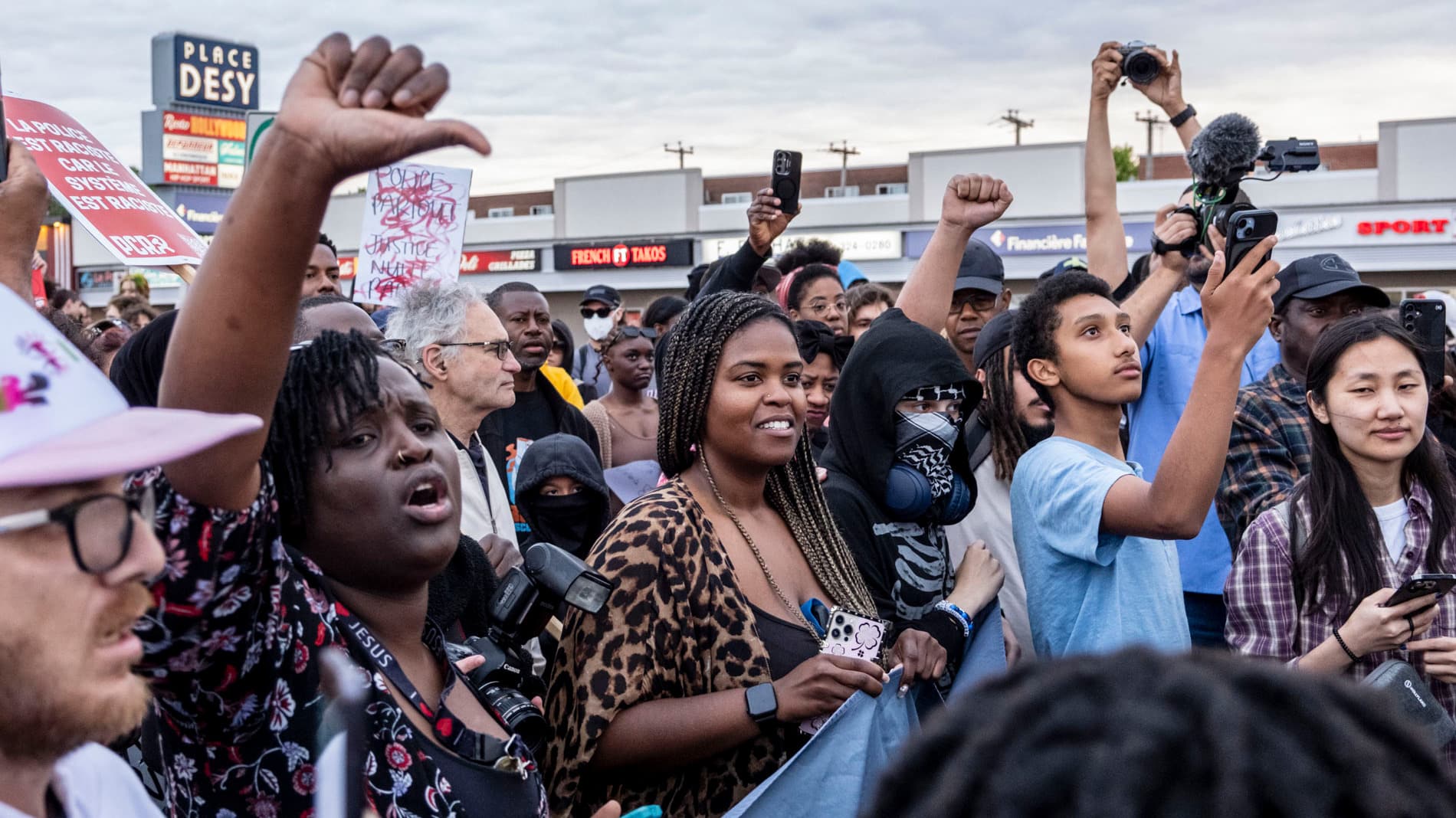
On August 11, this question moved from the realm of abstract debate to the heart of a public meeting at Montreal City Hall. For four and a half hours, dozens of citizens questioned the Chief of the Service de police de la Ville de Montréal (SPVM), Fady Dagher, about the allegations involving PDQ 39, as well as about the racial profiling and police practices they say they have been subjected to for years.
Anastasia Marcellin, who states she has been denouncing racism at PDQ 39 since 2009, asked why these alleged behaviors had not been addressed sooner. "It’s not just Neighborhood Station 39. The problem isn't just the police officers; it’s the system," she declared.
The SPVM Chief acknowledged that his organization might have "blind spots" and promised a "real culture change." However, he also defended the decision to keep the criminal investigation under the responsibility of the SPVM, arguing that a transfer would risk delaying the process.
In the room, two conceptions of Montréal-Nord were once again pitted against each other. That of an institution seeking to correct its practices in the face of identified problems, and that of citizens who believe these problems have been known for too long to be reduced to a few individual behaviors.
For Michel Parazelli, this distinction is essential. "When we stigmatize and point fingers at people who live in places that are not socially accepted, we fuel division and overshadow [...] the social, economic, and cultural logic that can explain the existence of those situations."
The battle over Montréal-Nord is therefore not just about the words used to describe the neighborhood, but also about the power to define what is worth seeing, telling, and remembering. The borough has chosen to reclaim this narrative with the "Mille histoires, une communauté" initiative. As for the organizations and residents, they have long been demanding that their reality not be reduced to crime, violence, and police intervention.
A new visual identity alone, however, cannot erase a stigma built up over the years. It can, however, shift the perspective, provided that the thousand stories promised truly find their place in the narrative of Montréal-Nord.
.jpg)