
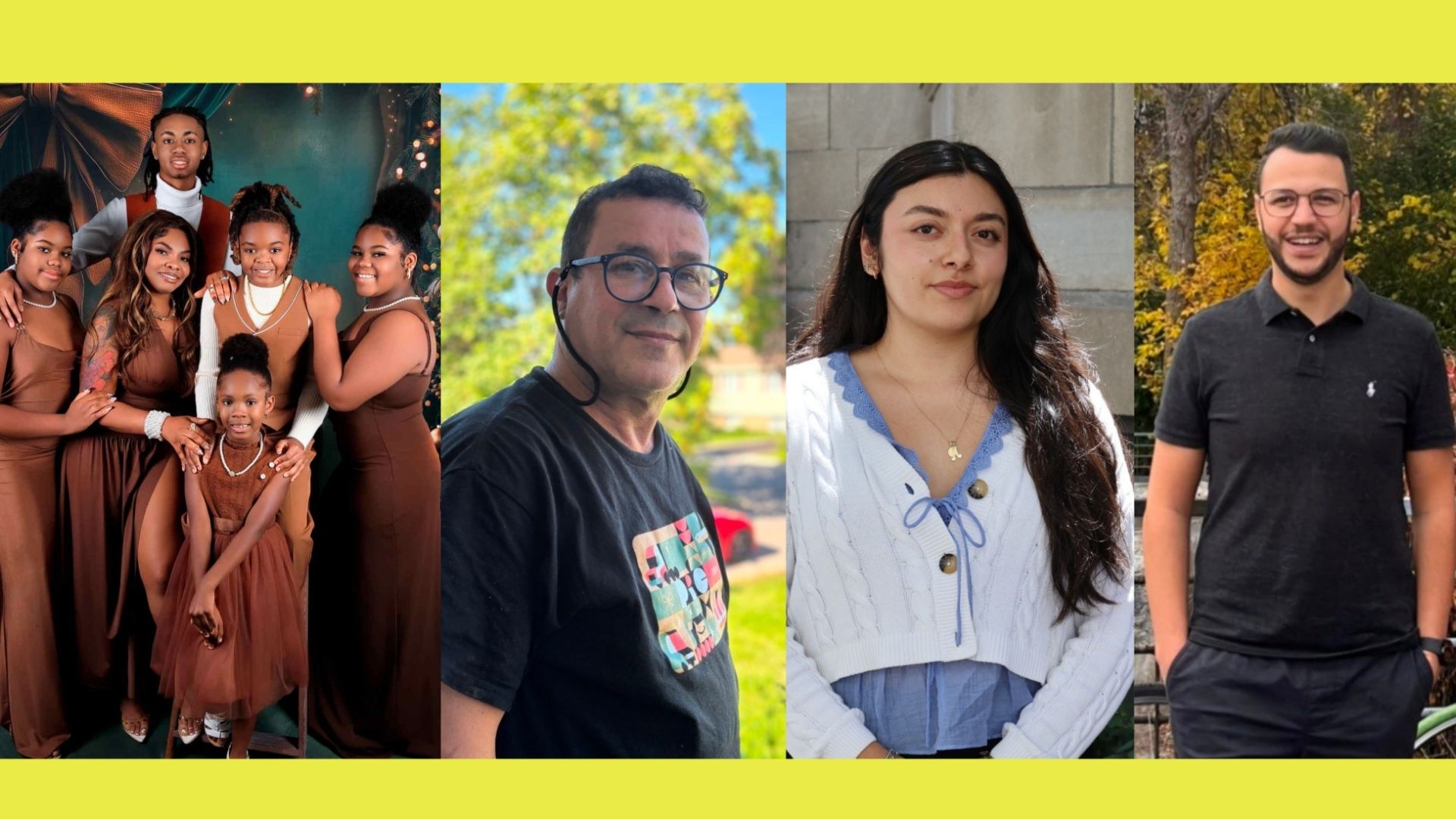
With the Quebec election on October 5th just weeks away, La Converse met with citizens from immigrant backgrounds in Montreal and Laval. Some are following the campaign, others barely at all. Some will vote, others will not. For some, the election comes down to the grocery bill; for others, it’s about hospitals, jobs, housing, or even the very definition of their place in Quebec. Their voices tell a story not of an "immigrant vote," but of a diverse range of relationships with politics.
At Villeray Park, Henri "Moussa" Bien-aimé doesn't seem particularly concerned about the upcoming election. At 33, this construction worker who arrived from Haiti at age 6 hasn't voted in years. He remembers voting once, around age 19, with his mother. Since then, he has distanced himself from the ballot box just as he has from political news.
His mother, Moussa confides, believes that elections are essentially rigged. He doesn't go quite that far and even acknowledges that voting can help secure "benefits for the people" and improve infrastructure.
His life is going well. "As long as they don't bother me in my neighborhood," he sums up, embracing his disconnection from the country's political life. One in three Quebecers did not head to the polls during the 2022 election, and Moussa is one of them. His relationship with elections is hard to pin down as complete disinterest. For him, voting can have consequences, but he doesn't feel invested enough to participate.
"We are never safe from a Trump"
In Laval, Salim Triaï views the election from a completely different perspective. At 63, this Algerian who arrived in Quebec 16 years ago votes regularly, as does his spouse. That said, Salim isn't caught up in the campaign yet, preoccupied, he explains, by his appliance repair business. He will vote, nonetheless. Not necessarily because he identifies with a party, but because the act matters. "I vote just to say that I exist," he says.
His vote isn't a blank check, says the man who was a union executive in a previous life. Avoiding identification with any one party, Mr. Triaï has down-to-earth priorities: the price of food, healthcare, retirement, and his children's future. "When you look at access to care, it’s been the same thing since 2010. [...] The wait at the emergency room, you go there, you stay for about... – the last time, my son stayed for 12 hours."
Regarding immigration, he says he is not very concerned about current debates, which he doesn't follow closely enough. His personal experience in Quebec is quite positive, even excellent, he says, citing his daily interactions with customers.
If he could speak directly to the party leaders, Salim would first ask them to look beyond Quebec's borders. "We aren't in an isolated space," he says. In an interconnected world, "a tremor in the Far East, the ripples reach here." Finally, he would invite them to prepare for the political shocks that can arise elsewhere. "We are never safe from a Trump or a Trump-like figure," he warns.
What emerges from his testimony is not a spectacular endorsement or rejection, but a form of minimal and deliberate participation: voting to count, even when you aren't following every detail.
This diversity is not insignificant. Since the early 2000s, Quebec politics has no longer been organized solely around the old sovereignist-federalist divide. The work of political scientists Éric Bélanger and Jean-François Godbout shows the emergence of another important axis, centered on the management of ethnocultural diversity. In the 2022 election, this identity-based divide helped differentiate party bases. But in daily life, these major fault lines take on less theoretical forms.
When immigration levels threaten jobs
David Tran, for his part, didn't really follow politics until recently. At Villeray Park, this Montreal native, who has lived in the neighborhood for about twenty years, is enjoying the nice weather with his spouse and their baby on this September day.
An IT teacher, David long ignored voting, but this time, he doesn't want to miss the opportunity, he says. The reason? Immigration is now an issue directly linked to his job. In fact, at the institution where he teaches, a large portion of the clientele consists of international students. However, the decline in this clientele over the past two years means, according to him, fewer cohorts, and could therefore mean fewer contracts for him. "We're a bit short on students. Before, most of the clients were international students. So now, there's less clientele. And if there are fewer clients, no groups open up. [...] And no groups opening up means no contracts for teachers," he fears.
What might appear in public debate as a statistic on immigration levels thus becomes a very concrete question: will I still have a job?
David says he feels perfectly Quebecois, but adds that immigration policies now have a measurable impact on his career path. For him, the cost of living remains the other major concern.
If he could speak to the party leaders, he would ask them to review immigration policy, but also to pay more attention to the cost of living. "If you look at inflation, it has really gone up over the last five or six years during COVID. So I don't know if, in a few years, we'll still be able to afford groceries like we used to," he says.
Five children, a $700 grocery bill
In Cartierville, Midelene Lubins views politics from a different perspective. Having arrived from Haiti with her family, this woman in her forties is now a single mother of five children, all born in Quebec.
For her, politics starts at the grocery store. "Life has become expensive," she says. Housing weighs on her budget, even in subsidized housing, since her contribution increases with her income. Then there is food, which is particularly expensive with five children, including teenagers. She estimates that a "good grocery basket" that once cost her $200 to $300 now costs her about $700.
On this issue, the experience of Midelene, Salim, and others is part of a broader trend: according to the 2026 Annual Food Price Report, food prices in Canada are 27% higher today than they were five years ago. And despite the slowdown in inflation, the report still predicts a 4% to 6% increase in food prices in 2026, including in Quebec. For a family of four, researchers estimate that the annual grocery bill will reach nearly $17,600, which is about $1,000 more than in 2025.
Health is Midelene's other major concern. She laments the difficulty of seeing a doctor quickly when a child is sick and says she sometimes feels like she has to jump through hoops before finding an opening. Safety also matters to her. When she talks about racial profiling, her thoughts quickly turn to her 19-year-old son, whom she worries about every time he goes out with his friends.
Her work as a nursing assistant in a health center also gives her a unique perspective on the transformations in the health network, particularly due to the reduction in support staff, which she says has led to an increased workload. This is a deciding factor in her choice, because, Midelene asserts, her vote will go to the party that intends to abolish Santé Québec and return to the CIUSSS, an organization she considered more efficient.
Despite all this, Midelene will vote, even if she doesn't put much stock in politicians' promises. When asked if they truly understand the reality of a single mother working to support five children, her answer is blunt: "I don't think so. They were born with a silver spoon in their mouths."
Becoming a citizen means participating
Amine Benkara brings a much more intense relationship with politics to this mosaic. At 37, this immigrant who arrived in Quebec in 2022 under the Regular Skilled Worker Program has just obtained his Canadian citizenship. The provincial election will be his first opportunity to exercise his right to vote as a citizen. And he fully intends to use it. "I believe in one thing: that your voice won't be stolen," he says.
Amine follows the debates, consults the platforms, watches political shows, and above all, he faces the reality of housing, the cost of living, wages, taxes, and public services. His experience, however, has led him to temper the idealized image of a Quebec where "everything is beautiful, everything is fine, everything is fair."
He specifically denounces what he considers to be a waste of public money and projects that drag on, citing, among others, SAAQclic and the difficulties related to social housing. But what worries him most is not limited to governance issues. As a young worker and future homeowner, he thinks about housing, the cost of living, wages, and taxes. If he had the party leaders in front of him, he would ask them a very concrete question: "What are you going to do for the next five years?" Not just promises, he insists, but "a very precise, very clear plan" to improve the situation for the middle class.
Immigration remains an important dimension of his choice, however. Amine believes that some political discourse targeting minorities has hardened in recent years. He says he identifies more with certain proposals from Québec solidaire, particularly regarding housing, reducing the cost of living, and wealth redistribution.
But beyond the platforms, Amine would like political leaders to get more in touch with the daily reality of immigrant workers by inviting them to take the bus at the end of the day. "They would really see the people who work hard for this country," he says. This is also the population he would like to see more considered in political debates.
"Representation doesn't always equal change"
Mariana Gutierrez Herrera, 25, is at the other end of the spectrum. Having arrived from Colombia with her parents in 2004, she is now a graduate student in political science at the Université de Montréal and works with humanitarian organizations helping immigrants. Her interest in politics therefore comes not only from books or university courses, but is also fueled by what she sees on the ground.
For Mariana, immigration is the main issue of this election. Next come safety, police violence, education, and health. She specifically wants debates on safety to take more account of what is happening in neighborhoods with large racialized populations. But she doesn't feel represented by the political class. "Representation doesn't always equal concrete answers or concrete changes," she says.
This distinction between presence and representation aligns with the results of a study on political representation in Quebec conducted by Benjamin Ferland and Éric Desrochers. The researchers paint a complex picture: certain groups, notably women and those with less education, appear to be less well-represented in some respects, but no single group is systematically underrepresented. In fact, young people are sometimes better represented than the other groups studied.
For Mariana, this issue is personal. As a young woman of color, she says she sees few women of color in positions of power and sometimes feels pressure not to "make waves."
Yet, she herself experiences some of the difficulties dominating the campaign, particularly regarding housing. Mariana still lives with her parents and commutes long distances daily to the Université de Montréal because she cannot afford to rent on the island. But even then, she refuses to reduce her political choice to her own personal comfort.
An "immigrant vote"?
Six people, six different relationships with the election. One does not vote; another votes to feel like they exist; a mother of five looks at campaign promises through the lens of her grocery bill and working conditions in the healthcare system; a teacher discovers that immigration policy can indirectly determine his next contract; a new citizen sees their first vote as a way to participate in Quebec's future; and a young political scientist seeks to understand why public policy struggles so much to address the realities she observes.
Under these conditions, it is difficult to speak of an "immigrant vote." Research by political scientists Éric Bélanger and Jean-François Godbout on the electoral behavior of Quebecers shows that the system has become more fragmented. The old standoff between sovereignty and federalism is no longer enough to explain electoral choices: economic divides and those related to ethnocultural diversity now play a significant role.
On the ground, this fragmentation does not necessarily look like an ideological debate. These voices do not say how "immigrants" will vote, but rather show something simpler and harder to measure: the same ballots can carry radically different expectations.