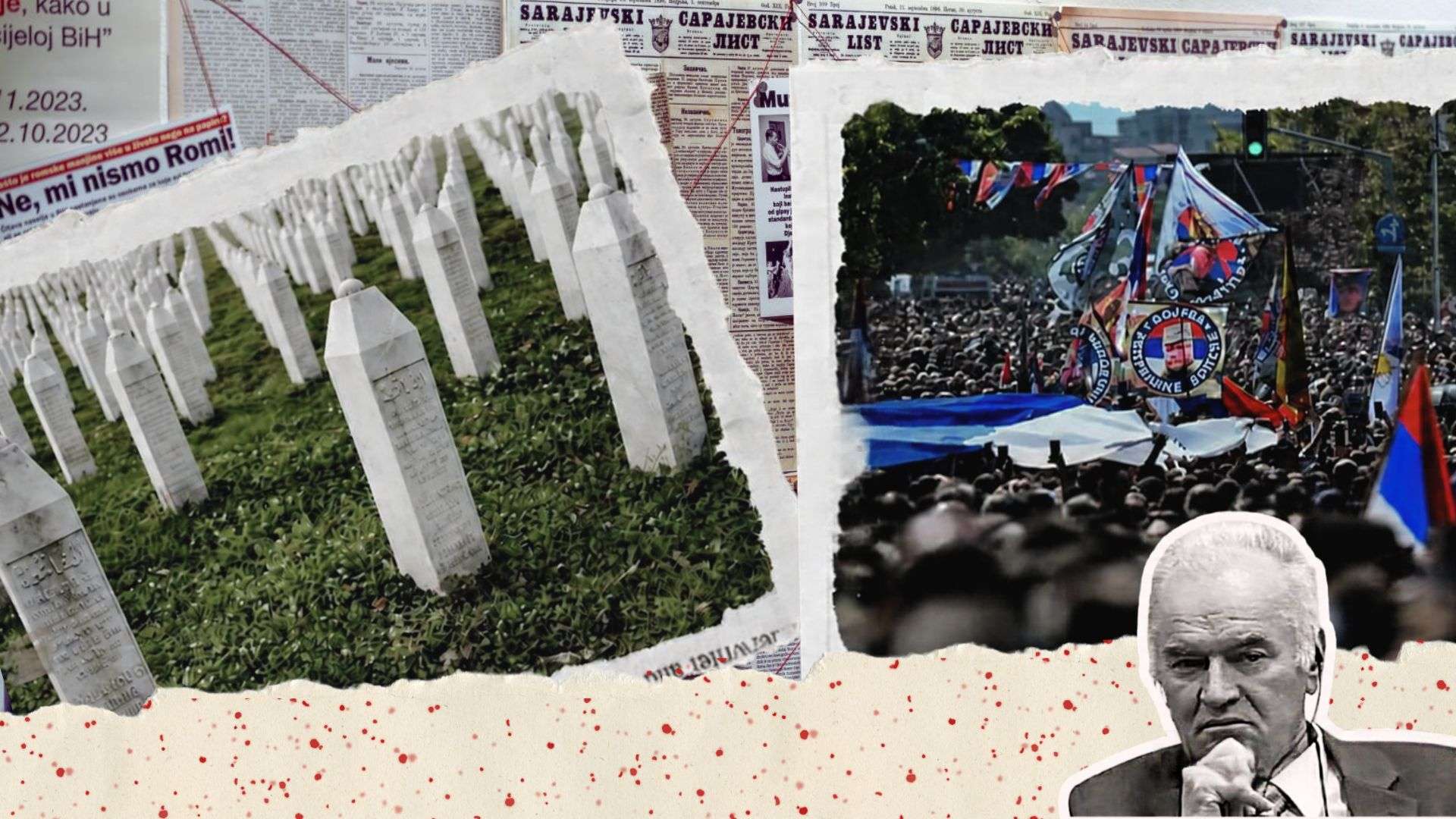
The death of Ratko Mladić, convicted of genocide and war crimes, has reignited divisions over the legacy of the Yugoslav wars. But where do Roma stand in this debate? In Serbia and Bosnia and Herzegovina, their perspectives reveal tensions between historical responsibility, political pressure and the struggle for everyday survival.
The denial of war crimes committed across the former Yugoslavia is no longer simply a question of access to information or education. Decades after the wars of the 1990s, facts established by international courts continue to be challenged, particularly when they come into conflict with national narratives and identities.
Thirty-five years after the beginning of Yugoslavia's breakup, following wars, persecution, camps, sieges and genocide, the struggle is no longer only about what happened, but also about a fundamental question: do we have an obligation to acknowledge what has been established by courts and scholars?
Roma have lived alongside Serbs, Bosniaks, Croats and Albanians for generations. They experienced the wars of the 1990s as civilians, victims and members of the armed forces. Yet their perspectives have rarely been heard in public debates about responsibility, memory and reconciliation.
A media burial
Ratko Mladić’s death, and subsequently his funeral, remained among the leading stories in European and international media for days. For citizens of the Federation of Bosnia and Herzegovina, the death of the man whom international media had dubbed the “Butcher of the Balkans” was a moment of renewed trauma and a reminder that his death did not make his crimes disappear. On the other side of the entity line and across the Drina River, however, the picture was different. In Republika Srpska and Serbia, many mourned his death and celebrated him as a hero.
Thirty-one years after the Srebrenica genocide, in which more than 8,000 Bosniak men and boys were killed, societies continue to inhabit two parallel realities: for some, Mladić is a convicted war criminal; others celebrate him as a hero or remember him simply as an army general.
Within this profound interethnic divide, Roma perspectives have received far less attention. Their views on Mladić's legacy, however, are far from uniform.
Hiding in the Shadow of the Majority
In Serbia and Republika Srpska, nationalist narratives surrounding the wars of the 1990s have shaped public debates about historical responsibility for decades.
From this perspective, Ratko Mladić is a hero, despite the final judgment sentencing him to life imprisonment for genocide, crimes against humanity and war crimes committed in Bosnia and Herzegovina between 1992 and 1995.
The divisions within Serbian society over this issue were also confirmed by Aleksandar Nedeljković, journalist and editor of the Rromane Nevimata news portal. He believes that in an environment dominated by a nationalist narrative, departing from the views of the majority carries serious risks for members of unprotected minorities.
As Nedeljković explains, Roma often shape their publicly expressed views according to the dominant narrative around them, but this does not necessarily reflect what they actually think about the war criminal.
“They are actually protecting themselves in this way because they are aware that they have to conform to the opinion of the majority,” Nedeljković says.
This is particularly pronounced among individuals who are members of Serbia’s governing party and who have obtained certain positions through their political involvement.
“Deep down, however, these people, given that they are educated and informed, are capable of forming their own opinions on this issue, and I believe they know that a position contradicting confirmed court judgments is wrong. But they cannot say so publicly because, by remaining silent, they protect themselves and their positions,” Nedeljković says.
Although Roma are not directly responsible for or connected to the wars, and especially not to war crimes, Nedeljković believes that being part of a society creates an obligation to take a position on the events of the 1990s, if for no other reason than the fact that Roma were both victims and participants in the armed conflicts.
A War Continued by Other Means
The war in Bosnia and Herzegovina was brought to an end by the Dayton Peace Agreement, but competing interpretations of it continue. Generations born years after the war have inherited narratives in which Ratko Mladić is celebrated. Among those who gathered across Republika Srpska to pay tribute to him following his death were many young people.
One member of this post-war generation is Almir Agić, an activist, writer and journalist from Ilijaš, born in 2003 — eight years after the end of the war. He stresses that the so-called “different interpretation” of Ratko Mladić’s legacy is not a legitimate difference of opinion, but rather systematic denial of war crimes.
“There are not two equal sides here. On one side are mass graves, indisputable judicial facts and the trauma of thousands of families; on the other is an ideology of genocide and a political machinery that turns criminals into heroes. Ratko Mladić’s death has once again laid bare the poisonous essence of this system and the cowardice of a society that refuses to accept responsibility. A crime is a crime, no matter how much it is celebrated or embellished,” Agić says.
Agić stresses that it is unacceptable that the glorification of crimes has been tolerated for years under the guise of “freedom of opinion.”
“As long as villains are called heroes, this society remains trapped in the past, morally defeated and systemically rotten,” Almir says.
As a member of the Roma national minority, the largest of the 17 recognized minorities in Bosnia and Herzegovina, Agić points to his community’s particular position. Data about Roma casualties and war crimes committed against Roma during the war in Bosnia and Herzegovina remain scarce. Because of decades of marginalization and deep distrust of institutions, many Roma still avoid speaking about the trauma they endured.
Agić believes that acknowledging such crimes is not about imposing collective guilt, but is a basic prerequisite for building a civilized society.
“The easiest thing is to condemn someone else’s crime — that requires no moral courage. The real test begins when you have to condemn your own,” Agić says.
Asked whether Roma — who did not plan the wars, carry out genocide or create mass graves — should even concern themselves with these issues, Agić simply says that they must, for several reasons. Above all, Roma have lived in this region for centuries and have shared its fate, while Roma are always among the first to pay the price when hatred takes hold of a society.
“Generations of our people carry the scars of systemic erasure and genocide (Samudaripen). If anyone must stand up against injustice and understand the cry of the victim, it is us! We have no right to be indifferent toward the genocide in Srebrenica or toward any war crime,” Almir says.
He adds that empathy and the struggle for human dignity cannot have ethnic boundaries.
“I am Roma, and I am Bosniak, but even if I were Croat, Serb, Pakistani or a member of any other nation in the world, genocidal rhetoric must not be tolerated! Humanity does not allow for calculation or standing aside while mass crimes are committed. It comes down to a simple truth: turning away from Srebrenica, from genocide, means accepting the fascist logic according to which some lives are worth less,” Almir says.
A Position Between Two Worlds
For decades, nationalism has shaped political and social life in Serbia and across the region. Roma communities have had to navigate these competing national identities while struggling for recognition and equal rights.
But whose interests are they expected to defend? In the Western Balkans, where ethnic interests are often presented as national interests, Roma can find themselves caught between their own concerns and the political expectations of the majority.
But whose interests are these, really? The contradictions of the Roma position likely lies in the answer to this question. In the Western Balkans, where ethnic interests are routinely disguised as state interests, the position of Roma remains deeply precarious, unresolved and suspended between two worlds.
Vera Kurtić, an activist and researcher from Serbia, believes that ordinary people — meaning most Roma in Serbia — do not even know who Ratko Mladić is because they are focused on survival. At the same time, she says Roma tend to follow pro-government media but are not deeply ideological, because Roma have never received a clear message that they are equal to the Serbian people.
“Psychologically, Roma have a tendency to demonstrate that they are good citizens in order to feel accepted, in order to obtain things that legally belong to them anyway, such as social assistance or employment. Social protection, social justice and dignified work are concepts that are often beyond the reach of Roma, and fragments of these rights are offered to them in exchange for votes for whichever party happens to be in power.” our interviewee says.
In a small town near Niš, in southern Serbia, a Roma man offers a different perspective. A former military reservist, he remembers the wars of the 1990s but is now primarily concerned about making ends meet.
He tells us he has never thought about whether Ratko Mladić is a war criminal or a hero. Everything he knows about the subject comes from the media and, to a lesser extent, the internet, which he barely uses. “Politics did all of this... We all used to live well and peacefully, all together; there weren’t really differences between people. Today people hate one another, and that isn’t good,” he says.
The day before our conversation, our interviewee had been buying firewood, and that was his greatest concern.
“The most important thing for me now is that we have wood for the winter... What they’re doing in Belgrade doesn’t interest me,” he says.
According to Vera Kurtić, the authorities in Belgrade exaggerated the event for days, claiming that tens of thousands of people would attend and turning the funeral into yet another form of election campaigning.
“Serbian President Aleksandar Vučić himself, after the gathering — which he did not dare attend personally and for which he came up with an excuse — estimated that between 120,000 and 150,000 people had passed through Ratko Mladić’s farewell and funeral over the course of the day. Independent estimates by the Archive of Public Gatherings organization, however, put the figure at around 16,000,” Vera Kurtić says.
Regardless of the number of people present, she considers the event a great disgrace for Serbia and Republika Srpska, but also a debacle for the governing regime, which uses anything at its disposal to remain in power.
“Ratko Mladić, a criminal, deserved nothing better. His death was used for day-to-day political purposes, just as his atrocities were used during the 1990s,” she says.
Vera Kurtić particularly emphasizes what she considers to be the European Commission’s appropriate response.
“Serbia, as it currently stands, does not meet the conditions to be a candidate for membership in the European Union, and that should be formalized, above all because Serbia’s political regime is repressing its own population, which is incompatible with democratic principles. The European Commission’s disgrace lies in its tolerance of, and often support for, the governing regime and its continued hold on power,” she says.
She recalls that key political actors in Serbia during the 1990s supported the policies in whose name crimes were committed, and that some of them continue to represent Serbia today.
“People often say that nations have short memories, but apparently the same can be said of the European Union,” Vera says.
When it comes to the Roma community more generally, she believes that Roma do not need to have a single or official position on this issue.
“The Roma people are officially represented by the National Council of the Roma National Minority, which is an instrumentalized political body without political power, burdened by indications of corruption to which institutions do not respond, personal opportunism, and the desire of individuals to seize a piece of the ruling elite’s pie for themselves,” Vera Kurtić says openly.
Because, according to her, this body consists of careerists who protected the interests of the ruling clique even before the current regime, its claim to represent an entire people is highly questionable.
“Considering that every single member of this body is also a member of the governing party, whose roots reach back to the period when the genocide was committed, no official position on Ratko Mladić’s state funeral can be expected. Or perhaps it is better that none can be expected,” she says.
Vera Kurtić points to another dimension of this silence: the suffering of Roma during the wars of the 1990s remains a marginal issue in public discussions of the conflicts, including within Roma civil society. She argues that this history has received insufficient attention not only in Serbia, but across the countries that emerged from the breakup of Yugoslavia.
According to testimonies from Roma themselves, Kurtić says, Roma did suffer during the wars of the 1990s. She also recalls that after the Second World War, the story of Roma suffering was marginalized and minimized and only began to receive attention many years later, from a historical distance.
“The suffering of Roma in the recent wars in our region is an invisible and unexplored subject. It would not be a story about ‘what they did to us,’ but rather a story about the conditions under which crimes become possible and, even more importantly, a story about silence. There is a lack of political courage, but also of awareness that such a discussion needs to begin. Sadly, we cannot currently expect any such awakening of consciousness,” she concludes.
Between Truth and Denial
Under the guise of false patriotism, parts of the Serbian media have spent decades revising the past, transforming war criminal Ratko Mladić into a hero. The key mechanism behind this resistance rests on a skillful reversal of the argument and the promotion of the false premise that acknowledging genocide means condemning the entire Serbian people, which is simply not true. This manipulative construction of collective guilt has successfully served as a shield behind which individual responsibility has been transformed into a supposed defence of the nation’s survival. After many years, this has become an almost taken-for-granted narrative in Serbia.
Milorad Popović, a Roma activist, journalist and sports worker, rejects the principle of collective guilt. But his position also reveals the tensions surrounding historical responsibility: while he acknowledges the genocide committed in Srebrenica, he questions the legitimacy of the international court judgment that established Serbia’s responsibility for failing to prevent it.
“If we want to speak objectively, we must state precisely what has been legally established. The International Court of Justice ruled that Serbia did not commit genocide, was not complicit in genocide and did not incite its commission. However, the same court did establish that genocide was committed in Srebrenica and that Serbia violated its obligation to prevent it. Whether that judgment is legitimate and coherent with the situation on the ground during the war is something time will tell,” Popović says.
Although Popović questions the legitimacy of the judgment, the International Court of Justice's 2007 ruling is final and binding. It established that genocide was committed in Srebrenica and that Serbia violated its obligation to prevent it and failed to comply fully with its obligation to punish those responsible.
At the same time, he does not deny that Ratko Mladić was convicted by the International Criminal Tribunal for the former Yugoslavia of genocide in Srebrenica, crimes against humanity, and violations of the laws and customs of war, a conviction upheld on appeal in 2021. He notes, however, that Mladić was acquitted of the charge of genocide in six other municipalities in Bosnia and Herzegovina in 1992.
These competing interpretations of the past are not confined to debates about history. They also shape contemporary political life, particularly during election campaigns.
Ratko Mladić’s death could hardly have come at a worse moment, with general elections held in Bosnia and Herzegovina on October 4 and early parliamentary elections scheduled for October 25 in Serbia. The death of the war criminal became one of the instruments of election campaigning, as politicians, aided by the media and social networks, flooded the public sphere with their interpretations, analyses and positions. For them, he became a “weapon” in the election campaign; for ordinary people, this was simply another reason for relations between communities to deteriorate further.
Against this backdrop of political confrontation, Popović believes Roma could contribute to reconciliation without aligning themselves with competing national narratives. Yet his call for reconciliation sits alongside his doubts about the legitimacy of the court's judgment.
“We do not have to inherit other people’s hatreds in order to respect other people’s victims. We should not allow anyone to line us up and ask us: ‘Are you with the Serbs or the Bosniaks?’” he says.
Popović proposes establishing a Roma Forum for Peace and Reconciliation in the Balkans, bringing together young people from across the region to visit sites of wartime atrocities, examine historical archives and document the experiences of Roma victims whose stories have received little public attention.
Reality vs. Bridges
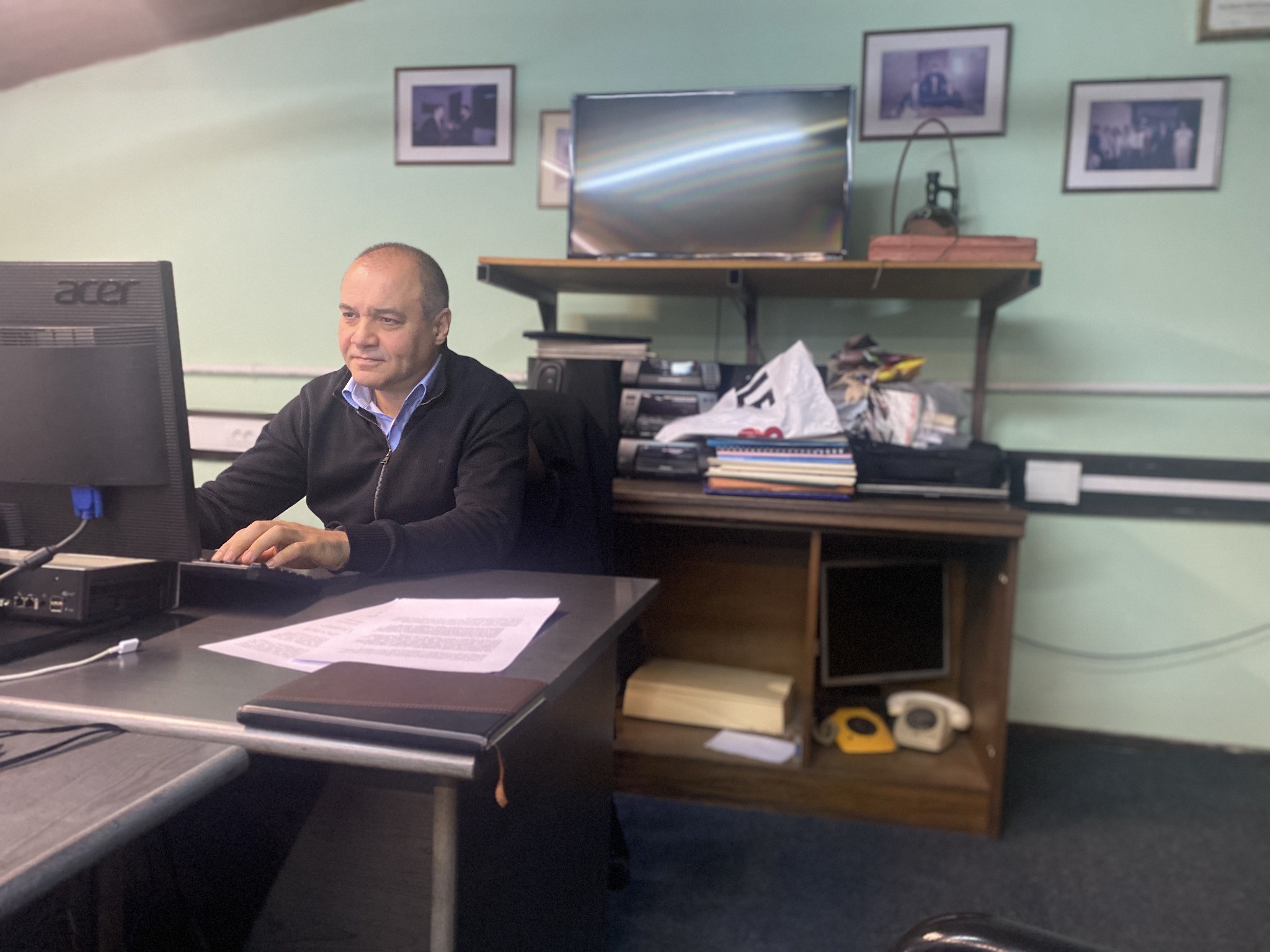
Photo: Lela Savic.
Until the time comes when Roma become a force for reconciliation, we must accept that the reality in Serbia is far from encouraging. Although the entire process — from bringing the remains of the war criminal to Serbia through the funeral itself — lasted only several days, its consequences could be much longer-lasting. Above all, diplomatic relations between Serbia and Bosnia and Herzegovina have been seriously damaged. Whether or not it was an election move by Bosnia and Herzegovina’s current foreign minister, Elmedin Konaković, following Ratko Mladić’s funeral he first recalled the staff of Bosnia and Herzegovina’s embassy in Serbia and then expelled two diplomats from the Embassy of the Republic of Serbia in Bosnia and Herzegovina. Since then, diplomatic relations between Serbia and Bosnia and Herzegovina have been reduced to a minimum.
Branko Đurić, a journalist and editor with the Roma editorial desk at Radio Television of Serbia, believes that the Republic of Serbia, thanks to its current government, has placed yet another burden around its own neck and that of all its citizens by granting quasi-state honours to someone it had previously sent away and handed over to the Hague tribunal — all for minor political gains.
“Serbia is seriously confronting the entire EU, as well as neighbouring countries Croatia and Bosnia and Herzegovina. In a way, it is openly acknowledging that it supports everything the international community condemned and classified as war crimes, whereas previously, at least declaratively, it had tried to build reasonable relations, including by recognizing the Hague tribunal. This further isolates and destabilizes Serbia and distances it from the EU,” Đurić says.
Đurić also believes that the Hague tribunal failed to create a general impression that all perpetrators were punished fairly according to consistent standards.
“Had all crimes and all perpetrators been punished fairly, I am certain that tensions today would be far lower and that it would be easier in Serbia to accept Ratko Mladić’s guilt. I personally believe that he inflicted immeasurable suffering, first and foremost on the Bosniak people, and then immeasurable damage on his own Serbian people, because the killing of so many bound people, including underage boys — practically children — cannot be justified in any way. That is simply not in keeping with the tradition of the Serbian soldier and officer who earned his reputation and military honour, above all, in the First World War and the Balkan Wars,” Đurić says.
When it comes to his fellow Roma, Đurić does not believe that Roma as a community should have some collective position or align themselves behind a declaration issued in the name of the entire people by a Roma organization or other body. He believes Roma are too dispersed and heterogeneous and live in very different environments. For that reason, he says, it is difficult to expect a uniform opinion across many areas, even less sensitive ones, let alone on an issue such as this.
Nevertheless, because of their history and past suffering, Đurić believes Roma will always oppose — and should oppose — killing and wars carried out in the name of any ideology or national cause, as well as crimes committed during war, even when the war itself is defensive.
“The role of Roma as a non-territorial people, and as a people who have suffered so greatly yet have never waged war against anyone throughout their thousand-year post-Indian history, could precisely be one of reconciliation and pacifism. I don’t want to sound naïve, like saying, ‘We’re for world peace,’ but for Roma, any nationalist frenzy in this region could very easily turn into a tragedy similar to those of the past,” he says.
This pattern repeats itself in every wartime slaughter, Đurić says, particularly during the Second World War but also during the 1990s, when Roma were manipulated by all sides in the conflicts and many lost their lives as innocent civilians or were expelled.
“I think this gives us the right and the position to tell everyone: if it is suffering, we know what that means. If it is bloodshed and expulsion from our homes, we have experienced both. Now we say: Enough! We no longer want to participate in anyone’s wars whose purpose is to enrich warmongers of every colour and faith! We will not allow anyone on any side to use us as clay pigeons! We want to build a democratic community together with our neighbours — Serbs, Croats, Bosniaks, Albanians... wherever Roma live across the Balkans,” he says.
Finally, our interviewee Branko Đurić says that there is, in general, an urgent need for Roma to organize themselves politically more effectively and to find a minimum level of existential unity — a consensus capable of overcoming their many differences for the sake of their collective survival.
“Well organized and conscious of the goal we want to achieve, thanks to our numbers we can become a force whose voice matters in every country in the Balkans,” he says.
A Past That Remains Unresolved
As Serbia prepares for early parliamentary elections on October 25, the country faces a period of political uncertainty. Aleksandar Vučić has resigned from the presidency, but the nationalist narratives surrounding the wars of the 1990s remain present in political life.
For the Roma interviewed in this story, confronting that past raises different questions. Some believe their community could contribute to reconciliation. Others question the political structures that claim to represent them, while some are more concerned with the immediate challenges of making a living. Their perspectives reveal no single Roma position on the legacy of the wars.
Yet one issue emerges repeatedly: the experiences of Roma who suffered during the conflicts of the 1990s remain largely undocumented. Between the political calculations of those in power, deteriorating relations between states and the silence surrounding Roma communities’ own wartime losses, a fundamental question remains: whose suffering is remembered, and whose lives are treated as though they matter less?