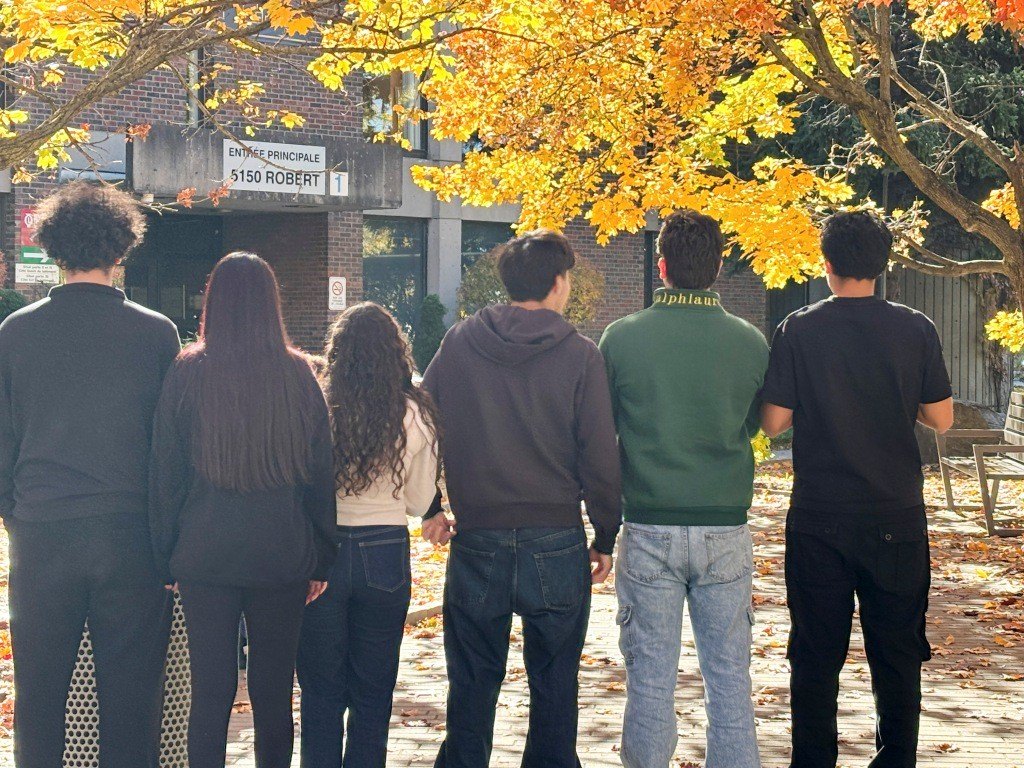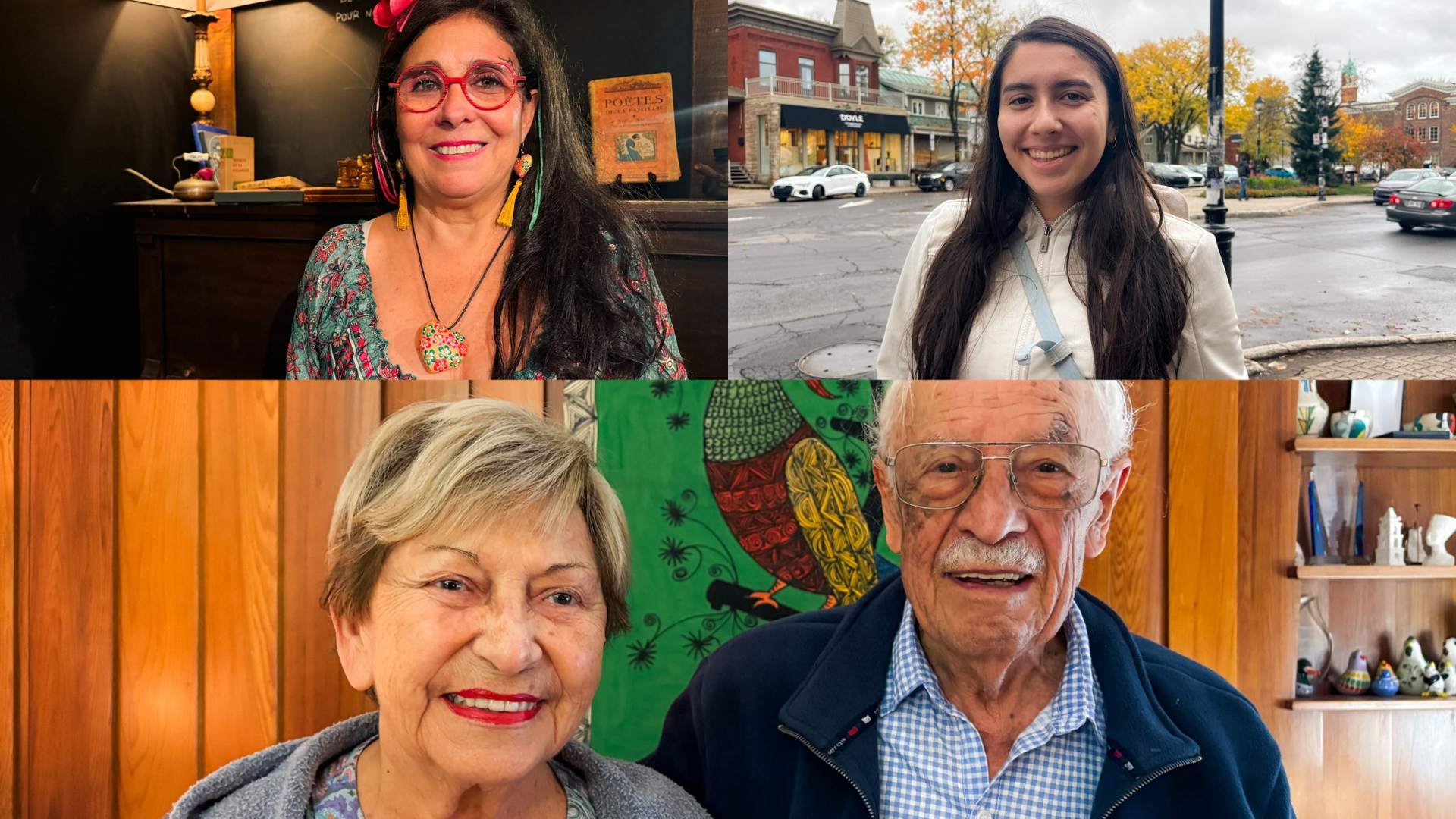

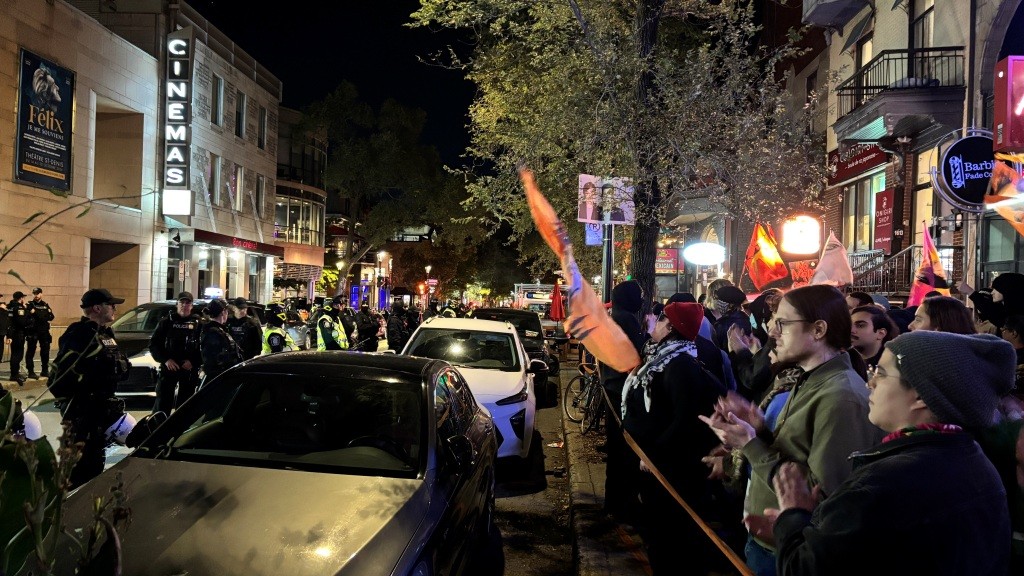
From the Latin Quarter to the Petit Maghreb, via a protest outside the Parti Québécois election night venue and a pro-independence cafe on Plaza St-Hubert, Montreal experienced the evening at different speeds. Between those who voted out of conviction, those who did so out of duty, those who refused to choose, and those who felt no connection to the process, we spent nearly six hours traveling the city to hear how this election resonated in daily life.
6:00 p.m., Berri-UQAM.
The wind is cold on Saint-Denis Street. The thermometer reads 10 °C, but Montrealers have already adopted the rhythm of autumn evenings: picking up the pace, turning up coat collars, and looking to get inside before night falls completely .
At the intersection of Saint-Denis Street and De Maisonneuve Boulevard, the police presence draws attention. A few hundred meters away, the Parti Québécois is set to hold its election night event at the Théâtre St-Denis. A protest against Paul St-Pierre Plamondon’s party is scheduled for 7:00 p.m.
I stay for a few minutes to observe what is happening.
6:02 p.m.
A man in his forties, wearing a toque and a thick beard, is sticking something onto a lamppost. I approach. On the flyer, an inverted fleur-de-lis accompanies these words: "Colonial state in the service of capital." Nicolas Chevalier will not be voting tonight: "I didn't vote because there was absolutely nothing on the ballot that interested me."
Nicolas, who lives in Notre-Dame-de-Grâce, sees some interesting ideas in Québec solidaire, but not enough to head to the polls. His disenchantment, however, goes beyond this election. "We are very far from a direct democracy, except for a few spaces where people can come together. And for me, it’s a certain disillusionment with the system..."
Then the conversation shifts to the issues of his housing, Quebec nationalism, social movements, and political representation. His apartment isn't ideal, his rent is a strain on his budget, and in his view, no party has offered a concrete solution to this problem. Nicolas walks away, but the street remains relatively lively.
6:21 p.m. In front of the former Saint-Jacques Cathedral, a drag queen dressed as the Virgin Mary is posing for a photo shoot. Montreal continues its show, while just a few streets away, people are preparing to count the ballots.
6:23 p.m. I stop Aimé Ishimwe, who is hurrying along with a friend toward the Cineplex Odéon in the Quartier Latin. Earlier that day, the 37-year-old City of Montreal employee had cast his vote. For him, the act matters: voting is a way to show interest and share an opinion. But the campaign left him feeling like something was missing. "It revolved too much around immigration in my opinion, and we didn't talk about issues that are priorities for me. We didn't talk about the environment, we didn't talk about affordable housing." The referendum also caught his attention. But Aimé leaves with a concern: "We aren't heading in the right direction. I find that for the last 10 years, instead of improving, we only talk about immigration."
6:40 p.m. It’s already dark. Mélissa and Jean-Luc Albert are looking for their polling station in the UQAM buildings. They live downtown and have no intention of leaving without having voted. Mélissa is a teacher. Jean-Luc works as a construction site supervisor. He arrived in Quebec at 17, about 20 years ago. She was born here.
They look up the address on their phones as they walk. For Mélissa, the government is never very far from daily life. But this time, the choice was particularly difficult. "I think it’s important to stay informed, to be involved. Sometimes people think it’s very far removed from us, but the government has a lot of impact on our daily lives," she says.
Like Aimé, Mélissa is concerned by the rhetoric that uses immigration as an explanation for certain social problems. "I think inclusion is much more beneficial than exclusion," she comments.
Jean-Luc speaks of voting as a duty, but also as a privilege. He has known another country, another political history. He says he understands what the fight for independence means, but refuses to see a specific population targeted in the process. His vote tonight is strategic. "Personally, I don't want the PQ to have a majority," he says. "I come from a country where independence is truly very important. And all immigrants will tell you that we all come from countries where we really fought for our independence. We understand the struggle for independence. But you can't target a specific population."
I leave them as they continue to search for their polling station.
6:51 p.m. I run toward the Théâtre St-Denis. The street is cordoned off. Metal barriers separate the PQ supporters waiting to get in. Protesters are beginning to gather on the sidewalk across the street.
7:00 p.m. Emily Fleming, who is Inuk, picks up a megaphone. The protest is aimed at comments made on September 30 by Paul St-Pierre Plamondon, who stated that First Nations and Inuit would be consulted on the draft constitution for a sovereign Quebec, but would not have veto power in the event of a referendum. "The resistance is only just beginning," she shouts to the crowd.
Police push the protesters back to the opposite sidewalk. Slogans ring out. Indigenous, decolonial, pro-Palestine, and feminist activists, as well as people from other activist circles, find themselves in the same procession.
Luc, who arrived from the North Shore, is participating in a protest for the first time. It was PSPP’s statements about First Nations that drove him to come to Montreal. "I think it’s the right thing to do—especially with the trend in the world right now—to make yourself heard on these kinds of things," he tells me. Yet, Luc votes with few illusions. "I think the parties are all beating each other up a little bit. But at least it’s a way to have a say. [...] It’s a matter of principle."
His other concern is the environment. He criticizes politicians for talking too little about the ecological crisis, partly because the political benefits are often short-term. He then shares his fear of what lies ahead. "I’m just afraid that, in reality, nothing will change because I think things are going badly and they’re going to get worse. If nothing changes, that scares me personally. For me, that’s enough to convince me that we have to act, that we have to try to make ourselves heard."
Khadidja Barbe, who is standing a few meters away, cast her ballot earlier this morning. She says she hasn't missed an election since she became eligible to vote. She would have liked the campaign to focus more on the cost of living, healthcare, and families struggling to keep their fridges stocked. She feels that identity issues took up too much space.
7:45 p.m. I head back down the street toward the polling station located in an UQAM building before it closes at 8:00 p.m.
Kassem, 21, a political science student at the same university, is voting in a provincial election for the first time. He says he wants to exercise a fundamental right: the right to participate in choosing the government. But he doesn't feel much enthusiasm. "I have no emotion. I’d say, 'May the least-worst candidate win,'" he summarizes. Kassem is mainly worried that political debate is drifting away from the issues he deems urgent: housing, rent, and food.
Late-arriving voters pass through the doors of the polling station, while the street gradually empties.
8:11 p.m., Beaubien metro station.
I walk toward Plaza St-Hubert. I was looking for a place where Montrealers of Latin American origin would be following the results. Many businesses are already closed. The cold is driving passersby indoors. I finally discover Club pays, an independentist community café that opened a few months earlier.

Inside, the atmosphere is different. The room is full. A large screen is broadcasting the election night coverage. Young people are watching, commenting, and applauding. And something surprises me: the applause follows the announcement of a lead for a Parti Québécois candidate just as much as it does for a Québec Solidaire candidate.
Both parties are sovereignist. Alex Valiquette, an activist with Oui Québec, explains this coexistence to me. "I think there is an appetite within the Quebec population to be able to look beyond political parties. [...] There are a lot of people who are like me: I agree with this thing from one party, but I don't agree with that other thing."
For him, polarization isn't fought just through speeches. "We have to meet. More humanity, more dialogue," he maintains. In this café, at least tonight, sovereignists of different sensibilities are looking in the same direction together.
9:50 p.m. I leave Plaza St-Hubert in an Uber. My driver, Marconi, is a permanent resident. He is not a Canadian citizen and therefore does not vote.
The man in his forties, who arrived from Haiti three years ago, doesn't really follow Quebec politics. On the road, he talks to me mostly about his work and his family. Construction blocks Rue Bélanger. He grumbles about the roadwork in the city, then notices, with compassion, a worker who is directing drivers to another lane in the cold. His tone changes.
Quebec politics, however, seems distant to him. "It’s not the same intensity, it’s not the same election atmosphere. [...] Back home, there are motorcycles, there’s noise, there are protests. You feel that there’s an election; you see t-shirts, banners. They’re in the street. Here, it’s the TV that tells you there’s an election." A few minutes later, we arrive in the Petit Maghreb neighborhood.
10:03 p.m.
Jean-Talon is still lively. Cafés are open, as are snack bars and several barbershops. I try a few approaches. One barber politely refuses to talk. Two men chatting in front of a business also prefer to keep their opinions to themselves. They want to "live their lives in Quebec in peace."
At Marché Saada, I meet Sami, an Algerian student who works nights to pay for his studies. He refuses to be recorded and asks to be cited under a pseudonym. Sami doesn't vote, naturally, and confides only one worry to me: changes in immigration policies could complicate his plan to stay in Quebec.
A little further on, at Do Ré Mi, young women are cleaning up before closing. They are also students. They are worried about what the future holds for them after their studies, especially if they wish to stay in Quebec. They, too, prefer not to give their names.
In this part of Montreal, politics suddenly feels quieter.
10:38 p.m.
In front of Fruiterie Ronica, I meet Emiliano, who has just finished his shift. He is in his sixties. He didn’t vote either. What’s on his mind tonight isn’t the election results; it’s his grocery bill. "Elections... honestly, I’m just tired. I work impossible shifts, and when I get home, I don’t have the head for politics. Politicians talk and talk, but I don’t see how it changes anything in my life," he confides.
What matters to Emiliano, then? "What I see," he continues, "is the grocery store. Before, I could fill a cart for $60. Now, with $60, I get almost nothing... everything is expensive, even basic things like tortillas or beans. My wife compares flyers every week; she goes to three different stores just to save a few cents."
A few streets away, another immigrant tells me the exact opposite.
10:57 p.m. Café Sidi Bou.
Tonight, Hatem broke his usual routine to come have a mint tea and share the election night with people from his community in this well-known corner of the Petit Maghreb.
Before entering the establishment, he shares his stance on the election and says he understands those who think all parties are the same, but he refuses to give in to discouragement. "When I was young, in Tunisia, we talked about voting as either a dream or a farce, depending on the year. Here, I can go to a polling station, no one stares at me, no one asks me why. Not voting would almost be a sign of disrespect toward that privilege," he asserts.
His enthusiasm isn't naive, though. "I’m not saying everything is perfect. Housing, the cost of living—that worries me too," he declares. "But I prefer to protest at the ballot box than in my living room. Afterward, you can criticize, but at least you participated."
Hatem voted for the Liberal candidate Frantz Benjamin in Saint-Léonard—Saint-Michel. "I made my choice by reading and comparing. I’m an accountant, so I like to look at the numbers and the commitments, not just the slogans. For me, the Liberal Party offers more stability and more openness to people like me—those who came here, who work, who pay their taxes, and who just want to be treated as full-fledged citizens."
11:12 p.m.
Café Sidi Bou is packed. A cloud of hookah smoke floats under the ceiling. Two televisions mounted on the walls are still broadcasting the election night coverage. The Parti Québécois, currently in the lead with 59 seats, will form a minority government.
Some customers are following the results. Others are playing cards. A remark rings out from one table: "The CAQ’s zero has me feeling high." The results keep coming in. So do the comments, some of them biting.
But outside, a few streets away, people are still working. Others are heading home. Some didn’t vote. Students are thinking about their future. A driver is waiting for his next fare. A woman is directing traffic in the cold. A man is calculating the contents of his grocery basket.
At 11:35 p.m., I close my notebook.
Election night in Montreal didn't feel like just one election night. It contained many: the one for activists in front of a theater, the one for young people still hoping to change something, the one for sovereignists gathered in a café, the one for newcomers who cannot vote, and the one for citizens who vote out of duty, conviction, or calculation.
And Emiliano’s, perhaps the quietest of them all: a night where politics is measured less by the number of ballots cast than by the price of a grocery bag.