From the social-democratic hope embodied by René Lévesque to what many perceive as an identity-focused shift by Paul St-Pierre Plamondon’s Parti Québécois, a segment of the Latin American electorate that once rallied to the cause of independence is now caught between nostalgia and the search for an inclusive national project.
But how did people from Latin America, some of whom fled military dictatorships, come to identify with the independence movement? And what explains their current disillusionment, their reflections on race and representation, and their tensions with the party’s new generation of activists?
The echo of a promise
"Long live Quebec, long live freedom, and therefore long live a free Quebec!"
It was with this iconic phrase—delivered from the balcony of Montreal City Hall by Charles de Gaulle in 1967—that Quebec’s new Premier, Paul St-Pierre Plamondon (PSPP), concluded his swearing-in speech after leading the Parti Québécois (PQ) back to power as a minority government. He promised to "put the house in order" before reopening the debate on Quebec’s future and calling for a third referendum.
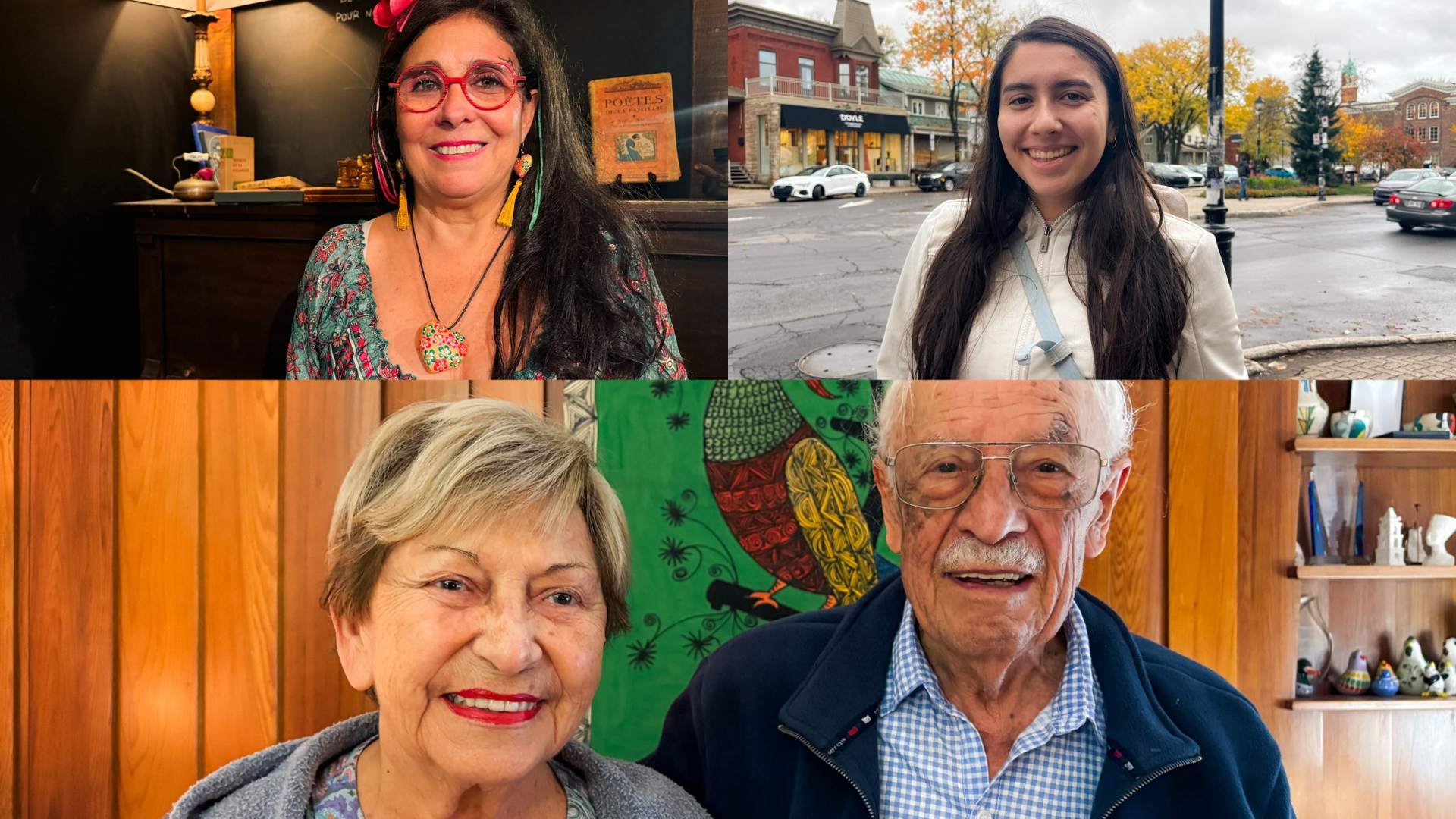
In the riding of Camille-Laurin, located in the Mercier borough, Flavia García listened to the sovereignist leader’s words on her screen. In the warmth of her kitchen, surrounded by terracotta tiles brought back from Mexico, this retired French teacher of Argentine origin shook her head with skepticism.
Having arrived in Quebec in 1987 at the age of 23, the poet was won over by the French language and drawn to a collective project that was republican and open to the world. In 1995, during the second referendum, she voted "yes" while pushing her daughter’s stroller.
Three decades later, Flavia García’s situation illustrates the dilemma faced by many Latin-Quebecers. While remaining a sovereignist at heart, she no longer recognizes herself in the PQ’s current platform, which she criticizes for an identity-based rhetoric that blames immigrants for the failures of public services.
"When Paul St-Pierre Plamondon says 'Long live a free Quebec,' he is appropriating a slogan that no longer aligns with the values it originally carried," the poet remarks in a calm voice. "He is recycling and reclaiming it for political ends. I am an independentist at heart, but it must be a project where I feel that my daughter, born in Quebec to Argentine and Peruvian parents, and my granddaughter, also born in Quebec and of Argentine, Peruvian, and Dominican descent, have a full place."
The resonance of anti-imperialism
To understand why Latin American immigrants embraced sovereignism during the 1970s and 1980s, one must look back at the political experiences that motivated their departure. On September 11, 1973, in Chile, the government of President Salvador Allende was overthrown by a military coup. Thousands of left-wing activists were then forced to flee the repression.
It is in their home in Ville Saint-Laurent—a warm, colorful house that has hosted many Latin American and Quebecois intellectuals over the decades—that Osvaldo Núñez and his wife, Zaida Macías, reflect on their journey. "We didn't choose to leave our country; we were forced to," recalls Mr. Núñez.
Arriving in Quebec in February 1974 with their two children, Mr. Núñez and Ms.Ms. Macías were welcomed by a network of civic, union, and intellectual solidarity. A former legal advisor to the Allende government, Mr. Núñez drew a direct parallel between the Latin American struggle and the Quebec people’s quest for self-assertion against federal power.
"There was a global movement for the liberation of peoples at the time... in Algeria, in Vietnam... In Chile, we saw clearly that the United States would be the main opponent to achieving major changes toward a socialist society. All of this led us to understand the Quebec people’s desire to be themselves, to preserve their struggles and their French-speaking culture. We found poets and intellectuals here who, like Gaston Miron in Quebec or Pablo Neruda in Chile, shared the same anti-imperialist spirit and a deep desire for social justice."
Osvaldo Núñez quickly became involved in union and intellectual circles. In 1993, he made history by becoming the first MP of Latin American origin to sit in the Canadian Parliament, elected under the Bloc Québécois banner in Bourassa. His support for sovereignism was rooted in the vision of René Lévesque, the founder of the PQ, who viewed independence as a civic contract open to the world.
"René Lévesque had the strategic intelligence to grasp the spirit of the times and build bridges," he explains. "He championed the idea of 'a hundred ways to be Quebecois,' recognizing the hundred languages and accents that have come to enrich this land. It was a resolutely inclusive project: social democracy in economic and social terms combined with political independence. That is precisely what we have seen slowly crumble."
This sense of alienation has been fueled, according to these activists, by Paul St-Pierre Plamondon’s positions on immigration. The new Premier is indeed seeking to lower immigration thresholds and reduce the number of temporary residents, whom the party associates with the pressures placed on housing, schools, and hospitals.
When Zaida Macías is asked how one can convince an immigrant today to support sovereignty when the government’s rhetoric seems to hold them responsible for so many ills, she looks up at the ceiling, pauses for a long time, and confides: "That is an excellent question..."
Her husband adds: "There is an international trend toward making immigrants a scapegoat, as if they were the source of all problems."
"It’s a way to distract the electorate and mask failures in public policy regarding housing or healthcare. Independence is not an end in itself; it is a means to build a fairer, more equitable, and more inclusive society. That is what we fought for," Mr. Núñez continues.
The shadow of 1995 and the "ethnic vote"
To understand the rifts within the sovereignty movement, one must look back to October 30, 1995. During the second referendum, the NO side won by a narrow margin: 50.58% against 49.42% for the YES—a difference of 54,288 votes, with a historic voter turnout of 93.52%.
While nearly 60% of francophones chose YES, 90% to 95% of allophones and people from immigrant backgrounds opted for NO. After the results were in, Prime Minister and Parti Québécois leader Jacques Parizeau delivered words on camera that would leave a lasting mark: "It’s true... it’s true that we were defeated, basically by what? By money and ethnic votes, essentially." This statement triggered his resignation and left a wound in multicultural neighborhoods.
"I was there that night at the counting center with European and Catalan delegations," recounts Osvaldo Núñez, then a spokesperson for the Bloc Québécois on immigration. "Statistically, Mr. Parizeau’s observation reflected the arithmetic reality of the count. But phrasing it so impulsively was a grave political error. It served to point the finger at immigrants."
Refusing to blame the defeat solely on cultural communities, Mr. Núñez points out, however, that Ottawa had orchestrated an aggressive strategy by accelerating citizenship grants and funding rallies against the YES side.
Drawing on her 32 years of teaching French at the Ministry of Immigration, Flavia García offers a critique of her own: "You cannot ask a first-generation immigrant who has just arrived, who is living in job insecurity, or who has fled dictatorships and political instability in South America, to jump headfirst into the unknown of a process fraught with economic uncertainty."
"Furthermore, people often forget that in conservative regions like Beauce or the Capitale-Nationale, thousands of francophones overwhelmingly rejected independence. It is unfair to place the blame on Montreal immigrants when part of the regional right wing was itself turning its back on the project."
The "audible minority" and the privilege of white skin
Today, the debate goes beyond electoral arithmetic to touch on a dimension that has long remained on the margins: racial relations and the boundary of "whiteness" within the sovereignty movement itself. A boundary that Flavia García has learned to measure through her own experience as a Latin American immigrant.
"Have I experienced discrimination? Well, I am white and I pass unnoticed as long as I don't open my mouth. Those who are whiter, as in my case, suffer less than those who are ethnically very recognizable. That is why categories like 'visible minorities' exist. In truth, I don't know if I fit into the visible minority; I think I am more of an 'audible minority.' But some suffer more than others, and unfortunately, that depends on the color of your skin."
This distinction between "visible minority" and "audible minority" highlights a fracture often avoided in the independence discourse. While activists of European origin or with light skin can easily blend into the historical francophone majority, the assertion of a more traditional national identity—especially outside major multicultural centers like Montreal—raises concerns among racialized citizens, who fear it is a project based on homogeneity rather than plurality.
A distrust that the movement's new generation refuses to accept, however.
Pragmatic and activist: the new generation
Faced with the disillusionment of their elders, a new guard is joining the Parti Québécois, embodied by 24-year-old Soledad Orihuela-Bouchard. It was on a cold autumn day, sitting in a Longueuil café and enjoying a chai latte, that she shared her vision of an independent Quebec. Born to a Quebecer mother and a Bolivian father, this teacher serves on the PQ’s National Youth Committee and has been a Bloc Québécois candidate.
Far from the doctrines of the 1970s, the stance of Ms.me Orihuela-Bouchard is pragmatic and focused on the goal of national emancipation: "I don't define myself as left or right; I am first and foremost a sovereignist. For me, the absolute priority is for the country of Quebec to come into being."
Regarding the reduction of immigration levels advocated by the PQ, Soledad Orihuela-Bouchard says she feels no discomfort, seeing it instead as a responsible measure in light of current reception capacities.
"I have never felt uncomfortable with the discourse on immigration levels. What I understand is that we simply want to welcome people properly. Unfortunately, we were not prepared to receive so many people, both in terms of our healthcare system and housing. Today, the reality is that there are people sleeping on the street; news reports show newcomers who cannot find a place to live. That is not what we want as a society: we are a wealthy society, and we want to take care of people."
For the young activist, reducing immigration levels is therefore not a rejection of others, but a critique of government management.
"By wanting to lower immigration levels, we are not singling out immigrants as the problem. It is absolutely not their fault; it is a miscalculation. We promised them a golden opportunity, when in reality, we did not have the resources to welcome them properly. That is why I do not disagree with the party when it says it wants to take care of people first."
Refusing tokenism
When asked about the possibility of being used as a "diversity token" because of her Bolivian origins, Mme Orihuela-Bouchard rejects this idea and points to the party's openness.
"I am not the only one in the Parti Québécois from another background. In fact, everyone is welcome, and we have proof of that with our new MNAs, including Dieudonné [Ella Oyono], who is of Cameroonian descent. So no, I am not being used at all: I simply wish to take part in the project and have my voice heard."
Addressing young people from immigrant backgrounds who are hesitant to get involved, she also offers a welcoming message: "What I would say to a young Latin American or someone from another background is to come and observe the Parti Québécois project first. With us, anyone who wishes to participate, regardless of their origin, is welcome. The bigger the family, the happier we are."
A country, but not at any price
This desire for openness, however, is clashing with the polls. A post-election survey by Léger indicates that support for independence is plateauing at 29%, while a clear majority of the population, 67%, opposes holding a referendum during the current term, compared to barely 20% in favor.
This reluctance even exists among the ranks of PQ voters—42% of whom prefer to postpone the project—which confirms that while the population did want a change in government, they refuse to immediately return to constitutional polarization.
The PQ's rise to lead a minority government undoubtedly places the question of sovereignty back at the heart of the political arena, but the Quebec social fabric has transformed over the last few decades.
From the refuge granted to exiles from the Southern Cone in the 1970s and 1980s to the commitment of the younger generation, the journey of Latin-Quebecers shows that their connection to independence is not automatic, nor is it a rejection of the French language.
For many of them, the dilemma remains: they continue to dream of a sovereign Quebec that is master of its own destiny, but they reject what they consider to be a form of national affirmation that comes at the expense of the diversity of which they are an integral part.
As Flavia García sums it up in her kitchen in Mercier: "I will remain a sovereignist forever, but the country we build must be a place where my daughter, my granddaughter, and everyone who comes after will have exactly the same right to exist."