
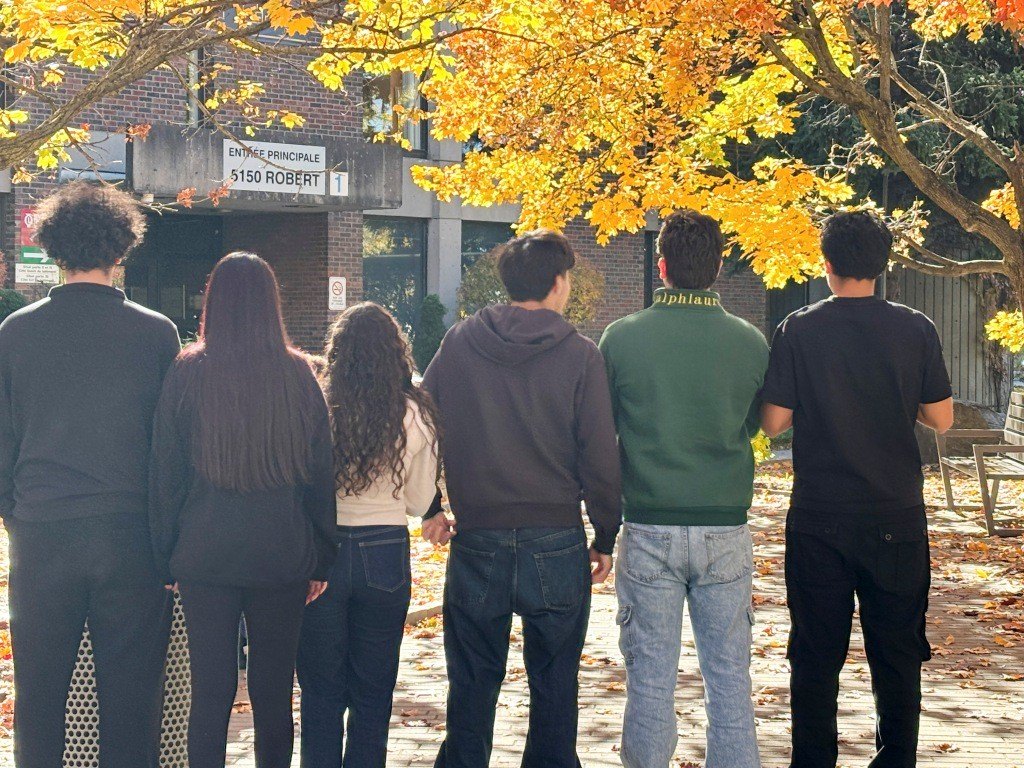
Montreal students are speaking out against overcrowded classrooms, difficulties in getting help, and dilapidated facilities. Others say they are satisfied with their school and prefer dialogue over protest. As French high school students mobilize over their study conditions, testimonies gathered in Montreal reveal contrasting experiences, set against a backdrop of educational inequality and a recurring debate over the role of student voices.
At lunchtime, François-Perrault Park fills with small groups of teenagers from Joseph-François-Perrault (JFP) High School. Some are playing volleyball, others are chatting. The October sun illuminates this peaceful scene, which contrasts with the images of blockades and sometimes violent protests seen during the high school strikes in France. But when we ask 4th-yearth secondary students what they think of their study conditions, the answers come quickly.
Stéphane* believes there are no major problems at his school. However, he mentions that sports equipment is sometimes inadequate. Sandy, who is on the school’s volleyball team, talks about the lack of equipment but also about overcrowding. In her French class, she explains, there are up to 37 students. And to ensure learning, "there aren't enough teachers," she says, linking the lack of staff to the pressure on classrooms.
Michel-Ange considers the mobilization of French high school students, who are protesting the lack of resources in their schools, to be legitimate. Regarding Joseph-François-Perrault, he cites the example of the music program, which has been waiting for years for a venue where students could perform their shows. Twice a year, they have to leave the school to hold their concerts.
Support services also worry some students. Sarah believes the school lacks resources, including for specialized services. She mentions psychoeducators: the school has them, she says, but not enough. She also questions the professional qualifications of some of the people working there. "There are some, but not enough, and I know that the ones we have right now aren't necessarily qualified." At that point, her friend Sandy quickly chimes in with an example of an English teacher who allegedly taught two other subjects.
However, the students do not portray their school as a place where everything is wrong. Stéphane clarifies that, in his opinion, there is no major structural problem at JFP. But for Sandy, the damaged equipment, the lack of teachers, and the absence of a performance hall end up weighing on school life. "Just because it's better than in France doesn't mean it's good," she summarizes when comparing Quebec conditions to those that triggered the French student protests.
Thirty students, one teacher
The day before, in front of Antoine-de-Saint-Exupéry High School in Saint-Léonard, the students we met described a different, equally contrasting reality. Around a wooden table in the shade of the trees, some defend their school and the teachers who support them. Others talk about heating issues, maintenance problems, or classes disrupted by the prolonged absence of a teacher.
Maya, a 5th-yearth secondary student, believes that classes of about 30 students do not allow teachers to devote enough time to each individual. "The teacher doesn't have the time to put their energy into each of us," she says. Another issue raised by Maya concerns the replacement of teachers who leave the school. "For example, in 3rd-yearth secondary, we had a history teacher who left, and we had a substitute. For the whole year, we didn't do anything, and at the end, they just passed us anyway," she says.
The issue of replacements comes up repeatedly in discussions. Rayan and Mehdi say that in 4th-yearth secondary, after their science teacher left, several chapters of the curriculum were not covered before the ministerial exam. According to Rayan, the substitute only arrived a few weeks before the test. He claims he had to retake the material over the summer after failing the exam. Mehdi also says he failed and was unable to catch up on all the learning. "There are several chapters that I still don't understand to this day," he adds.
At Saint-Exupéry, complaints are not just about classes. Students mention rooms that are too cold in winter or too hot in summer, as well as maintenance issues. Malika says that rats fell from the ceiling of a science classroom when she was in 2nd-yearth secondary.
Divided conditions, delayed responses
The students met in Saint-Léonard do not all agree on the quality of their study conditions. Jonas, who attended schools in France before arriving in Quebec, believes the comparison favors the Quebec system. "For me, in Canada, it's better," he says. He understands the reasons that drive French high school students to protest, particularly the lack of teachers, but does not see the need for a blockade here. "The school gives us everything. Everything is good. The teachers are there. If they aren't there, there are always substitutes," he maintains.
Disagreement also exists regarding the means to make things change. Some say they are ready to consider a blockade, while others reject this approach. For Malika, problems should first be addressed through dialogue. "Violence solves nothing. A conversation around a table could solve many more problems," she believes.
Regarding the young French students, she offers an explanation: "But also, I think they do that because they tried conversations around the table, but it didn't work for them." Her comments respond in a way to a question we asked: do they feel their concerns are heard and that discussions can lead to change? Malika says she feels that problems are dismissed when they are reported. "When we try to talk about a problem, most of the time, they put the problem aside," she reports.
Difficulties that official data help to contextualize
The testimonies gathered from two schools do not allow us to measure the scale of the problems across the entire network. However, data from the Centre de services scolaire de Montréal (CSSDM) provides a more concrete overview of the pressures that certain high schools are facing.
In its 2026-2029 Three-Year Plan for the Allocation and Destination of Buildings (PTRDI), the CSSDM identifies schools where enrollment exceeds the capacity listed in the document. At the Académie de Roberval in Saint-Michel, 564 students are enrolled for a capacity of 518, representing an occupancy rate of 109%. The school is also slated for temporary relocation following the authorization to reconstruct Wing C.
At Louise-Trichet High School in Tétreaultville, the PTRDI reports 609 students for a capacity of 567, an occupancy rate of 107%. The CSSDM states that it has added modular classrooms and expects that students will be able to use the building located at 8300 De Teck Street once renovations are complete.
The situation varies from one school to another, however. At Académie Dunton in Anjou, the PTRDI indicates 722 students for a capacity of 863. It adds that the expansion project, intended to add 523 spots, has been suspended by the Ministry of Education. An occupancy rate below 100% is not enough on its own to conclude that a school is not under pressure: actual available space, relocations, and the specific needs of programs must also be taken into account.
The CSSDM notes that its enrollment has decreased by approximately 2,000 students this year compared to last year. Nevertheless, it highlights the scale of the real estate portfolio to be maintained: more than 185 buildings with an average age of 75 years. The school service center reports renovation and construction work, including 8 schools and 151 new classrooms announced in its projects.
The staffing issue is just as important. Contacted by La Converse, the Centre de services scolaire de Montréal (CSSDM), which oversees Joseph-François-Perrault school, asserts that every classroom has a teacher, whether permanent or substitute. According to ministerial data consulted by the CSSDM, 127 primary and secondary teaching positions were nonetheless vacant in its network as of September 28, 2026. The school service center also indicates that it has recruited 3,500 people, nearly half of whom are in the teaching staff.
This data does not provide an exhaustive portrait of Montreal schools. The Centre de services scolaire de la Pointe-de-l’Île (CSSPI), which serves Antoine-de-Saint-Exupéry school among others, did not respond to requests for information from La Converse. The picture remains partial, but it shows that the issues raised by students (capacity, building conditions, recruitment, and staff turnover) are not merely individual perceptions.
A three-tier school system with unequal consequences
For Catherine Beauvais-St-Pierre, president of the Alliance des professeures et professeurs de Montréal, the difficulties reported by students are part of a system where needs are unevenly distributed. She refers to a "three-tier school system": private schools, selective public programs, and regular classrooms. "Regular classrooms in public schools are becoming increasingly... demanding," she observes.
According to her, the admission criteria, fees, and procedures required by certain programs can limit access for some families. She cites the arts and media program at Lucien-Pagé school in Villeray, which requires two teacher recommendation letters and a video. These requirements can disadvantage families who are less familiar with the rules of the school system or have fewer resources.
Professor Marie-Odile Magnan, a researcher in the sociology of education at the Université de Montréal, notes a growing concentration of students with special needs in regular classrooms, while more young people attend selective programs. This distribution reduces school diversity and can contribute to very different learning experiences from one school to another. "There is less social diversity, there is less redistribution of students into different classes. So, it creates a kind of segregation, effectively," she judges.
For Ms.Ms. Beauvais-St-Pierre, this concentration complicates the task for teachers, who must meet varied needs without always having the necessary resources to do so. Recruitment difficulties and repeated staff changes can also affect the continuity of learning. Added to this, according to her, are maintenance problems in certain establishments: ventilation, heat, vermin, or building deterioration. She is calling for "a clear plan from the government" to meet urgent needs, but also to ensure long-term maintenance.
Both experts agree on the importance of school diversity, without claiming that it alone would solve resource problems. For Ms.Ms. Magnan, research shows that it can help reduce inequalities. Ms.Ms. Beauvais-St-Pierre also sees it as a lesson in collective life: "Learning to live with others, learning to also rub shoulders with people's differences—all of that is a win for society."
The issue therefore goes beyond the material conditions of each school: it also concerns how the system distributes students, needs, and learning opportunities.
From individual discontent to collective mobilization
Material conditions are not enough to explain why students might take to the streets. It is also necessary for the difficulties to be perceived as shared by everyone and for a group to be able to carry them collectively. "There still needs to be an esprit de corps, so communication between young people, gatherings, associations," explains Marie-Odile Magnan. A difficulty may be experienced as an individual injustice without becoming a common demand if students cannot talk about it among themselves or if they think they are the only ones experiencing it.
Social media can help circulate personal accounts and inspire young people, particularly by showing them what is happening elsewhere. However, its influence does not guarantee mobilization. The researcher points out that Quebec society is also marked by individualism and that young people must be able to organize themselves to transform scattered concerns into collective action.
Nevertheless, she sees elements in the study conditions described by the students that could fuel a movement. "And we can perhaps see an influence," she says regarding the French movement. However, she refuses to say whether or not a mobilization will take place in Quebec.
The feeling of being heard also plays a role. When a student feels that their voice does not matter, it can affect their sense of belonging to the school, their recognition, and their well-being. "I think that spaces where young people are given a voice need to be further developed in schools," says Professor Marie-Odile Magnan. It is not about automatically acting on every request, she clarifies, but about ensuring that students can express themselves and that their concerns are taken into consideration in decision-making.
The 2012 precedent and government choices
The idea of student mobilization in Quebec is nothing new. In 2012, the "red square" movement brought together hundreds of thousands of students to protest the tuition fee hikes announced by Jean Charest’s Liberal government. After months of strikes and demonstrations, the Parti Québécois government elected in September cancelled the increase. The 2012 student movement and Bill 78 serve as a reminder that youth mobilization can influence political decisions.
The comparison has its limits, however. The 2012 movement primarily concerned post-secondary studies and was driven by organized student associations. In secondary schools, students do not necessarily have the same structures or the same autonomy to coordinate collective action.
For Marie-Odile Magnan, one should not underestimate the ability of young people to make things happen, but it remains to be seen whether current conditions can lead to mobilization. Criticisms of the public school system are already being voiced by unions, associations, and citizen groups. A collective statement from students could add a different kind of political pressure, she believes.
The newly elected government has committed to holding an Estates General on education within its first 100 days in office. The consultation could open a space to debate the dilapidated state of schools, teacher retention, violence in schools, and inequalities between educational paths. It will not, on its own, guarantee that the problems described by students can be solved.
At Joseph-François-Perrault as at Antoine-de-Saint-Exupéry, young people do not all demand the same things and do not share the same interpretation of their study conditions, and many prefer dialogue to confrontation.
What happened in Saint-Jérôme may be an isolated incident. But could it also be a harbinger, a warning shot fired at institutions? The question of the space granted to student voices then arises: are institutions ready to hear them?
Furthermore, mobilization is also intensifying in Montreal's CEGEPs. On its social media channels, the Coalition de résistance pour l’unité étudiante syndicale (CRUES) is calling for a general strike week from November 9 to 13, 2026, against austerity and student precariousness.
*All names of the minors we interviewed have been changed.